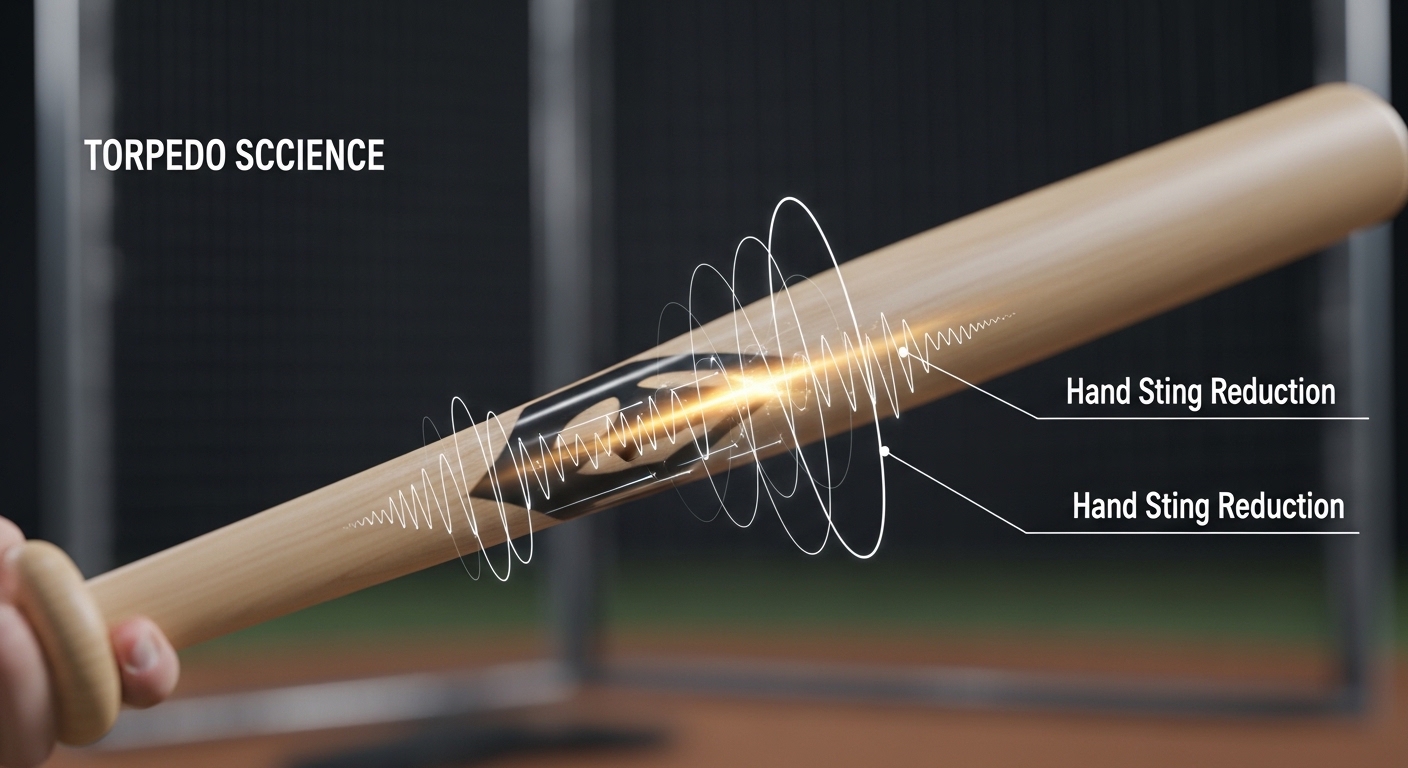
Torpedo Bat Sweet Spot Science: How It's Found, Measured, and Validated
Every baseball bat has a sweet spot. But until the torpedo bat, no bat had ever been engineered to put that sweet spot where a specific player actually hits.
The concept sounds simple. The execution is a data science problem wrapped inside a physics problem wrapped inside a manufacturing problem.
The torpedo bat's sweet spot is not a feel. It is a data-derived coordinate on the barrel — determined by Statcast contact zone tracking, validated by physics simulation, and reproduced by CNC manufacturing to ±0.01 inch precision.
The Problem the Sweet Spot Science Was Solving
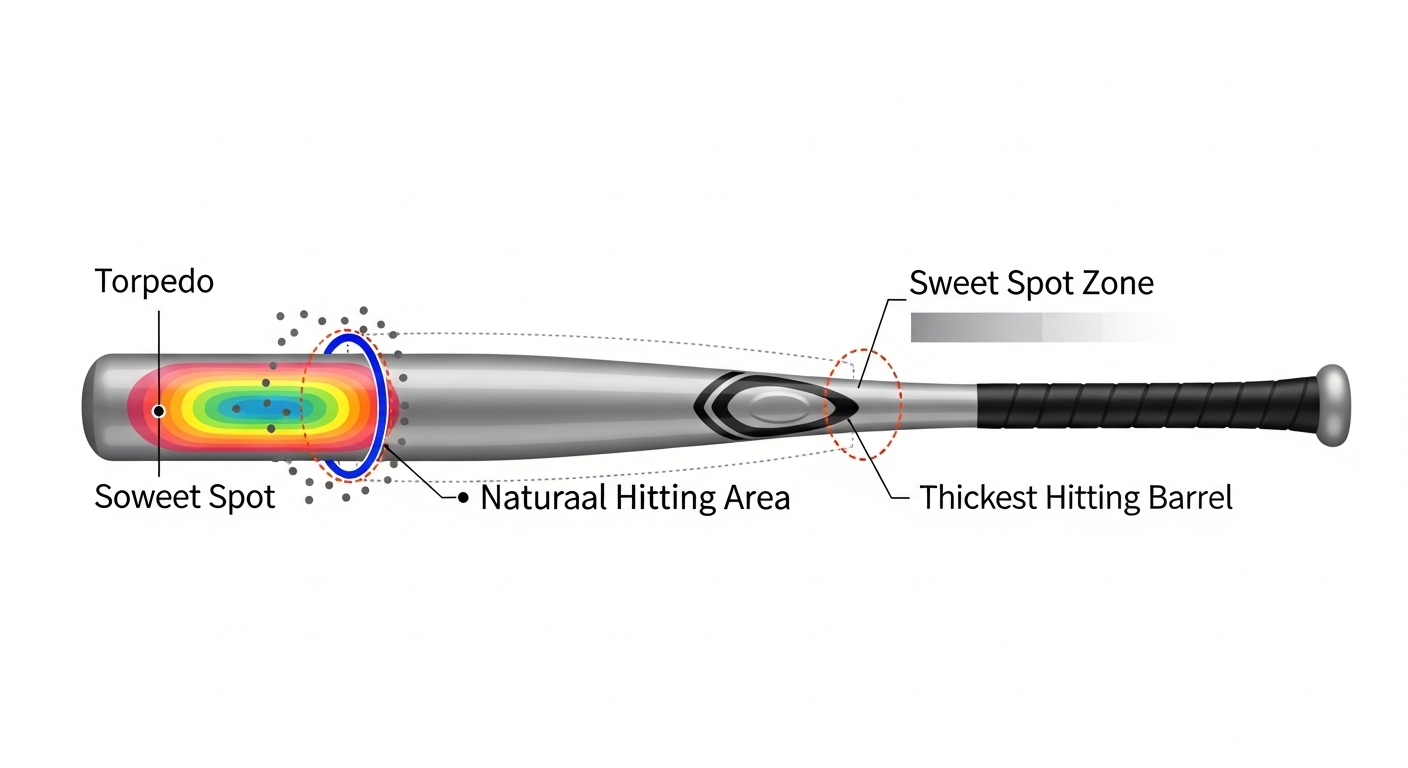
Traditional bat fitting asks one question: what length and weight do you prefer? Sweet spot location was never a variable. It was fixed by the bat's conventional geometry — near the very tip of the barrel — and every player was expected to adapt their swing to that location.
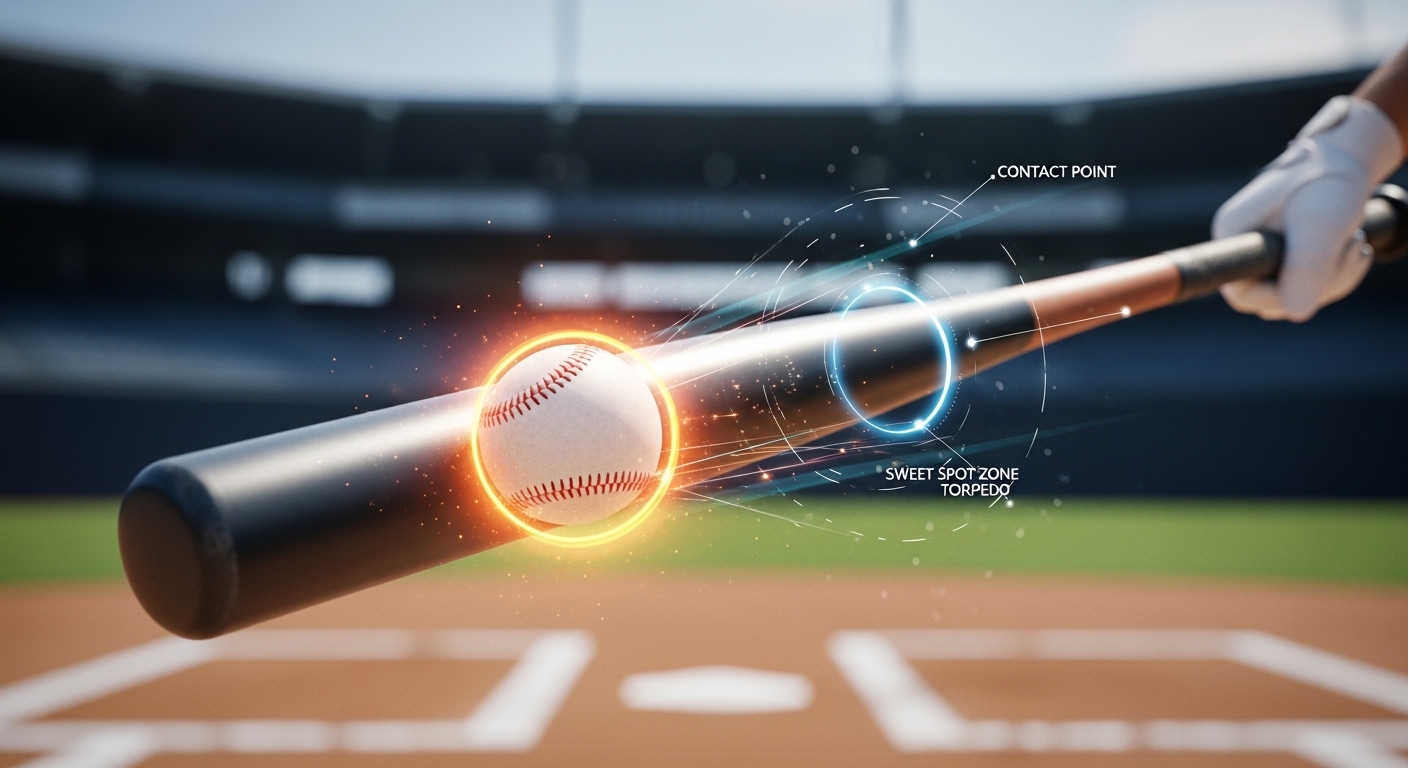
The data showed this was backwards. Statcast contact zone tracking revealed a consistent reality across hundreds of MLB players: the modal (most frequent) contact location on the barrel was not at the tip. It was 6 to 8 inches from the end.
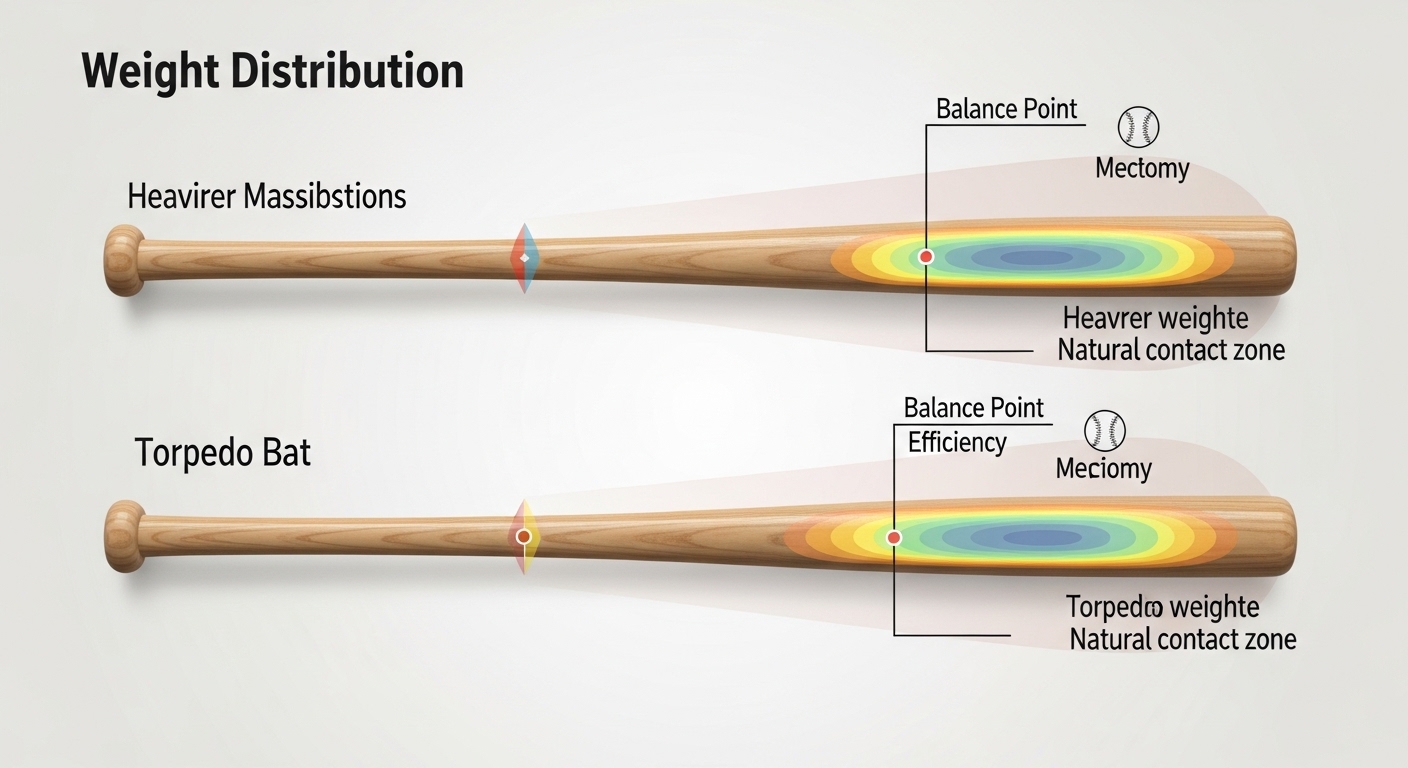
The traditional sweet spot was sitting in the wrong place — not for one or two players, but for the vast majority of hitters in professional baseball. Aaron Leanhardt understood what this meant: "It's just about making the bat as heavy and as fat as possible in the area where you're trying to do damage on the baseball."
Six Definitions of the Sweet Spot
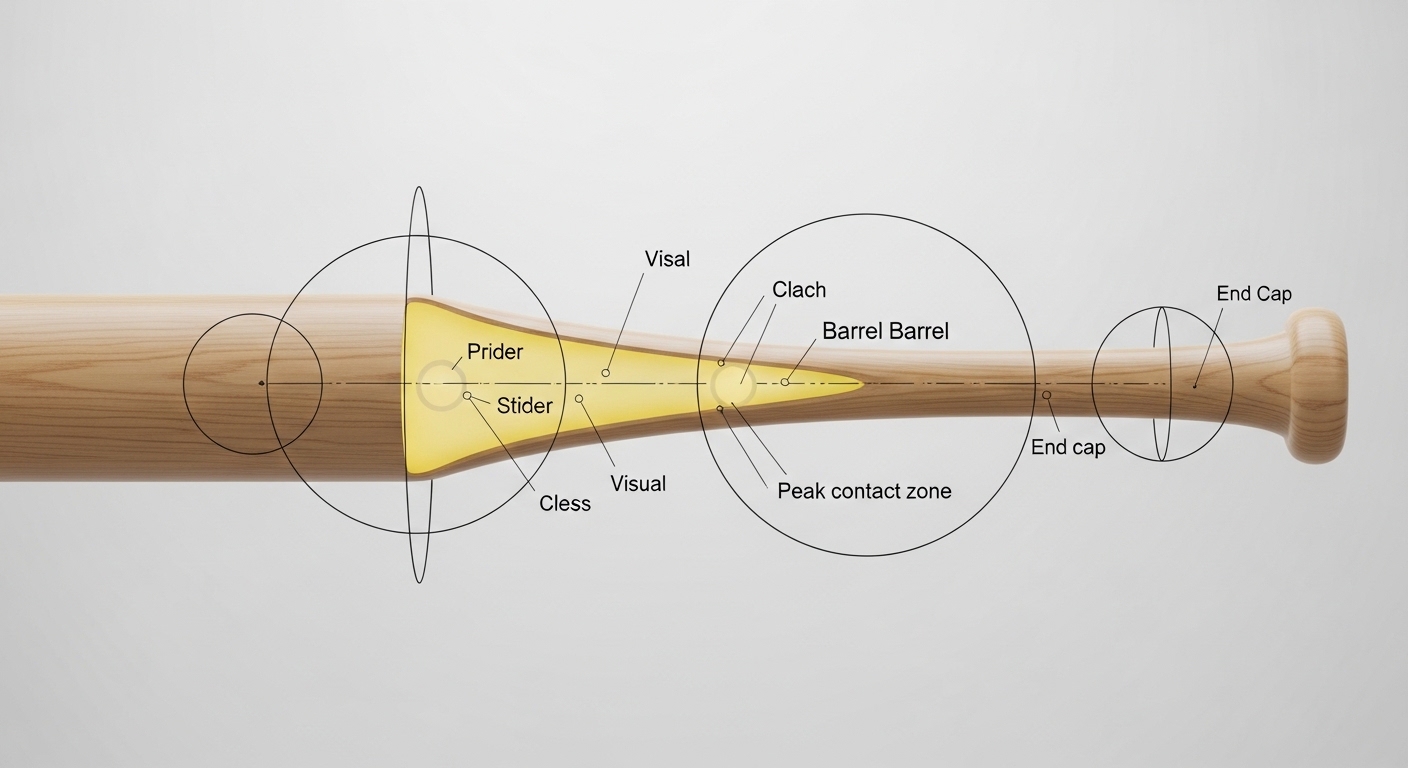
The term "sweet spot" is used differently depending on whether the speaker is a physicist, an analyst, a hitting coach, or a player. There are actually six distinct definitions in common use — and part of what makes the torpedo bat remarkable is that it brings most of them into alignment for the first time.
| Sweet Spot Type | Definition | Traditional Bat Location | Torpedo Bat Location |
|---|---|---|---|
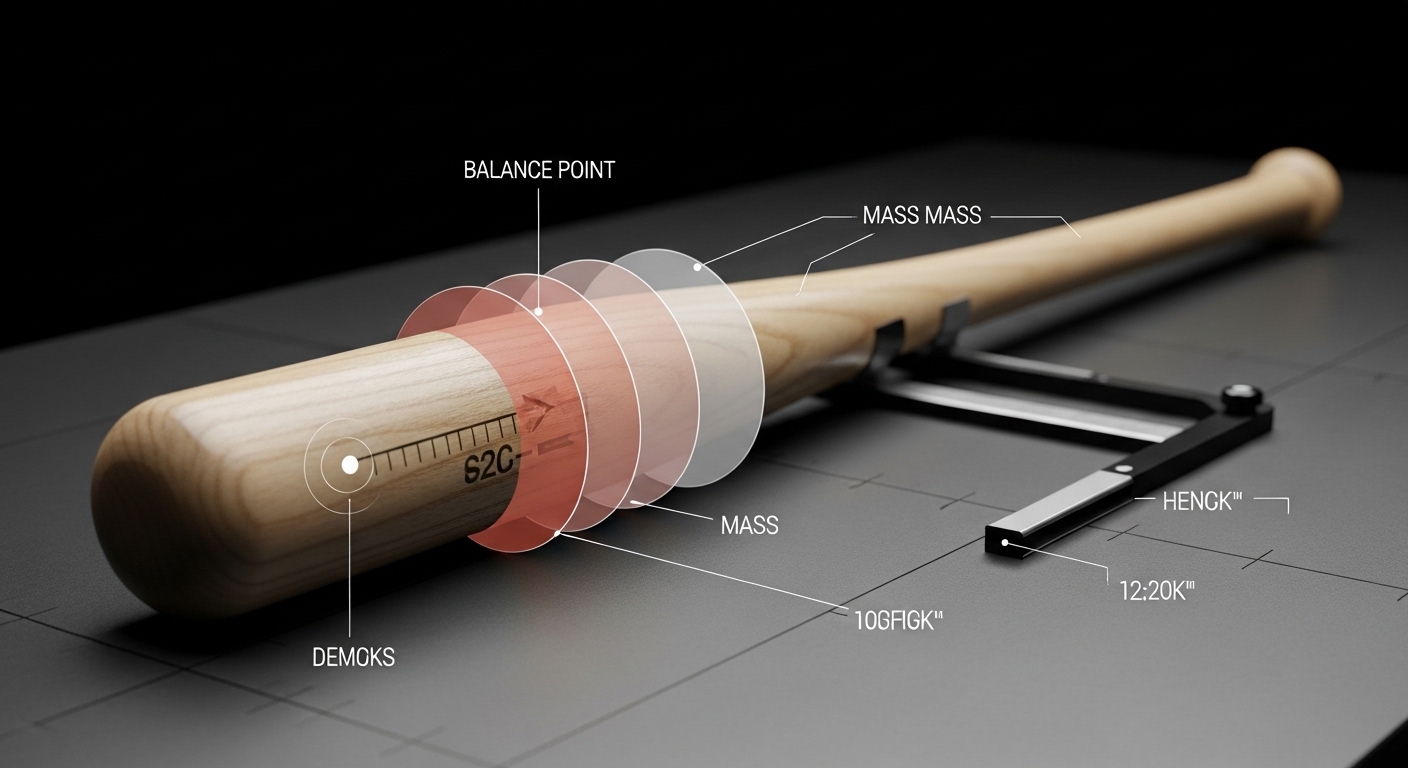
| COP Sweet Spot | Zero reactive force at handle; bat and hand move together | ~5–6" from barrel tip | ~6–8" from tip — shifted with mass |
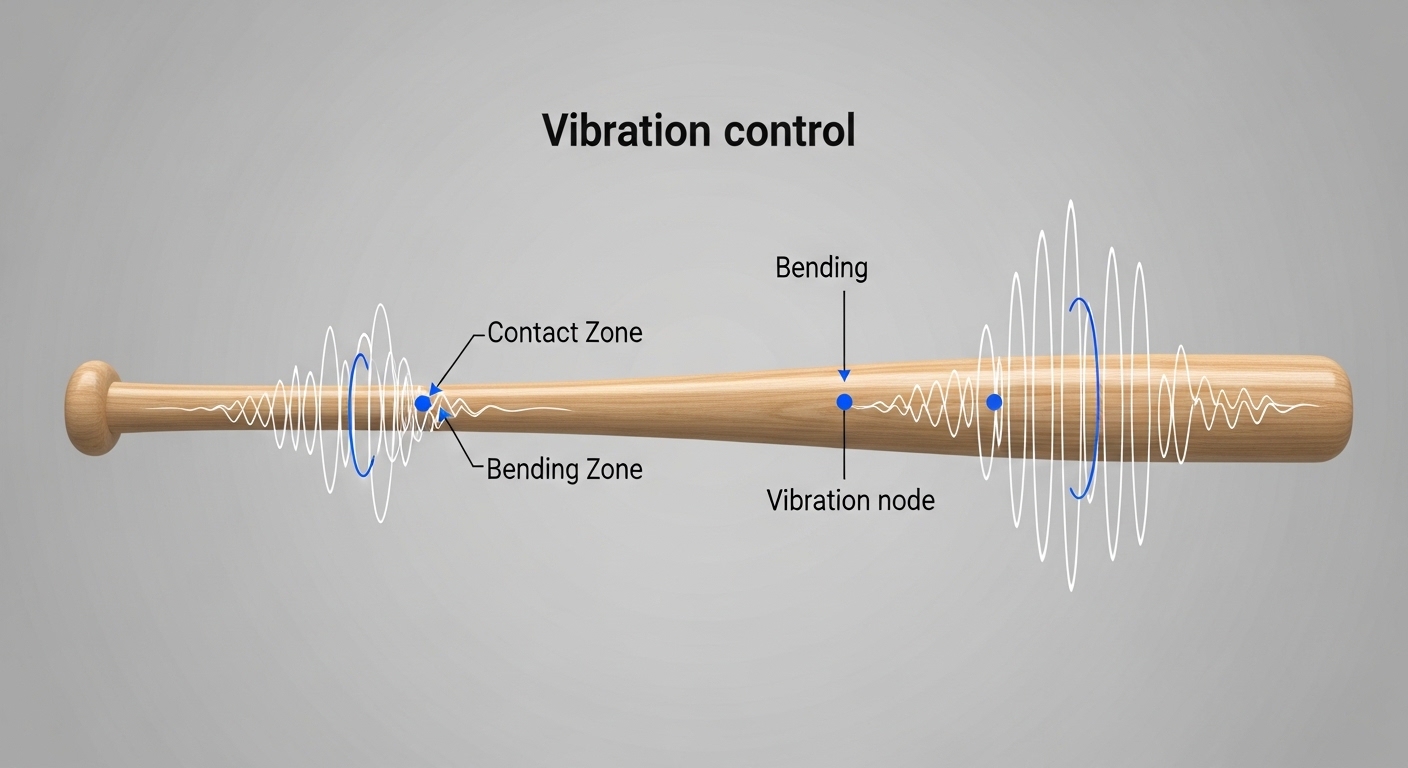
| Vibration Node Zone | Between 1st and 2nd bending mode nodes; minimal sting | ~5–7" from tip | ~6–8" from tip — nodes migrate with mass |
| Peak Collision Efficiency | Maximum energy transfer; highest EV per unit bat speed | Near barrel tip | ~6–8" from tip — aligned with peak mass |
| Bat Speed Gradient Optimum | Point just past peak collision efficiency where bat speed gain compensates mass loss | ~1–3" past sweet spot center | Exists on torpedo too — positioned further from tip |
| Statcast Sweet Spot (LA) | Launch angle 8–32°; not a bat location but a batted ball outcome | Produced anywhere on barrel | Indirectly improved by better contact quality |
| Player Contact Sweet Spot | Where a specific hitter actually makes best contact most frequently | ~6–8" from tip (typical — but bat isn't built for it) | ~6–8" from tip — bat IS built for it. |
The final row is the most important. The player contact sweet spot — where this specific hitter makes their best contact most often, as revealed by Statcast data — falls at 6–8 inches from the tip for most MLB players. Traditional bats are not engineered for this location. The torpedo bat is the first bat design in baseball history that explicitly builds the structural sweet spot to match the player's actual contact sweet spot.
The Sweet Spot Data Pipeline: From Statcast to CNC Spec
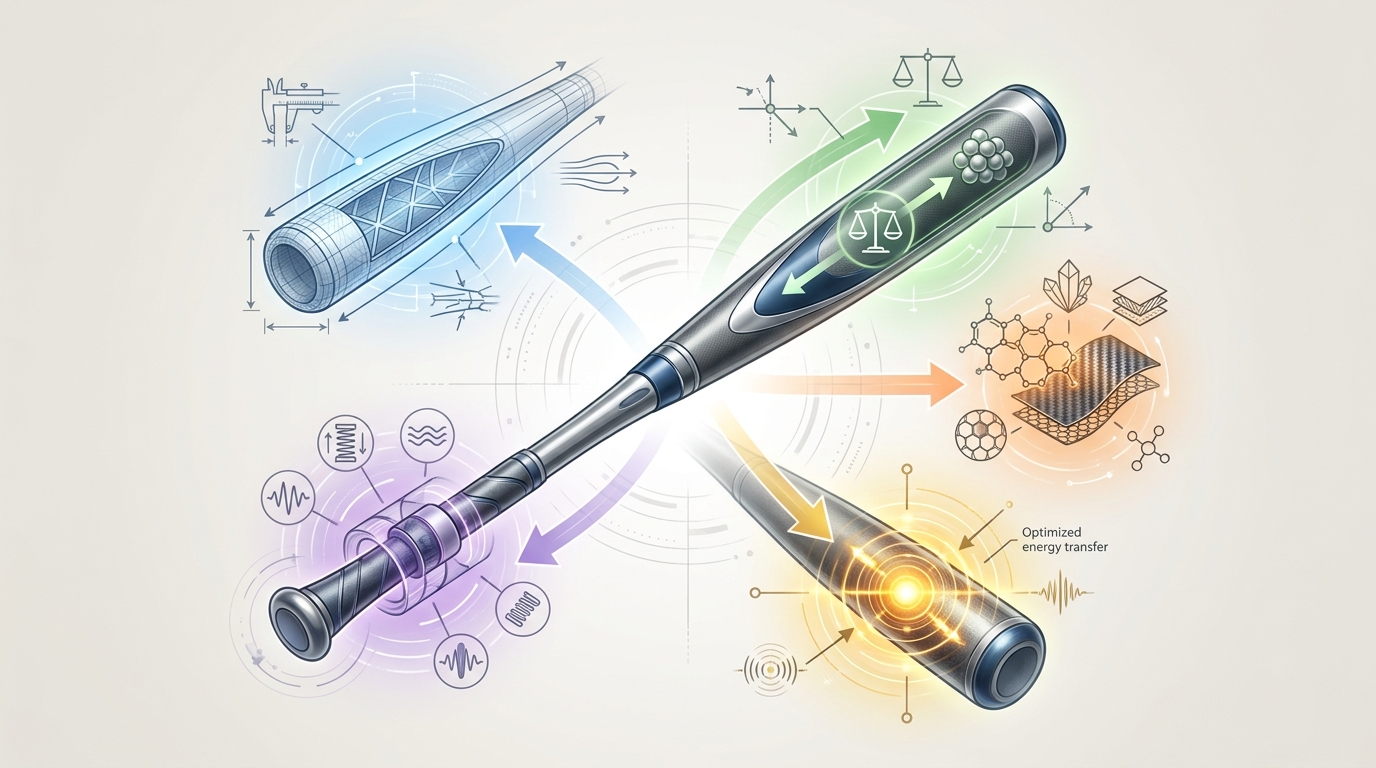
Locating the sweet spot for a torpedo bat is not a matter of opinion or feel. It is a seven-stage data and engineering pipeline that starts with raw contact zone data and ends with a CNC program specifying peak diameter position to the millimeter.
Collect contact zone data
Across 200+ at-bats using MLB Statcast Hawk-Eye cameras (12 per ballpark); contact point tracking on every batted ball event.
Filter to competitive swings only
Statcast defines competitive swings as fastest 90% of swings + any 60+ mph swing producing 90+ mph EV.
Map contact distribution to barrel distance
Baseball Savant contact zone export; Blast Motion sensor data for contact point on handle-relative axis.
Validate with high-speed camera review
Edgertronic cameras (up to 25,000 fps); visual confirmation of contact point distribution.
Generate CNC barrel specification
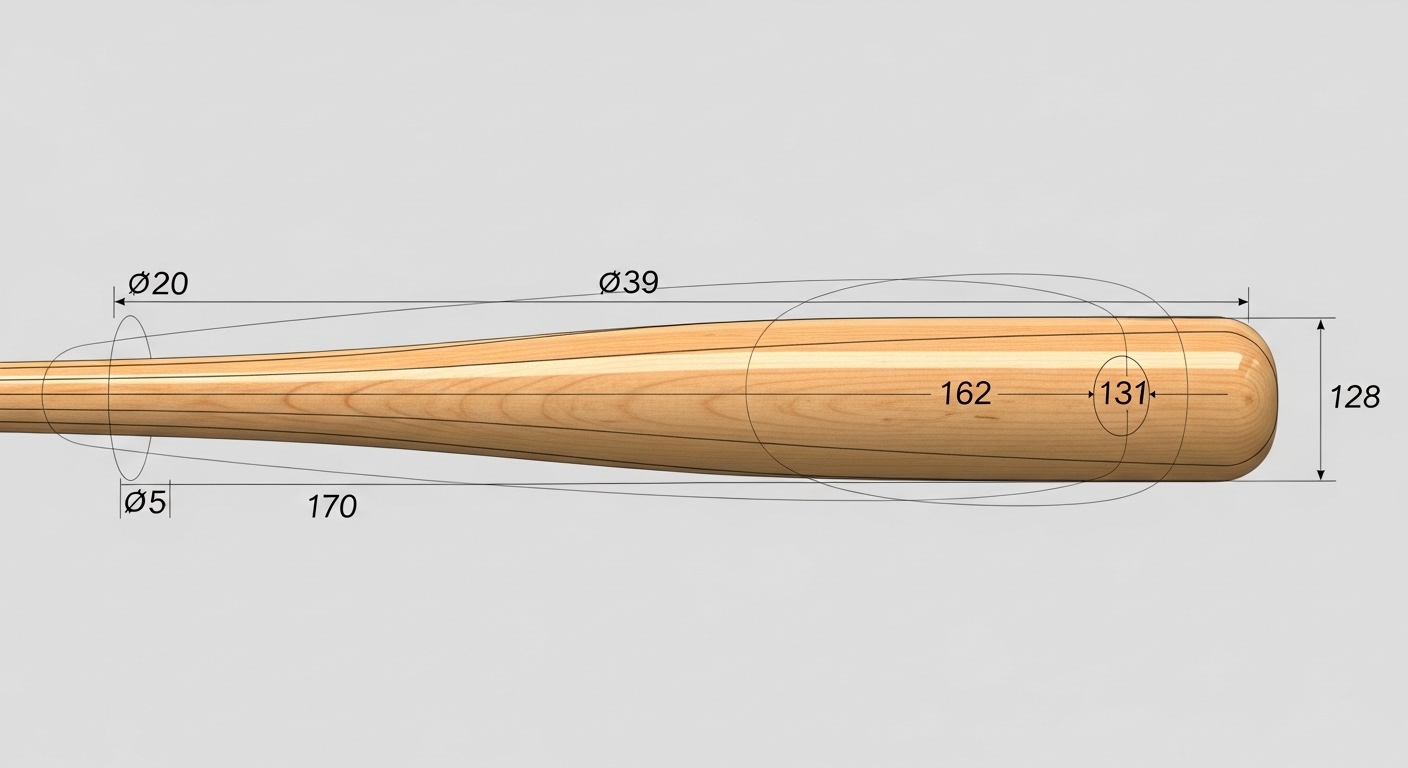
Physics modeling: place peak diameter at modal contact location; calculate taper profiles and weight budget.
Prototype and swing-test validation
Player swing testing with prototype bats; Statcast comparison of pre/post exit velocity and squared-up rate.
Ongoing monitoring and re-spec
Continuous Statcast tracking through the season; contact zone may shift with swing adjustments.
Why 200+ At-Bats? Contact zone location varies by pitch type, location, handedness of pitcher, and count. A small sample may not represent a player's true modal contact point. Leanhardt consistently worked with large samples to identify a stable contact zone estimate.
The Bat Speed Gradient: Why the Optimal Contact Point Is Not the Sweet Spot
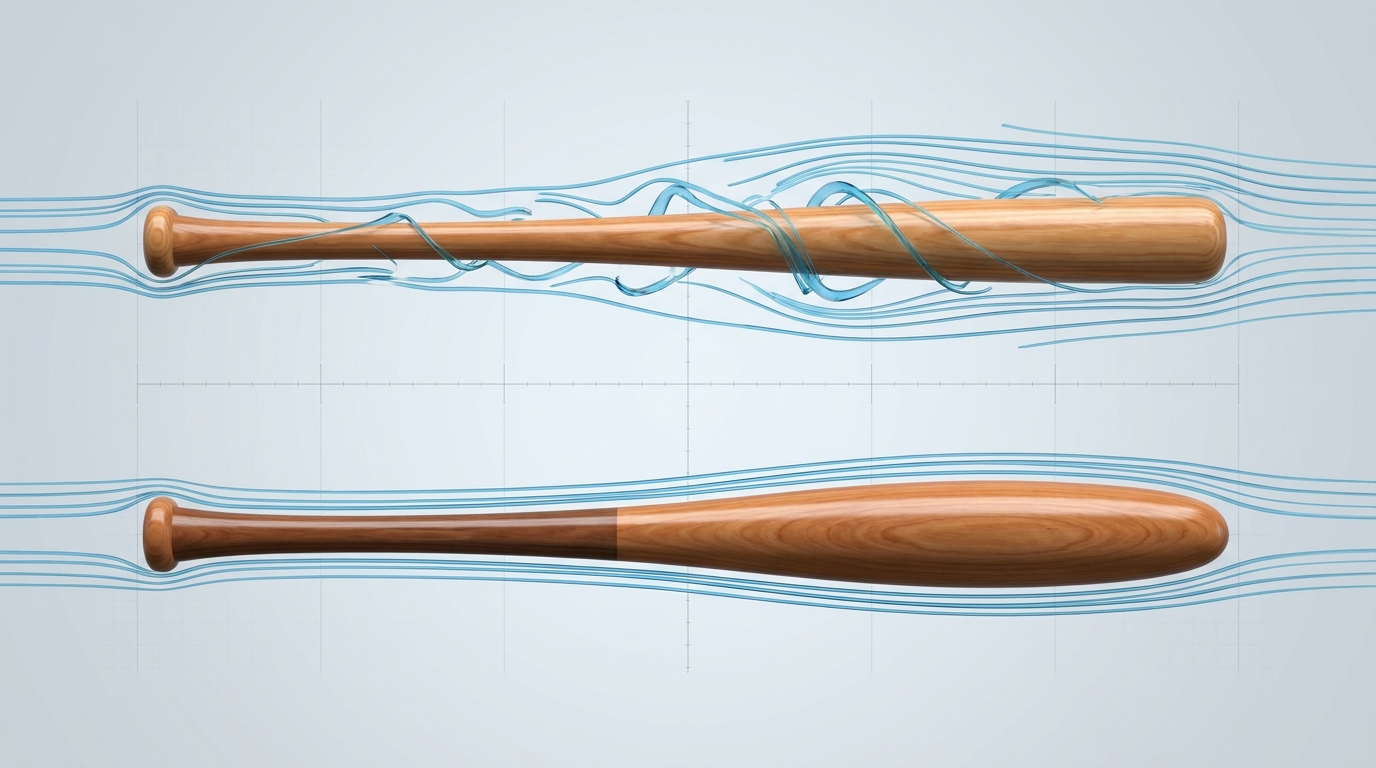
This is the most counterintuitive insight in torpedo bat sweet spot science. When a hitter swings a bat, it rotates around the hands as a pivot point. This means different parts of the barrel are moving at different speeds: slower near the hands, faster toward the tip.
What This Means for Torpedo Bat Design: This gradient insight has a direct implication for where the torpedo's peak diameter should be positioned. If the optimal EV contact point sits slightly distal to the peak mass zone (closer to the tip), then the ideal torpedo design places peak diameter not exactly at the modal contact point, but fractionally inside it — so the bat speed gradient pushes the optimal contact zone to land at the modal contact location.
This is a second-order optimization that the most sophisticated torpedo bat builders incorporate into their CNC specifications, adjusting the peak diameter position by a half-inch or more based on the player's typical swing arc radius.
The Statcast Metrics That Validate the Sweet Spot Science
Once a torpedo bat is built and a player begins using it, the sweet spot science does not end. Statcast tracking provides a continuous stream of validation data — metrics that directly reflect whether the bat's sweet spot is in the right location.
| Metric | What It Measures | MLB Average | Elite Threshold | Torpedo Impact |
|---|---|---|---|---|
| Bat Speed | Barrel speed at 6" from tip | 70–75 mph | 80+ mph | ↑ via lower MOI |
| Squared-Up % | % swings achieving ≥80% of max EV | ~28–30% | 35%+ (elite) | ↑ via wider sweet spot |
| MaxEV (EV50) | Top 50th percentile exit velocity | ~100–102 mph | 108+ mph (elite) | ↑ at contact zone |
| Hard-Hit Rate | % batted balls ≥95 mph EV | ~36% | 50%+ (elite) | ↑ via contact zone mass |
| Barrel Rate | % PA producing Statcast barrel | ~7–8% | 15%+ (elite) | ↑ converts near-barrels |
Squared-Up Rate: The Most Direct Validation Metric
The most direct validation metric for the torpedo bat's sweet spot science is Squared-Up Rate — the percentage of swings where the attained exit velocity reaches at least 80% of the maximum possible exit velocity given bat speed and pitch speed.
DRaysBay's analysis of torpedo bat physics noted the key test: "players using them should see a bounce in their MaxEV that is not fully explainable by an increase in bat speed and in their Squared-Up% that is not fully explainable by changes to launch angle, spray angle, and contact rate."
Player Validation: The Goldschmidt Case Study
Paul Goldschmidt's case is the most analytically valuable. With only +0.3 mph of bat speed gain, any improvement in his Squared-Up% or MaxEV cannot be attributed to swinging faster — it would have to come from improved contact quality at the sweet spot.
| Player | Bat Speed ↑ | Squared-Up % ↑? | MaxEV ↑? | Interpretation |
|---|---|---|---|---|
| Anthony Volpe | +3.0 mph | Monitor | Early positive | Large bat speed gain → likely MOI-driven |
| Jazz Chisholm Jr. | +1.1 mph | Monitor | 2 HR, March 29 | Contact quality gain probable |
| Cody Bellinger | +2.5 mph | Monitor | Early positive | Both levers potentially active |
| Paul Goldschmidt | +0.3 mph (minimal) | Key validation target | Key validation target | If Sq-Up% rises without bat speed → pure sweet spot gain |
| Austin Wells | +2.0 mph | Monitor | HR March 29 | Both mechanisms possible |
The Confidence Effect: When Sweet Spot Science Meets Psychology
Not every element of the torpedo bat's sweet spot benefit is measurable in Statcast data. Dan Russell of Penn State, Alan Nathan of the University of Illinois, and Lloyd Smith of WSU all acknowledged a factor that sits outside the physics but inside the reality of performance: confidence.
The wider barrel diameter of the torpedo — visible in peripheral vision at the plate — may cause hitters to feel they have more contact margin, which relaxes their mechanics and allows freer, more aggressive swings. This is not dismissible as mere psychology. In hitting, mechanical freedom is a genuine performance driver.
Lloyd Smith's Key Insight: This Is About Accuracy, Not Power
Washington State University mechanical engineering professor Lloyd Smith offered the most succinct framing of what the torpedo bat's sweet spot science actually achieves: "If there is a competitive advantage with the torpedo bat, it's likely more due to an improved batting average than it is to an enhanced bat performance."
This is a crucial distinction. The torpedo bat does not primarily make the ball travel faster on its best hits. The research — including Nathan's simulation — found peak exit velocity is approximately the same between torpedo and traditional bats. What changes is the quality of the contacts that are not perfectly centered: near-misses, slightly jammed hits, inside-zone contacts that would have been weak grounders or pop-ups on a traditional bat.
The torpedo bat converts these near-misses into real hits by moving its sweet spot to where those contacts actually occur. The gain shows up in batting average, in reduced weak contact rate, in more consistent barrels — not in home run distance.
Frequently Asked Questions: Torpedo Bat Sweet Spot Science
How does Statcast determine where a player makes contact on the barrel?
MLB's Statcast system uses Hawk-Eye camera arrays (12 cameras per ballpark) that track the exact position of the bat and ball in three-dimensional space at the moment of contact. From this data, analysts can calculate where on the bat's barrel the contact occurred — measuring from the barrel tip in inches. Over hundreds of at-bats, this data builds a contact zone distribution for each player, revealing their modal (most frequent) and mean contact location.
What is the bat speed gradient and why does it matter for sweet spot location?
The bat speed gradient is the variation in barrel speed along the bat's length during a swing. Because the bat rotates around the hands as a pivot, the barrel tip moves faster than the section near the handle. This means that a contact point 2–3 inches further from the hands produces higher barrel speed at impact — and therefore potentially higher exit velocity — even if that location has slightly lower collision efficiency than the peak mass zone. The gradient-adjusted optimal contact point for maximum EV sits slightly distal to the sweet spot's peak collision efficiency location.
Which Statcast metric best validates whether a torpedo bat's sweet spot is working?
Squared-Up Rate is the most direct validation metric. It measures the percentage of swings where the attained exit velocity reaches at least 80% of the maximum possible EV given bat speed and pitch speed. If a torpedo bat's sweet spot is correctly positioned, Squared-Up Rate should increase beyond what bat speed gain alone can explain. MaxEV (EV50) is the second-best metric — improvement in a player's best-contact quality without corresponding bat speed gains is strong evidence of improved sweet spot alignment.
Why is the torpedo bat's sweet spot custom-positioned for each player?
Because every player's modal contact zone is different. Swing path, arm length, hip rotation timing, pitch tendency, and handedness all influence where a player most frequently contacts the ball on the barrel. A torpedo bat built for a contact hitter who naturally hits at 7 inches from the tip would be suboptimal for a power hitter whose natural contact zone is at 6 inches. The data pipeline that produces each bat generates a player-specific CNC specification — and the sweet spot position is the most important variable in that spec.
Does the torpedo bat's sweet spot science work for amateur players?
The underlying physics are universal — the sweet spot benefit works regardless of the player's level. However, the precision of sweet spot positioning depends on the quality of contact zone data available. MLB players have Statcast tracking on every at-bat; amateur players may rely on bat sensors (Blast Motion), video analysis, or experienced hitting coaches to estimate their contact zone. The torpedo bat's sweet spot benefit is real at the amateur level, but the precision of the design's data inputs may be lower.
Explore the Complete Torpedo Bat Technology Series
Gallery