Torpedo Bat Performance: What the Evidence Shows in 2026
Torpedo bat performance became one of baseball's biggest equipment questions after the New York Yankees hit nine home runs against the Milwaukee Brewers on March 29, 2025. Several Yankees were using the distinctive bat profile, with more wood concentrated farther down the barrel and less at the tip. The immediate assumption was that the bats were producing extra power.
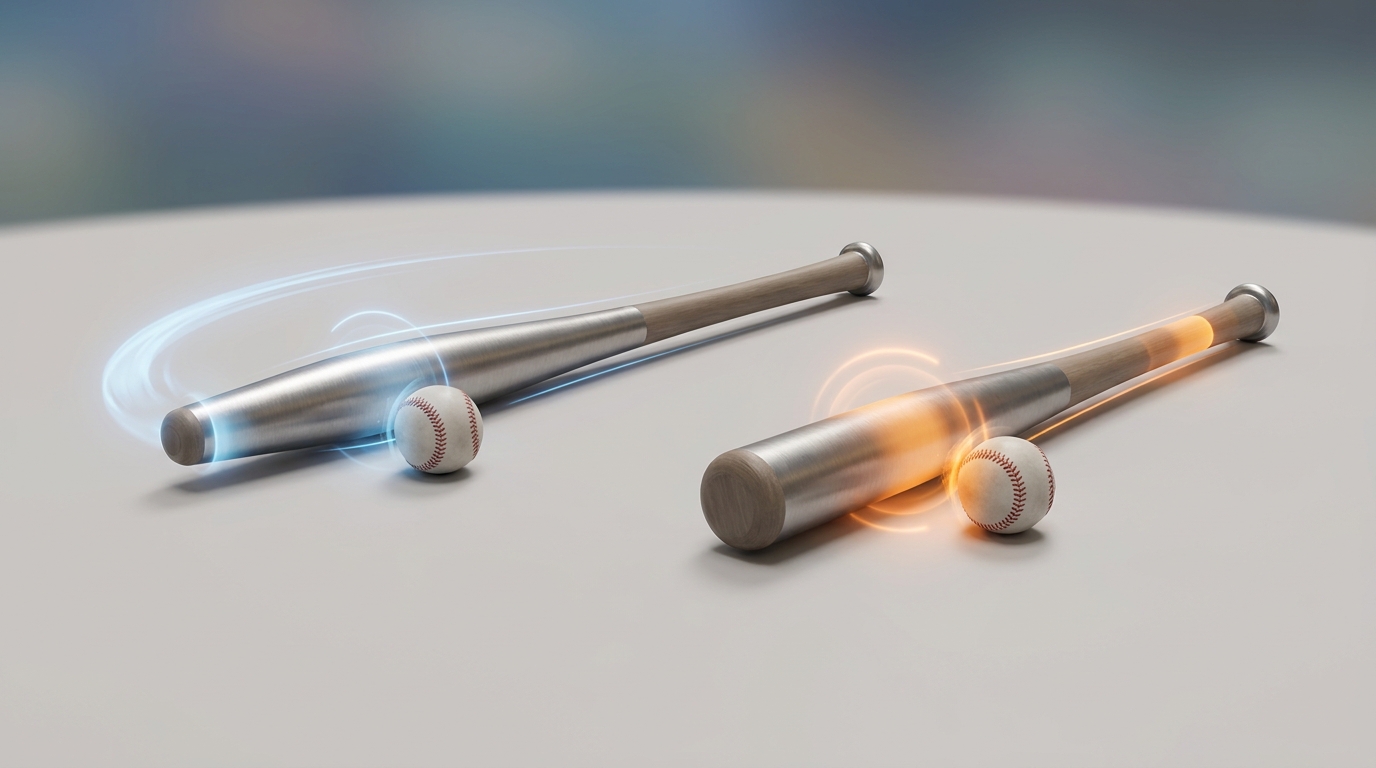
The evidence available in 2026 gives a more useful answer. A torpedo bat is not inherently a more powerful baseball bat. Controlled laboratory testing found essentially the same peak collision performance as comparable traditional wood bats. What changed was the location of the productive part of the barrel: the torpedo design shifted the sweet spot farther from the tip and toward the hitter's hands.
That distinction matters. A player whose normal contact pattern lines up with the relocated sweet spot may produce more consistently useful contact. A hitter already matching the strongest part of a traditional barrel may gain little. The torpedo bat is therefore better understood as a contact-location and bat-fitting tool rather than a universal exit-velocity or home-run upgrade.
Torpedo Bat Performance Numbers at a Glance
Controlled Lab Peak Performance
Essentially Equal Nathan, Smith & Russell 2026 — standard and torpedo maple bats produced essentially the same peak BBCOR.Sweet Spot Location
~0.5–0.6 in. Inward 2026 laboratory testing — the productive region of the tested torpedo design was shifted farther from the barrel tip, toward the hands.2025 Full-Season Hard-Hit Results
13 of 16 Improved UC Berkeley Sports Analytics retrospective of confirmed 2025 torpedo bat users using Baseball Savant data.2025 Full-Season Bat Speed
9 of 16 Improved Same full-season analysis; only four players increased bat speed by more than 1 mph.Early 18-Player EV Study
61% Improved Sportscasting analysis through May 20, 2025 — average EV change among the sample was +0.48 mph. Useful observational evidence, not a controlled bat test.Understanding the Evidence: What Should Carry the Most Weight?
Torpedo bat research now includes controlled laboratory testing, physics modelling, full-season Statcast analysis and early player samples. These sources answer different questions. The most important change since the bat first became famous is that we no longer have to rely only on simulations and short MLB samples.
| Evidence Level | Evidence Type | Sources | What It Tells Us |
|---|---|---|---|
| Level 1 | Controlled laboratory testing | Nathan, Smith & Russell, 2026 | Peak BBCOR was essentially the same; the torpedo design shifted the productive zone and one tested torpedo bat produced a somewhat wider high-performance region. |
| Level 2 | Physics modelling | Alan Nathan, FanGraphs, 2025 | Predicted similar maximum EV, poorer performance nearer the tip and better performance farther inward, creating a shifted and potentially wider useful hitting region. |
| Level 2 | Full-season player analysis | UC Berkeley Sports Analytics, January 2026 | 13 of 16 confirmed users increased hard-hit rate, while bat-speed changes were much less consistent. |
| Level 3 | Early-season Statcast comparisons | Sportscasting, ESPN and other 2025 analyses | Several early adopters improved EV, hard-hit rate, slugging or distance, but these comparisons cannot isolate the bat from player development, swing changes, opponents or sample size. |
| Level 3 | Individual player cases | MLB reports and Statcast observations | Useful for showing how differently players respond, but individual success or failure does not prove a general equipment effect. |
The 2026 laboratory work should now be the foundation of any torpedo bat performance discussion. Researchers tested two standard and two torpedo maple bats based on profiles used by the same MLB player. Baseballs were fired from an air cannon at the bats while researchers measured the incoming and rebounding speeds to calculate BBCOR across different impact locations.
The important result was not a large jump in maximum power. Peak BBCOR was essentially identical. Instead, the shape of the performance curve moved along the barrel. That fits the original idea behind the torpedo design: put the most useful part of the bat where a particular hitter is more likely to make contact.
What the Evidence Shows Across the Main Performance Metrics
| Performance Dimension | Current Evidence | 2026 Verdict | What Matters Most |
|---|---|---|---|
| Peak Exit Velocity | Controlled lab + physics modelling | No clear universal advantage | Peak collision performance of comparable bats is very similar. |
| Exit Velocity Across the Barrel | Lab testing + modelling | Location dependent | The torpedo moves the productive region farther inward while giving up some performance toward the narrowed tip. |
| Hard-Hit Rate | Full-season Statcast analysis | Promising observational signal | 13 of 16 confirmed 2025 users increased hard-hit percentage, but the bat cannot be isolated as the sole cause. |
| Bat Speed | Statcast + inertial measurements | Not automatically higher | A torpedo can be designed with lower MOI, but it can also be built with swing weight similar to a traditional bat. |
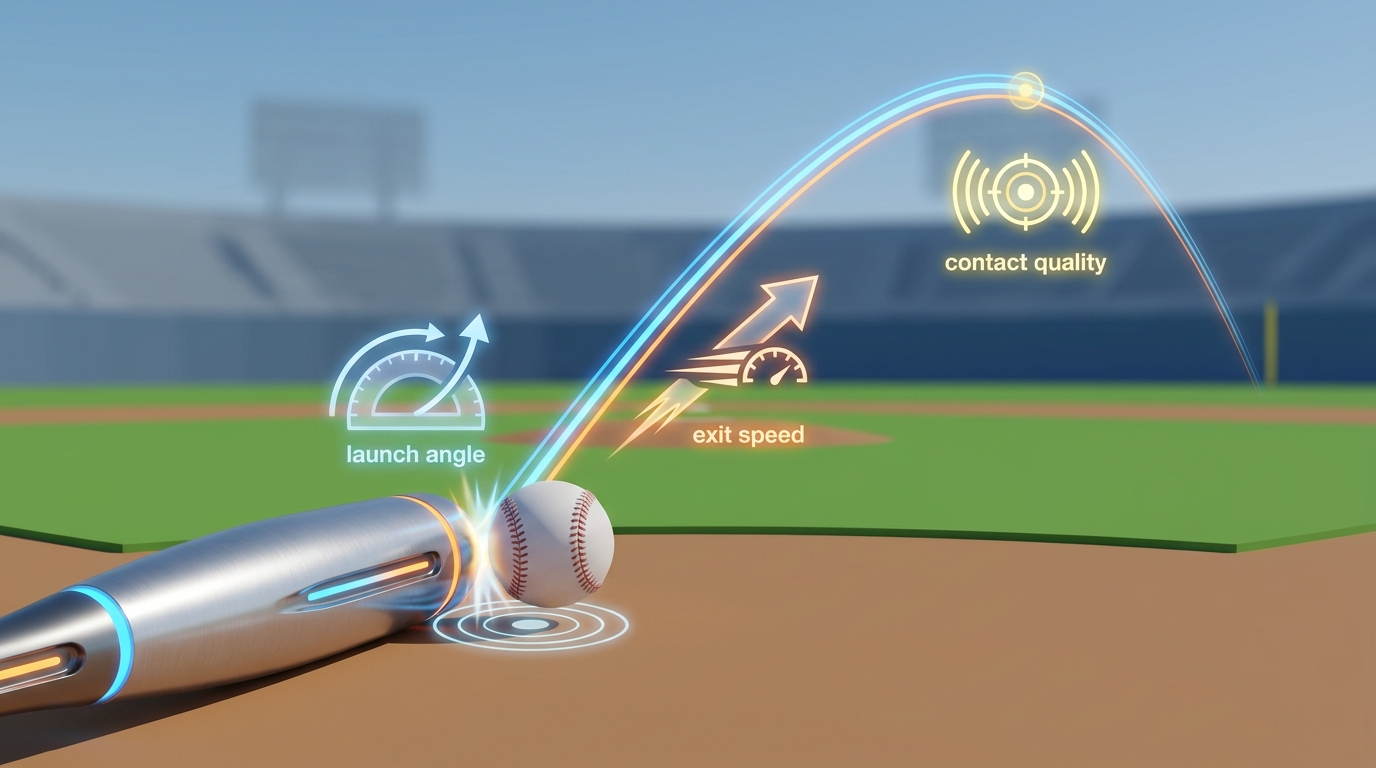
| Distance / Home Runs | Lab + observational MLB data | No intrinsic power advantage proven | Distance still depends on exit velocity, launch angle, pitch, contact location and the hitter. |
| Contact Quality | Lab + player data | Most plausible practical benefit | Moving the productive barrel region toward a hitter's frequent contact location may make good contact more repeatable. |
What Changed After the 2026 Laboratory Study?
The 2025 discussion often treated the torpedo bat as a way to generate additional exit velocity. The controlled 2026 research makes the picture more precise.
- PEAK POWER: Essentially unchanged. The standard and torpedo bats reached very similar peak BBCOR values. There is no evidence that the shape itself creates a major extra-power effect.
- SWEET SPOT LOCATION: Clearly changed. The torpedo profile moved its strongest region roughly half an inch farther from the barrel tip and toward the hands in the tested design.
- SWEET SPOT WIDTH: Potentially wider, but not guaranteed. One of the two torpedo bats produced a wider region of high BBCOR; the other closely matched the standard bats once the shifted location was accounted for.
- WOOD VARIATION STILL MATTERS. Two torpedo bats built to the same shape did not perform identically. Researchers attributed the difference to natural variation in the wood's inertial and vibrational properties.
- PLAYER FIT REMAINS THE KEY ADVANTAGE. A hitter who frequently makes contact farther inward can place the bat's strongest region where it is more useful to that specific swing.
The updated evidence therefore supports a narrower but stronger conclusion: the torpedo bat can improve how well the bat's productive zone matches a hitter, rather than simply making the bat more powerful.
What the 2025 MLB Season Tells Us About Real-World Performance
Early 2025 studies were encouraging but necessarily small. Sportscasting compared 18 known users through May 20 and reported that 61% increased average exit velocity, with an average change of +0.48 mph across the sample. Other early analyses found gains in measures such as slugging, fly-ball distance and barrel rate among some adopters.
Those figures are still useful, but they should not be treated as controlled experiments. Players change training, mechanics, approach and physical condition between seasons. Opponents change too. Some players also used torpedo bats for only part of the year, making clean before-and-after comparisons difficult.
A later full-season analysis from UC Berkeley Sports Analytics provided a better long-term view. Among 16 confirmed users with sufficient data in both 2024 and 2025, 13 increased their hard-hit rate. Bat speed was much less consistent: nine of 16 increased it, and only four gained more than 1 mph.
That pattern is important. If large bat-speed gains were the torpedo's primary mechanism, the full-season data should show a stronger and more consistent increase in swing speed. Instead, the clearer signal appeared in hard-hit contact. That is compatible with a bat whose productive region is better matched to where a hitter makes contact.
What Each Performance Page Covers
-
01 | Exit Velocity Tests
Controlled testing, physics modelling and Statcast evidence showing how exit velocity changes across different parts of the barrel.
📊 Deep dive: Torpedo Bat Exit Velocity Tests → -
02 | Distance Analysis
How exit velocity and launch angle translate into carry, and why a torpedo bat should not automatically be expected to hit the ball farther.
📏 Deep dive: Torpedo Bat Distance Analysis → -
03 | Player Testing
Early adopter data, full-season outcomes and individual MLB cases showing why the results vary considerably from player to player.
🧪 Deep dive: Torpedo Bat Player Testing → -
04 | Lab Methodology
How researchers test baseball bats using BBCOR measurements, air-cannon impacts, modal analysis and impact-location mapping.
🔬 Deep dive: Torpedo Bat Lab Methodology →
The Torpedo Bat Performance Verdict in 2026
With controlled testing now available alongside a complete 2025 MLB season, the evidence supports six practical conclusions:
- RAW POWER: No universal advantage has been demonstrated. The strongest controlled evidence found essentially equal peak collision performance between comparable traditional and torpedo wood bats.
- CONTACT LOCATION: This is the clearest advantage. The torpedo design can move the bat's strongest region farther toward the hands, which may better match where a specific hitter actually makes contact.
- HARD-HIT CONTACT: The real-world signal is encouraging. Thirteen of 16 players in a full-season retrospective increased their hard-hit percentage, although observational data cannot prove the bat caused the improvement.
- BAT SPEED: It depends on the individual bat design. Moving mass toward the hands can reduce MOI and create a quicker-feeling bat, but torpedo bats can also be built to have almost the same swing weight as a player's conventional model.
- DISTANCE AND HOME RUNS: Treat early gains cautiously. Some players produced impressive power numbers after switching, but controlled testing does not support the idea that the torpedo profile alone creates substantially more hitting power.
- CUSTOM FIT: This remains the strongest reason to use one. The bat makes the most sense when its barrel profile is selected using information about the hitter's contact pattern rather than simply because the torpedo shape is popular.
Who Is Most Likely to Benefit From a Torpedo Bat?
Stronger Performance Case
- Hitters who regularly make their best contact farther from the barrel tip. The 2026 laboratory work confirms that the torpedo design can move peak performance inward, making this the most direct fitting case.
- Players whose contact pattern is concentrated in a repeatable part of the barrel. A customised profile becomes more useful when the manufacturer knows where the player commonly strikes the ball.
- Hitters looking for contact consistency rather than a simple power boost. The full-season hard-hit data and laboratory findings both fit the idea that the main opportunity is improving the frequency of useful contact.
Weaker Performance Case
- Hitters whose best contact is already near the productive region of a traditional bat. Moving the sweet spot offers little benefit if the existing barrel already matches the player's contact pattern.
- Players who frequently make effective contact close to the barrel tip. Removing wood from the tip is a trade-off. Both modelling and the torpedo's geometry indicate reduced performance in that outer region relative to a traditional design.
- Players expecting an automatic home-run or swing-speed increase. The latest laboratory evidence does not support a universal raw-power gain, and full-season bat-speed changes were inconsistent.
Torpedo Bat vs. Traditional Bat Performance
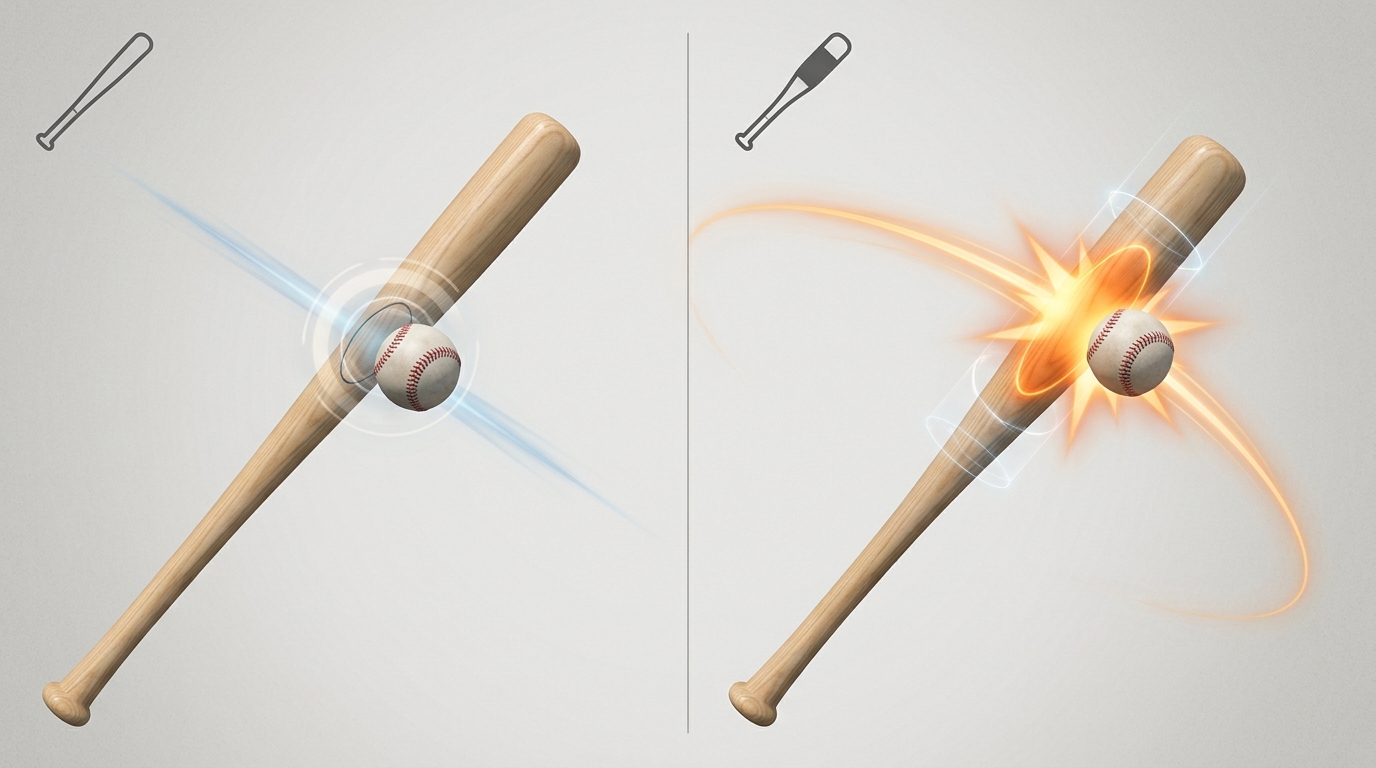
The most useful comparison is not simply which bat is "better." A traditional bat keeps more of its barrel diameter toward the end, while a torpedo moves part of that wood inward and narrows again toward the tip. The resulting performance curves therefore favour different impact locations.
For a detailed side-by-side breakdown of barrel zones, feel, weight distribution and player profiles, see our torpedo bat vs. traditional bat comparison.
Frequently Asked Questions: Torpedo Bat Performance
They can for the right hitter, but not because the shape automatically creates more power. The strongest evidence shows that a torpedo bat moves the productive part of the barrel farther toward the hands. If that better matches a player's normal contact location, it can improve the quality and consistency of contact.
Not universally. Controlled 2026 testing found essentially the same peak BBCOR for comparable torpedo and traditional maple bats. Earlier modelling and industry analysis showed that the torpedo can perform better at some impact locations farther inward and worse toward the tip. Average exit velocity can therefore improve for a well-matched hitter without the bat having a higher overall power ceiling.
The latest laboratory evidence says no in terms of intrinsic peak hitting power. Researchers found nearly identical peak collision performance. The practical difference was where that peak occurred along the barrel and, for one tested torpedo bat, how wide the productive region was.
Not automatically. Ball distance is primarily determined by exit velocity, launch angle, spin and environmental conditions once the ball leaves the bat. Some early MLB torpedo users recorded longer fly balls, but controlled testing has not established a built-in distance advantage for the torpedo shape itself.
The strongest evidence supports sweet-spot placement. The barrel can be shaped so that its most productive region sits closer to where a particular hitter tends to make contact. That may increase the chance of producing useful contact without increasing the bat's maximum collision performance.
Players have different contact locations, swing paths, bat-speed profiles, timing and equipment preferences. A torpedo design that matches one player's contact pattern can be poorly matched to another. Player statistics are also affected by training, health, pitch selection and normal year-to-year variation, so not every change after switching bats can be attributed to the bat.
Researchers Alan Nathan, Lloyd Smith and Daniel Russell tested two standard and two torpedo maple bats. Peak BBCOR was essentially the same across the designs, while the torpedo's productive region shifted roughly half an inch farther from the barrel tip. One torpedo sample also showed a somewhat wider high-performance region. Their findings support player-specific contact-zone fitting rather than a universal power advantage.
Explore the Full Performance Evidence
- 📊 Exit Velocity Tests: Lab Data and Statcast Results
- 📏 Distance Analysis: From EV Gains to Real Carry
- 🧪 Player Testing: MLB Results and Case Analyses
- 🔬 Lab Methodology: How Bat Performance Is Actually Measured
Related: From the Technology and Science Series
Gallery