Torpedo Bat Certification Standards: BBCOR, USA Bat, and USSSA Explained
✅ The Short Version
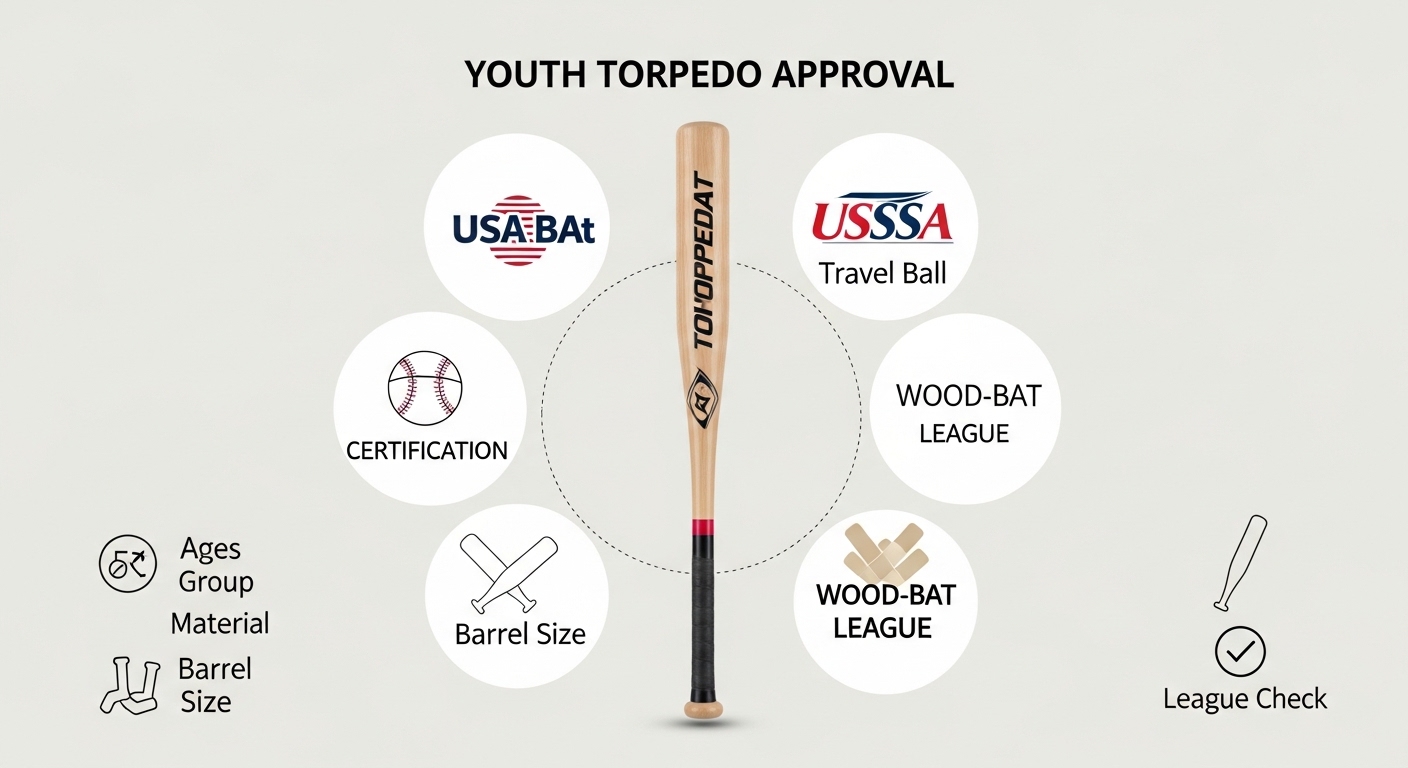
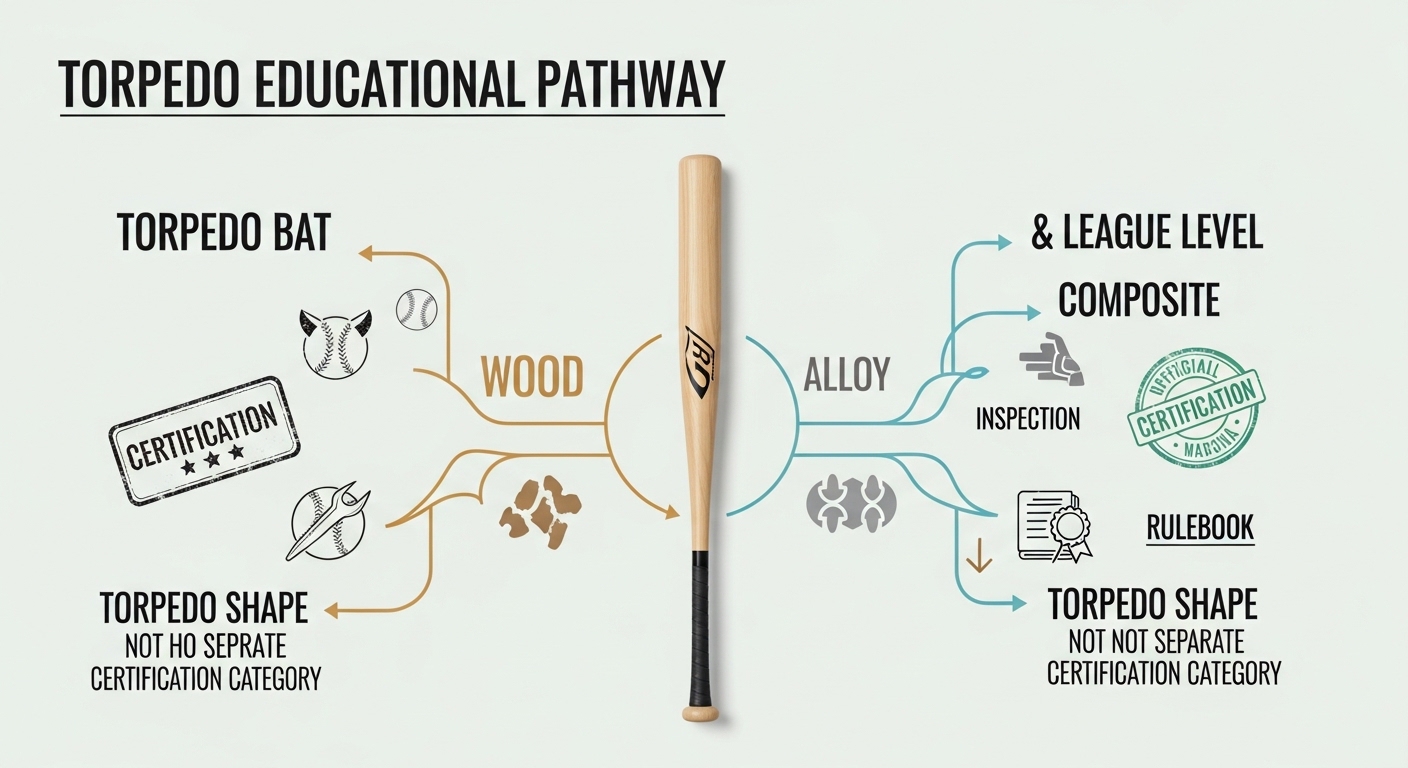
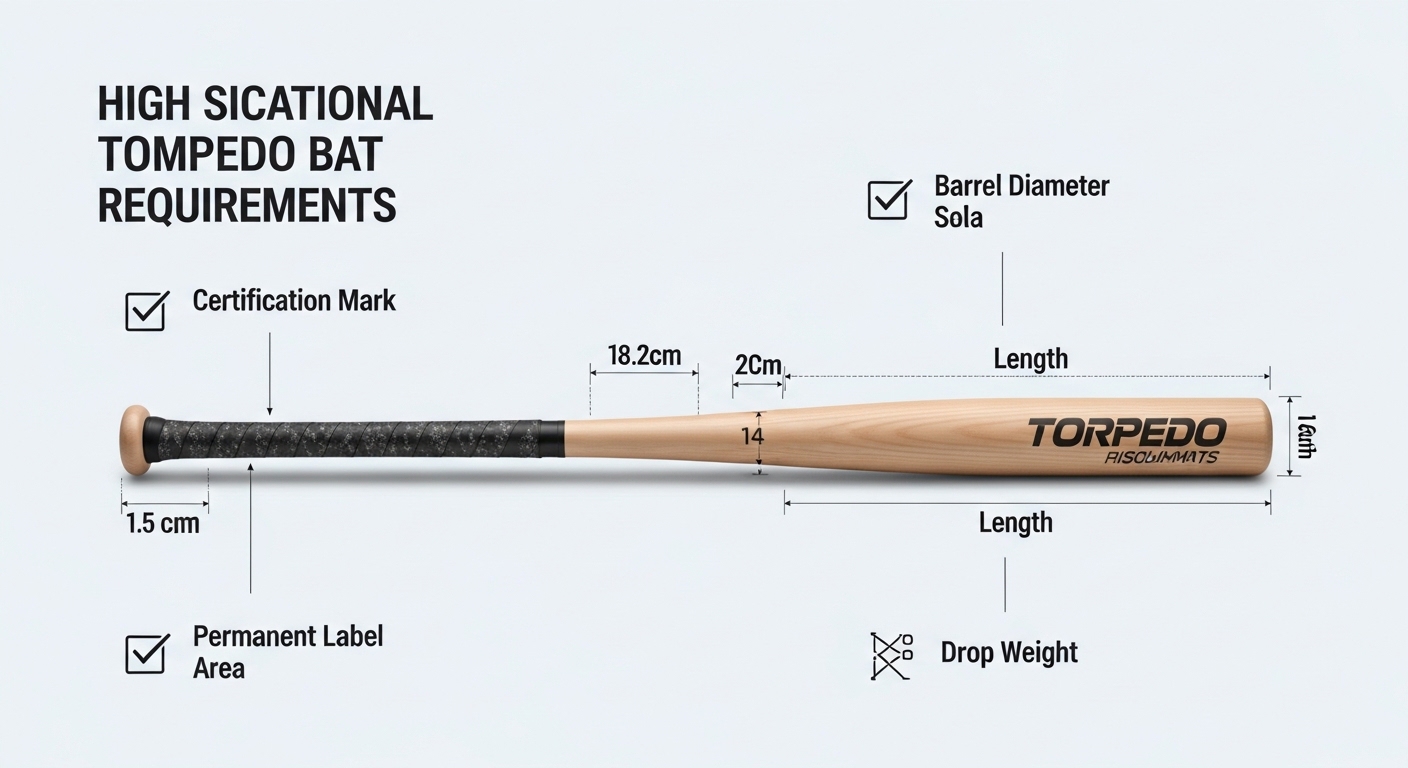
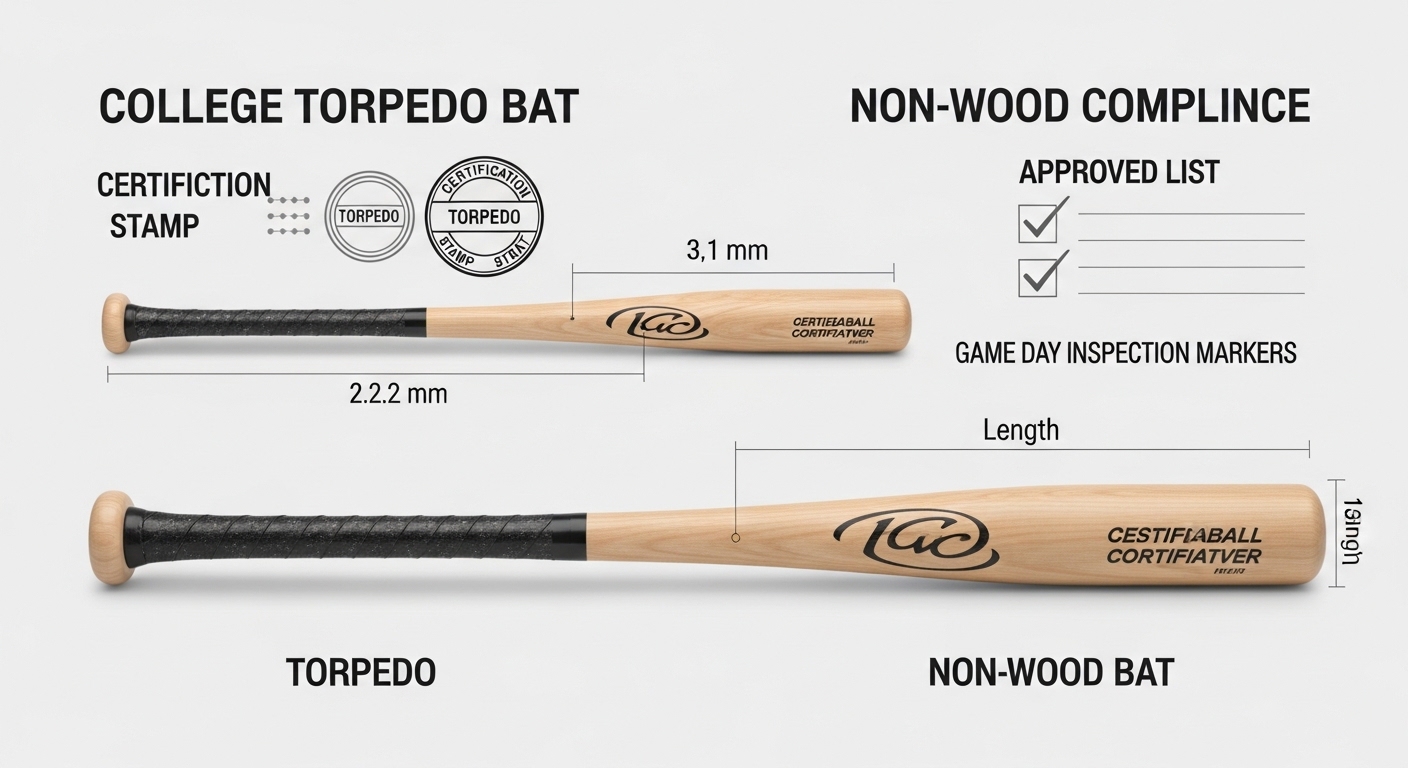
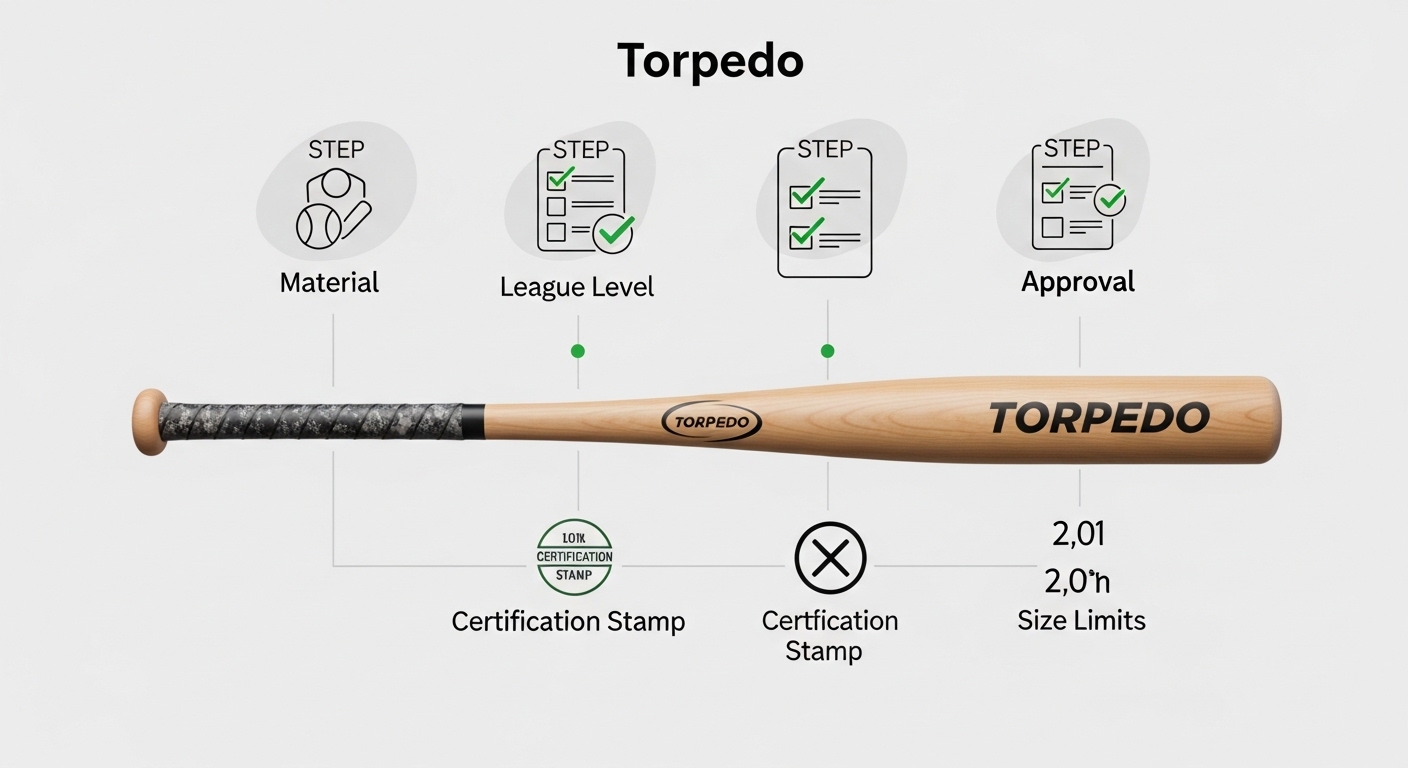
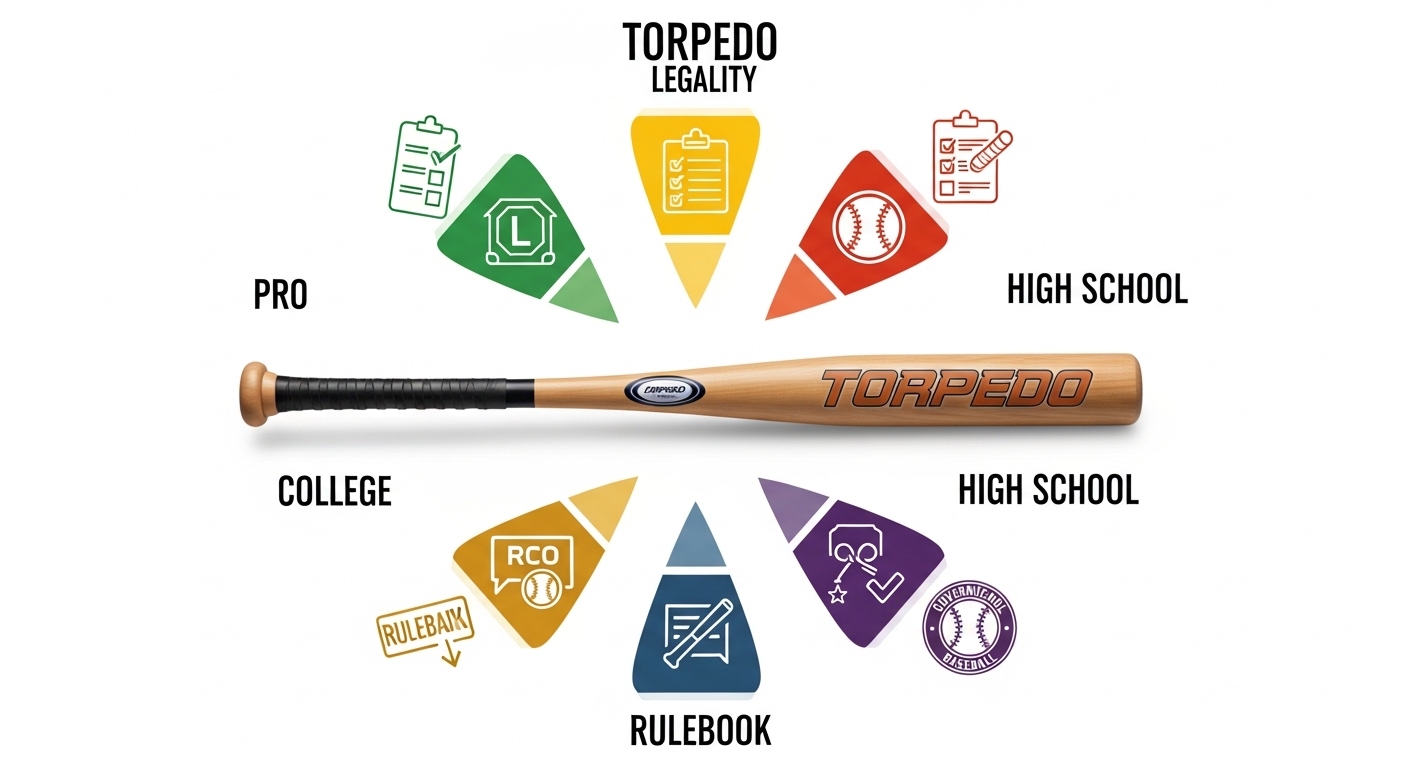
No torpedo-specific certification exists. A torpedo bat is tested and certified — or exempt from testing — under exactly the same standards as any other bat of the same material. The barrel geometry is not a separate certification category. The only questions that matter are: what material is the bat made from, and which league will it be used in?
The Four Standards: What Each One Is
BBCOR (.50)
Bat-Ball Coefficient of Restitution — the high school and college standardUsed by: NCAA and NFHS
Limits non-wood bat collision efficiency to ≤0.500 at all barrel test locations. Named for the ratio of post-impact to pre-impact ball speed. Wood bats have a natural BBCOR of ~0.500 — BBCOR caps non-wood at the same level.
USA Bat (USABat)
Wood-like performance standard for youth playUsed by: Little League Majors & below, Babe Ruth, Cal Ripken, PONY, and Dixie
Effective January 1, 2018 — replaced the older BPF 1.15 standard in these leagues. Performance nearly identical to BBCOR (within ~0.005) but without the -3 drop weight restriction.
USSSA 1.15 BPF
Bat Performance Factor — the travel ball standardUsed by: USSSA travel baseball
BPF 1.15 means the bat is 15% more lively than hitting a solid wall — a higher performance limit than BBCOR, allowing more trampoline effect. Explains why USSSA bats 'hit hotter' than BBCOR-certified bats.
MLB Ink Dot
Wood quality certification — not a performance limitUsed by: MLB, professional wood-bat leagues
An ink dot on the face grain of a wood bat certifies it is MLB-grade wood. It is a quality mark, not a performance test. Most professional wood torpedo bats from Marucci, Tater, and custom bat makers carry ink dot certification.
Master Certification Comparison
All four standards side by side across the dimensions that matter most for torpedo bat decisions.
| Standard | Used By | Performance Limit | Physical Specs | Wood Exempt? | How Tested |
|---|---|---|---|---|---|
| MLB Rule 3.02 | MLB only | No performance limit — wood only | ≤2.61" dia, ≤42" length, one-piece solid wood | ✅ Always — wood is the standard | No lab test — wood is the baseline. Experimental bats require prior approval. Ink dot certifies MLB-grade wood quality. |
| BBCOR (.50) | NCAA, NFHS (high school), LL Senior, LL Intermediate/Junior (accepted) | BBCOR ≤ 0.500 at all test locations | ≤2⅝" barrel, ≤36" (NFHS/NCAA), -3 drop weight, permanent silkscreen stamp | ✅ Solid one-piece wood exempt | Air cannon fires baseballs at bat. COR ratio of post-impact speed to pre-impact speed must stay ≤0.500 at all test zones. Composites also need ABI test. WSU SSL is the exclusive testing lab. |
| USA Bat (USABat) | Little League Majors & below, Babe Ruth, Cal Ripken, PONY, Dixie | Wood-like performance standard (~BBCOR 0.505 equivalent) | ≤2⅝" barrel, ≤33" (LL Majors & below), no drop weight restriction | ✅ Solid one-piece wood exempt | WSU SSL testing using USA Baseball Performance Test Protocol. Bat + graphics approved separately. USA Baseball gives final approval after WSU passes performance test. |
| USSSA 1.15 BPF | USSSA travel ball, some rec leagues | BPF ≤ 1.15 (higher limit than BBCOR — allows more trampoline effect) | ≤2¾" barrel (senior); age-specific sizes; no drop weight restriction | ✅ Solid one-piece wood exempt | BPF test — measures trampoline effect relative to solid wall. 1.15 = 15% more lively than hitting a solid wall. USSSA runs its own approval process; bats appear on the USSSA approved bat list. |
| Ink Dot (MLB wood) | MLB, professional wood-bat leagues | No performance limit — confirms wood quality/grade | MLB specs: ≤2.61" dia, ≤42" length, one-piece solid wood | ✅ Is the wood certification | Ink dot on the face grain certifies MLB-grade wood. Many high-quality wood bats are also bone-rubbed (compressing wood grain for density). Torpedo wood bats may carry ink dot if MLB-grade wood. |
The most important column: Wood Exempt? Every standard exempts solid one-piece wood from performance testing. This is why a wood torpedo bat is universally legal — it is the baseline against which all non-wood bats are measured, not a bat that needs to pass a test. The only wood bats that require certification are multi-piece wood (laminated), bats containing composite materials, and bamboo — all of which are treated as non-wood for testing purposes.
How BBCOR Testing Works: Inside the WSU Sports Science Lab
The WSU Sports Science Laboratory (WSU SSL) at Washington State University is the exclusive certification facility for NCAA baseball bats — and by adoption, for NFHS high school bats as well. The lab tests 50 to 100 bats per month during baseball season.
Air Cannon Impact Test
The lab uses a custom air cannon to fire baseballs at the bat at controlled, standardized speeds. The bat is mounted at a fixed pivot point. The test records the ball's speed before and after impact at multiple predetermined locations along the barrel. The BBCOR value is the ratio of the relative post-impact speed to the relative pre-impact speed — a value of 0.500 or below at every test location means the bat passes.
The 0.500 Ceiling and What It Means for Torpedo Bats
A BBCOR of 0.500 means the bat can return up to 50% of the ball's pre-impact energy. Wood bats naturally measure around 0.500 — the standard was designed to prevent non-wood bats from exceeding wood bat performance. For a torpedo-profile bat, this test is run at the same predetermined locations as any other bat, including the contact zone (6–8" from tip) where the torpedo concentrates its peak mass. The torpedo geometry does not change the BBCOR test methodology — it changes which zone of the bat has the most mass, but the test covers all zones. If any zone exceeds 0.500, the bat fails.
ABI Test for Composite Bats
Composite bats require an additional test that alloy bats do not: the Accelerated Break-In (ABI) protocol. Some composite barrels 'wake up' with use — their BBCOR value increases as the composite fibres compress and the barrel becomes livelier. The ABI simulates hundreds of game swings by pressing nylon wheels into the barrel in controlled increments, then rolling the barrel. After the ABI simulation, the bat is tested again for BBCOR. A composite bat must pass both the initial test and the post-ABI test. This is the gate that catches 'creeping hot' composites.
ABI Testing Stages for Composite Torpedo Bats
| Stage | What Happens | Why It Matters for Torpedo Composite Bats |
|---|---|---|
| Initial BBCOR test | Air cannon fires baseballs at bat. COR ratio ≤0.500 required at all test locations. | Torpedo-profile composite bats must pass this just like any other composite. The torpedo geometry is not tested differently — performance limits apply at all barrel zones. |
| Accelerated Break-In (ABI) | Two nylon wheels press into barrel in 0.012" increments, simulating use. Barrel is rolled to simulate hundreds of game swings. | Critical for composite torpedo: some composites 'wake up' with use and exceed BBCOR ceiling after break-in. ABI catches this before game use. A composite torpedo that passes ABI has been confirmed safe at the ceiling after simulated game break-in. |
| Post-ABI BBCOR test | COR ratio tested again after simulated break-in. Must still measure ≤0.500. | This is the gate that catches 'creeping hot' composites. If a composite torpedo bat exceeds 0.500 after ABI, it fails certification regardless of initial test results. |
| Approved bat list publication | Passing bat model added to WSU SSL NCAA Approved Bat List — publicly searchable. | Any torpedo composite bat on the WSU SSL list has passed both BBCOR and ABI. Absence from the list = not legal for NCAA/NFHS play. |
Why the ABI matters specifically for composite torpedo bats: if a composite torpedo is designed with its peak zone at 6–8" from tip, the ABI test ensures that zone's BBCOR does not creep above 0.500 after extended use. The 2020 Louisville Slugger META decertification was due to exactly this problem — post-ABI performance exceeded the ceiling on specific production runs. Any composite torpedo bat on the WSU SSL approved list has passed both tests.
USA Bat Certification: The Youth Standard
The USA Bat standard was introduced on January 1, 2018, replacing the older BPF 1.15 standard in Little League, Babe Ruth, Cal Ripken, PONY, and Dixie. The goal was to bring youth bat performance closer to wood — USA Baseball describes it as a 'wood-like performance standard'. The testing is done at WSU SSL using USA Baseball's own Performance Test Protocol. The process has two stages: the bat must first pass WSU SSL performance testing, then USA Baseball approves the graphics. Only after both steps can the manufacturer apply the USA Baseball certification mark to the bat.
The performance similarity between USA Bat and BBCOR is striking: per USA Baseball's own FAQ (citing Dr. Lloyd Smith and Dr. Alan Nathan), the performance of BBCOR and USA Baseball bats is nearly identical — within about 0.005 BBCOR. The primary difference is that USA Bat bats do not have the -3 drop weight restriction, allowing lighter bats for younger developing hitters. USA Bat bats can be produced in -3, -5, -7, -8, -10, and lighter drops.
USSSA 1.15 BPF: The Travel Ball Standard
USSSA uses a different measurement system: the Bat Performance Factor (BPF), which measures the trampoline effect of the bat relative to hitting a solid wall. A BPF of 1.15 means the ball comes off the bat 15% faster than it would off a solid wall. This is a higher performance limit than BBCOR — USSSA bats are intentionally 'hotter' than BBCOR bats, which is why USSSA players see higher exit velocities than BBCOR players at the same bat speed. This is also why a USSSA-stamped bat cannot be used in a Little League game: it exceeds the performance limits that league mandates.
For torpedo bats in USSSA play: an alloy or composite torpedo bat needs the USSSA 1.15 BPF stamp. Barrel diameter limits vary by age group: ≤2¼" for the youngest divisions up to ≤2¾" for older players. From January 1, 2026, USSSA 14U and above requires BBCOR-certified bats — the USSSA 1.15 BPF stamp is no longer accepted for 14U and above. A torpedo bat used by a 14U player in USSSA after that date must carry a BBCOR stamp, not a USSSA stamp.
Torpedo Bat Certification Matrix: Which Bat Is Legal Where
| Torpedo Bat Type | MLB | NCAA / NFHS | USA Bat Leagues | USSSA Travel | Wood-Bat Leagues |
|---|---|---|---|---|---|
| Solid one-piece wood torpedo | ✅ Legal | ✅ Legal | ✅ Legal | ✅ Legal | ✅ Legal |
| Alloy torpedo — BBCOR stamped | N/A — no non-wood in MLB | ✅ Legal | Check: needs USA Bat stamp for LL Majors & below | Check: needs USSSA stamp for travel ball | ❌ No non-wood in wood leagues |
| Alloy torpedo — USA Bat stamped | N/A | ❌ Needs BBCOR for high school/college | ✅ Legal (LL Majors & below, Babe Ruth, PONY) | ❌ Needs USSSA stamp | ❌ No non-wood |
| Alloy torpedo — USSSA stamped only | N/A | ❌ Not BBCOR certified | ❌ NOT legal in Little League | ✅ Legal in USSSA travel ball | ❌ No non-wood |
| Composite torpedo — BBCOR stamped + ABI | N/A | ✅ Legal if on WSU SSL approved list | Check: needs USA Bat stamp for LL Majors & below | Check: needs USSSA stamp for travel ball | ❌ No non-wood |
| Multi-piece wood / bamboo torpedo | ❌ Not one-piece solid wood | Needs BBCOR stamp (not auto-exempt) | Needs USA Bat stamp | Needs USSSA stamp | Check league rules — varies |
Decertification: How Bats Get Removed and What It Means
Certification is not permanent. WSU SSL monitors certified bats and can decertify a model if it fails re-testing. NFHS and NCAA rules both require that only bats on the current approved list may be used.
| Bat | Date | Standard | Reason / Lesson |
|---|---|---|---|
| Stinger Missile II (33") | August 10, 2022 | BBCOR / NCAA / NFHS | Decertified by WSU SSL. No specific reason published. Process: WSU notifies NCAA and NFHS; bat removed from approved list; leagues must stop allowing use. Lesson: any bat on the approved list can be removed if it fails re-testing. |
| Louisville Slugger META (33" / 2020 model) | February 21, 2020 | BBCOR / NCAA / NFHS | Three specific model numbers decertified. Likely due to post-ABI performance creep — composite barrel exceeded 0.500 after extended use. The 2025 Meta passed all testing; this was a specific production run of the 2020 model. |
| Note: No torpedo-profile bat decertified | As of early 2026 | BBCOR / USA Bat / USSSA | No torpedo-profile bat has been decertified from any standard as of early 2026. The torpedo geometry does not inherently produce higher collision efficiency — it redistributes mass, not energy transfer. Passing bats: Marucci CB15 Torpedo on WSU SSL BBCOR approved list. |
The torpedo bat legality implication from the decertification record: no torpedo-profile bat has been decertified from any standard as of early 2026. The torpedo geometry does not inherently cause certification failure — it redistributes mass, not collision energy. A torpedo bat that passes initial BBCOR and ABI testing has been certified for the same reasons any other bat is certified: its performance at all test locations stayed within limits.
How to Verify a Specific Torpedo Bat
Before using any non-wood torpedo bat in a game, verify certification using these official sources.
BBCOR (NCAA/NFHS)
Official Source:
ssl.wsu.edu/approved-bats/
How to Verify: Search the WSU SSL Approved Bat List by manufacturer or model. If the bat model is on the list with a BBCOR notation, it is certified. Absence from the list = not approved. Also check the bat itself for 'BBCOR Certified .50' silkscreen on taper.
USA Bat (USABat)
Official Source:
usabaseball.com/bats
How to Verify: Search USA Baseball's online approved bat database. Bat must also carry the USA Baseball certification mark (shield logo) on the taper. Check that the specific model number matches — graphics approvals are model-specific.
USSSA 1.15 BPF
Official Source:
usssa.com/sports/baseball/bats
How to Verify: Look for the USSSA 1.15 BPF logo on the bat taper. USSSA maintains an approved bat list on their website searchable by brand. Note: the USSSA stamp alone is not sufficient for Little League — only USSSA-sanctioned leagues.
MLB Wood / Ink Dot
Official Source:
Manufacturer certification — no centralized list
How to Verify: Ink dot on face grain confirms MLB-grade wood. Look for a small stamped circle on the wood grain of the barrel face. Most professional-grade wood torpedo bats from Marucci, Tater, and similar carry ink dot certification.
Quick verification for BBCOR: search ssl.wsu.edu/approved-bats/ — this is the official NCAA/NFHS approved bat list, publicly accessible. If a bat model is on this list, it is certified. If it is not on this list, it is not approved for NCAA or NFHS play regardless of what the manufacturer claims.
Frequently Asked Questions: Torpedo Bat Certification
Does a torpedo bat need a special certification?
No. There is no torpedo-specific certification. A torpedo bat is certified — or exempt — under the same standard as any other bat of the same material. Solid one-piece wood: no certification needed anywhere. Alloy or composite torpedo: needs BBCOR for high school and college, USA Bat for Little League Majors and below, USSSA 1.15 BPF for travel ball. The barrel shape is not a separate certification category.
What is the BBCOR 0.500 limit and how does it affect torpedo performance?
BBCOR 0.500 is the maximum allowed ratio of the ball's post-impact speed to its pre-impact speed — meaning the bat can return at most 50% of the ball's energy on any tested contact zone. Wood bats naturally measure around 0.500. The limit was designed to prevent non-wood bats from exceeding wood bat performance. For a torpedo bat, this ceiling applies at all barrel zones including the torpedo's peak mass zone (6–8" from tip). The torpedo's performance advantage at that zone comes from MOI reduction and mass alignment — both of which operate within the BBCOR ceiling. A BBCOR-certified torpedo bat cannot produce higher exit velocities than a BBCOR-certified traditional bat at the ceiling; the torpedo's advantage is in making it easier to reach that ceiling at the contact zone.
What is the ABI test and why does it matter for composite torpedo bats?
The Accelerated Break-In (ABI) test simulates hundreds of game swings by pressing nylon wheels into the composite barrel and rolling it. After this simulation, the bat is tested again for BBCOR compliance. Some composite barrels become livelier with use — the ABI catches bats that pass the initial test but would exceed the ceiling after real-world break-in. For composite torpedo bats, the ABI test is especially important because the torpedo's peak mass zone (6–8" from tip) is the zone most likely to see repeated, heavy contact. A composite torpedo on the WSU SSL approved bat list has passed both the initial BBCOR test and the post-ABI test.
Is bamboo a wood bat for certification purposes?
No. Bamboo bats require BBCOR certification for NCAA and NFHS play — they are not exempt as solid one-piece wood bats. This is because bamboo is technically a grass, not a wood, and bamboo bats are typically laminated (multiple pieces bonded together) rather than turned from one solid piece. A bamboo torpedo bat used in a high school or college game would need BBCOR certification to be legal, even though it looks and feels like wood.
Can I find a list of all BBCOR-certified torpedo bats?
Yes — search the WSU SSL Approved Bat List at ssl.wsu.edu/approved-bats/ and look for bats from manufacturers who produce torpedo-profile models. Marucci's CB15 Torpedo is the primary BBCOR-certified torpedo bat in the database as of early 2026. Filter by manufacturer to find all Marucci models; torpedo-profile bats will be identifiable by name. The list is updated as new models are certified and as any models are decertified.
Continue in the Rules Section
Gallery