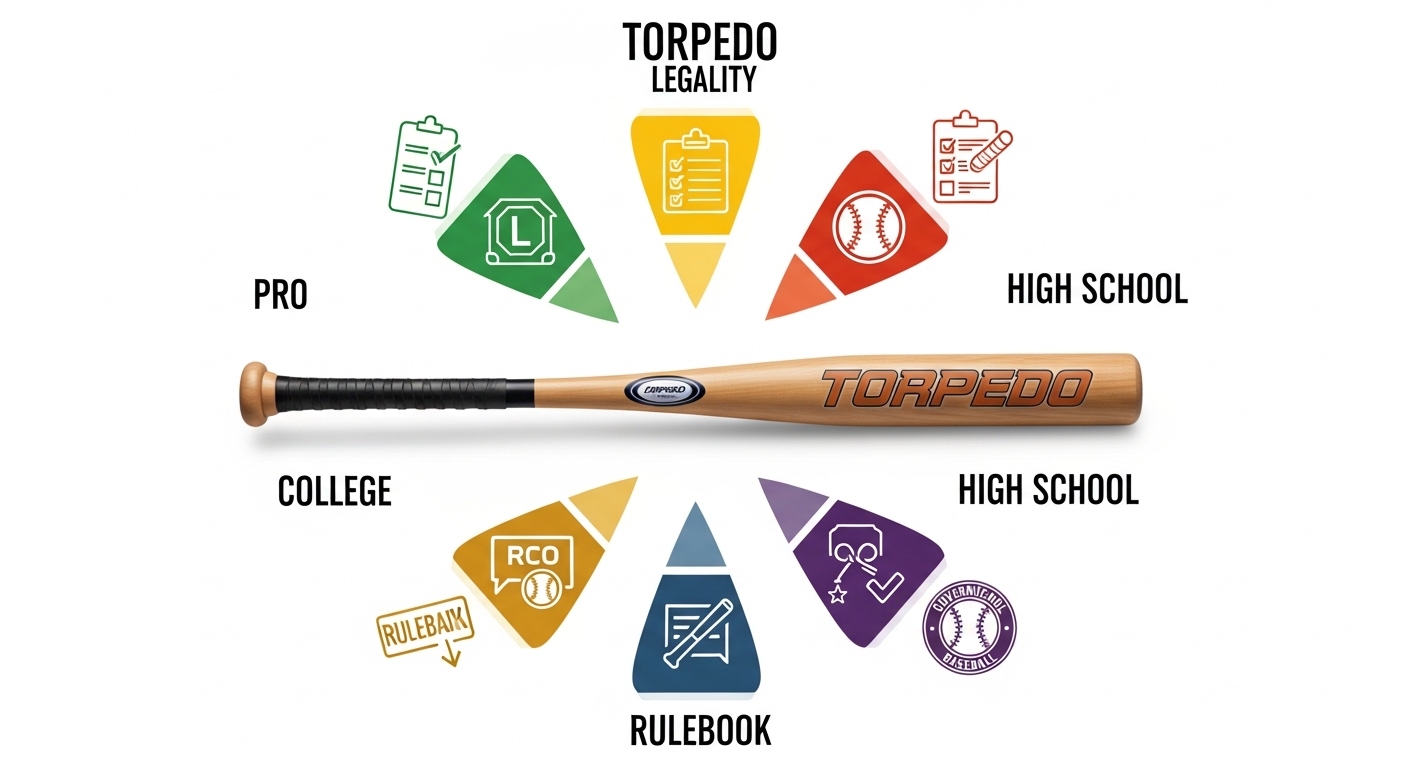
Torpedo Bat High School Rules: NFHS Rule 1-3-2 Fully Explained
✅ SHORT ANSWER: Yes
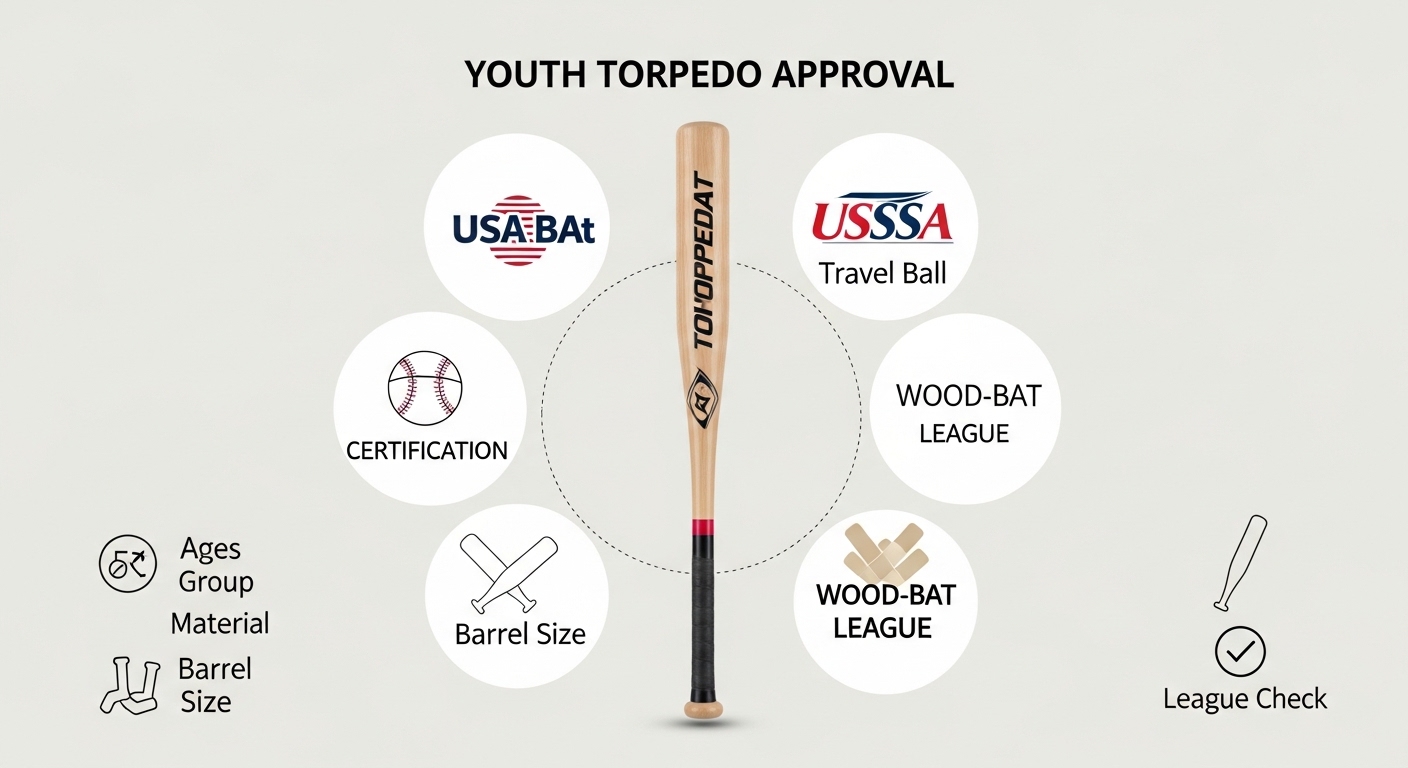
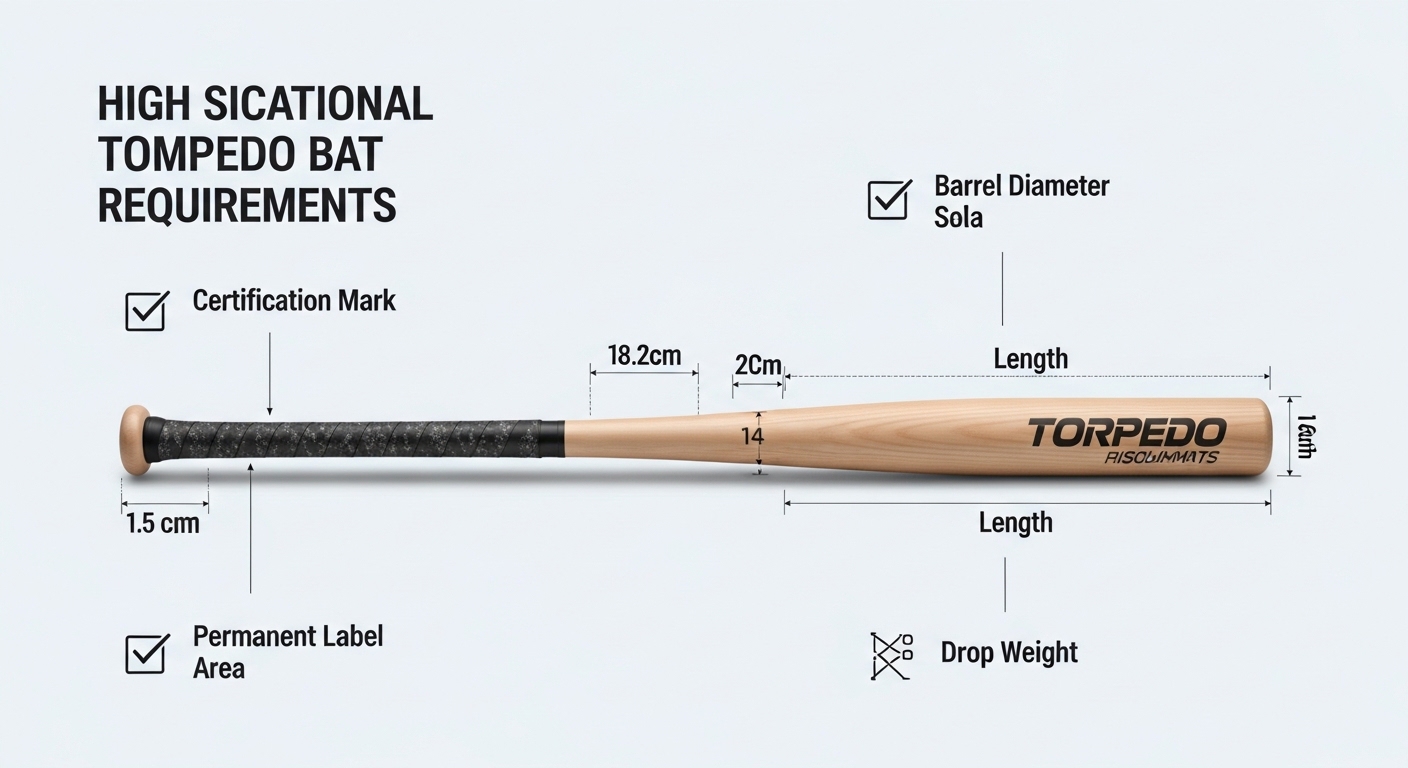
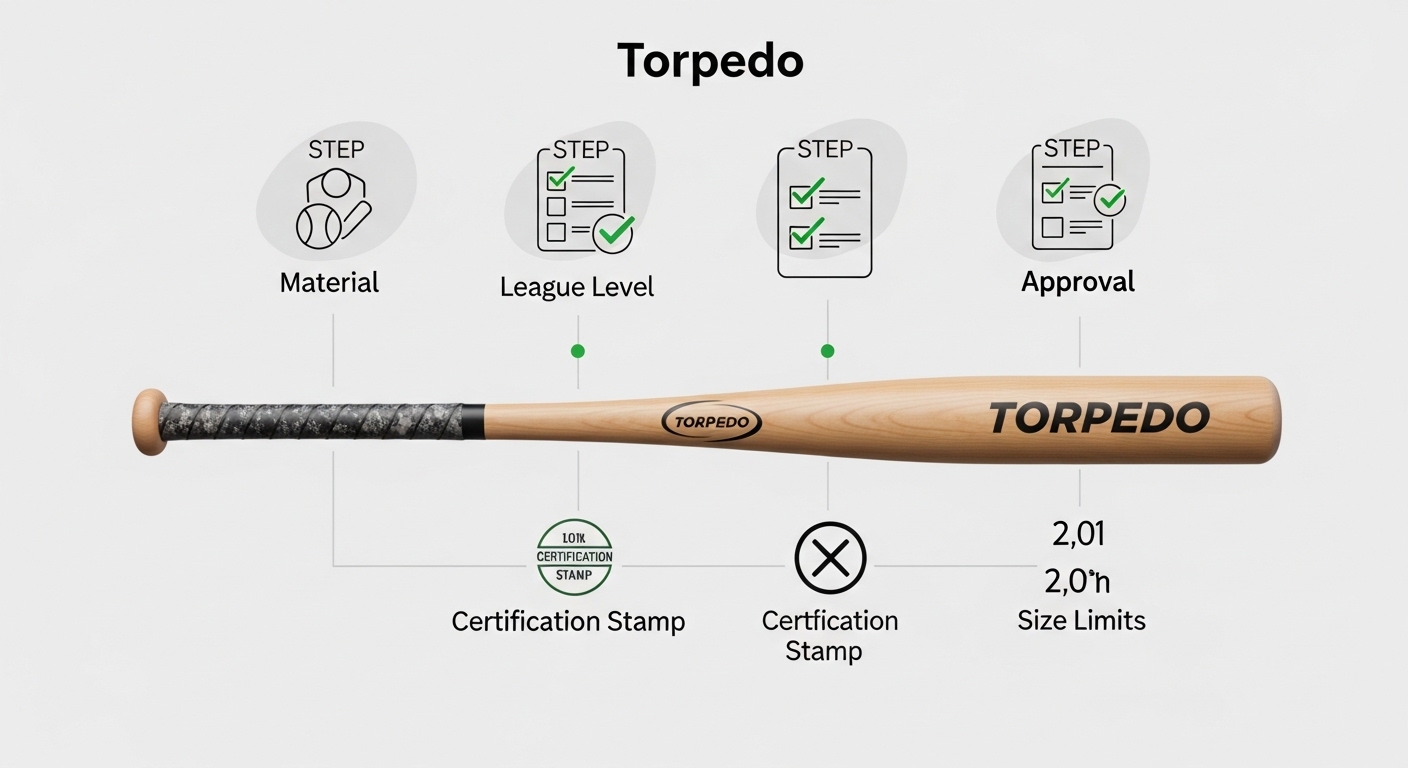
The torpedo bat is legal in high school baseball. A solid one-piece wood torpedo bat is automatically legal under NFHS Rule 1-3-2 with no stamp required. A non-wood torpedo bat (alloy or composite) is legal if it carries a valid BBCOR certification stamp, permanently silkscreened by the manufacturer — no stickers accepted. Drop weight -3, barrel ≤2⅝", length ≤36". No 2025 rule change affected the torpedo bat.
High school baseball bat rules are governed by the National Federation of State High School Associations (NFHS) Rule 1-3-2. Every state high school athletic association — all 50 states plus the District of Columbia — operates under NFHS rules for baseball. The torpedo bat became national news in March 2025 when Yankees players used it to set a single-game home run record on Opening Day, and coaches and players across the country immediately asked whether high school players could use one. The answer under Rule 1-3-2 is yes.
Understanding Rule 1-3-2 thoroughly protects players and coaches from accidental bat violations — which carry real in-game penalties. This page covers every requirement, the 2025 rule updates, the silkscreen requirement in detail, state-level variations, and the penalty structure for illegal bats.
NFHS Rule 1-3-2: The Exact Text That Governs High School Bats
Rule 1-3-2 states that non-wood bats used in high school play must:
The torpedo bat analysis under this rule: "at thickest part" — a torpedo bat is thickest at its contact zone (6–8" from tip). That zone must be ≤2⅝". The rule does not specify where the thickest part must be located, only what it may not exceed. A torpedo bat whose widest point is 2⅝" or less — wherever that point occurs — complies. The same rule language that permits the torpedo at the MLB level governs the high school level. Wood is one-piece and solid — automatically exempt from BBCOR testing. No state high school association has added torpedo-specific language to its bat rules as of early 2026.
The Complete NFHS Rule 1-3-2 Checklist for Torpedo Bats
Every requirement under Rule 1-3-2, applied specifically to torpedo bat configurations:
| Status | Requirement | Wood Torpedo Bat | Non-Wood Torpedo Bat |
|---|---|---|---|
| ✅ | Barrel diameter ≤ 2⅝" at thickest part | Complies — torpedo thickest at 6–8" zone, must be ≤2⅝" | Same requirement — ≤2⅝" at thickest barrel point |
| ✅ | Length ≤ 36 inches | Same length limits apply to wood and non-wood | Same — standard BBCOR sizing runs 31"–34" |
| ✅ | Drop weight not more than -3 | Wood exempt from drop weight restriction | Required — a 33" non-wood torpedo must weigh ≥30 oz. All BBCOR bats are already -3. |
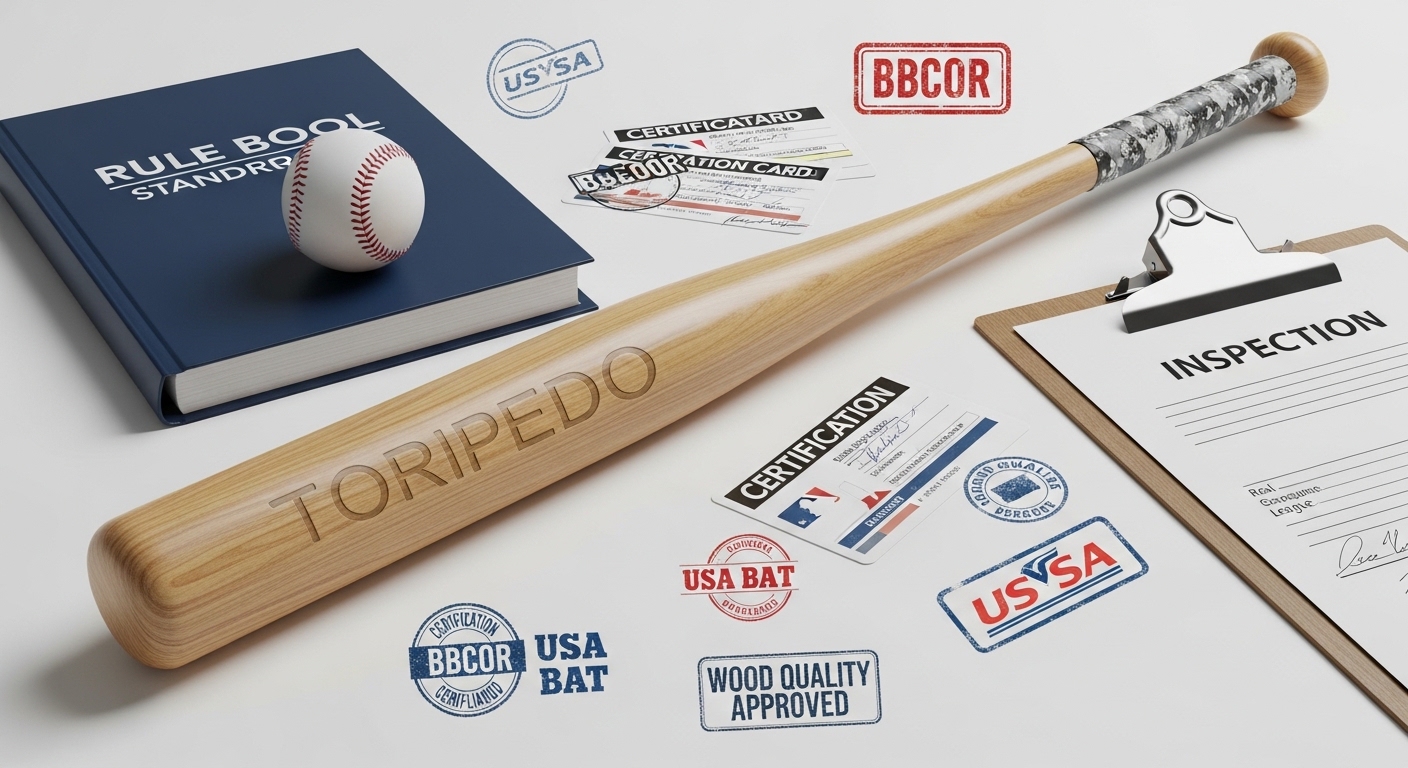
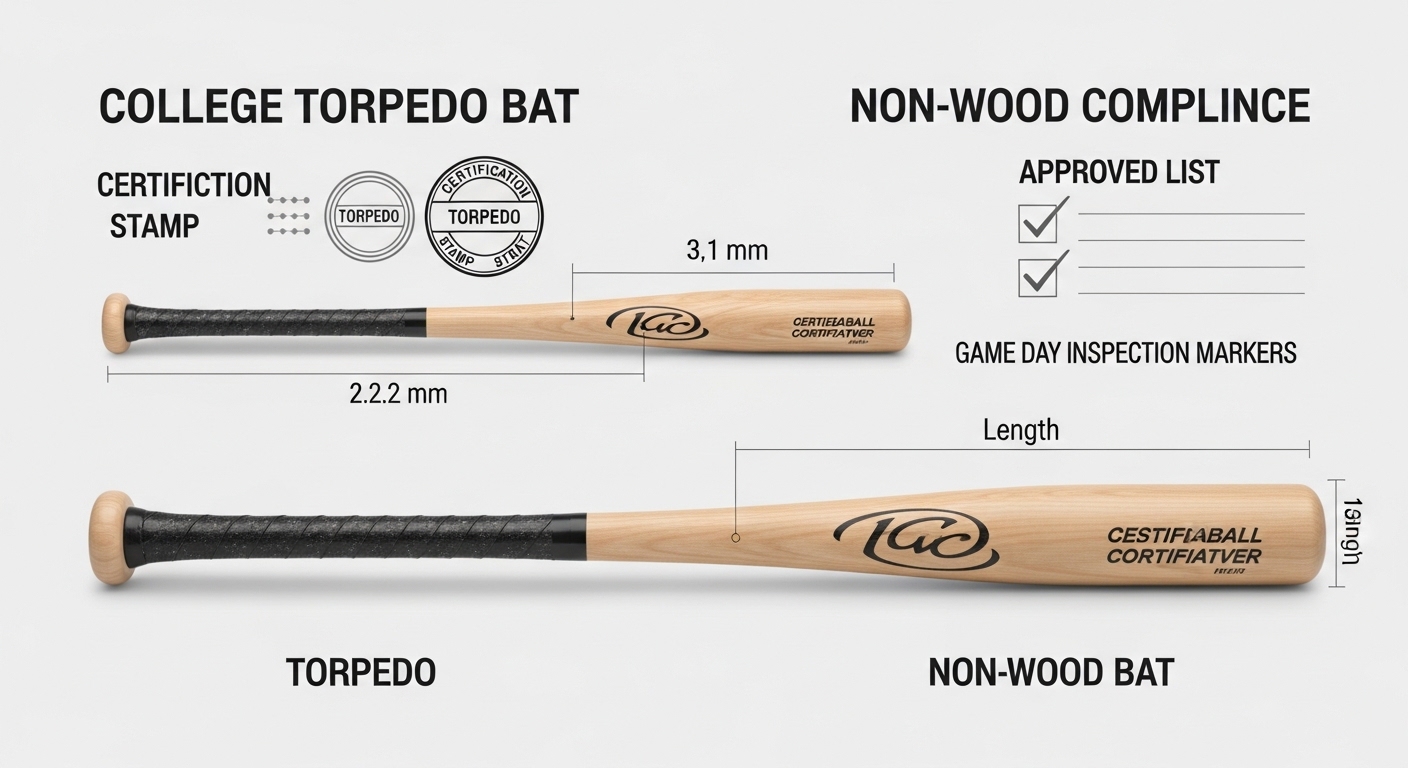
| ✅ | BBCOR certification mark — permanent silkscreen | Wood exempt — no stamp required | Required. Rectangular mark, minimum 1" × 1" on barrel, contrasting color, reading 'BBCOR .50' |
| ❌ | No label, sticker, or decal accepted as BBCOR mark | N/A — no mark required for wood | Critical: after-market BBCOR stickers are NOT legal. Mark must be from manufacturer. |
| ✅ | Bat labeled as aluminum/alloy or composite | N/A — wood bat | Required — bat material type must be silkscreened on the bat |
| ✅ | Free of rattles, dents, burrs, cracks, sharp edges | Required — wood bats that crack or splinter mid-game are removed | Required — metal bats that dent or crack are removed |
| ❌ | No alteration, modification, or 'doctoring' of bat | Wood — carving, shaving, or corking is illegal | Non-wood — rolling, shaving barrel, or any alteration illegal; may constitute civil/criminal violation per NFHS note |
| ✅ | Knob required — minimum ¼" protrusion | Required on all bats | Required on all bats |
| ✅ | Tape or grip allowed ≤18" from handle end | Tape/pine tar/resin ≤18" from handle | Tape/resin/pine tar ≤18" from knob base. NEW 2025: explicitly allows resin and drying agents for non-wood bats. |
The 2025 NFHS Rule Changes: What Changed and What Didn't
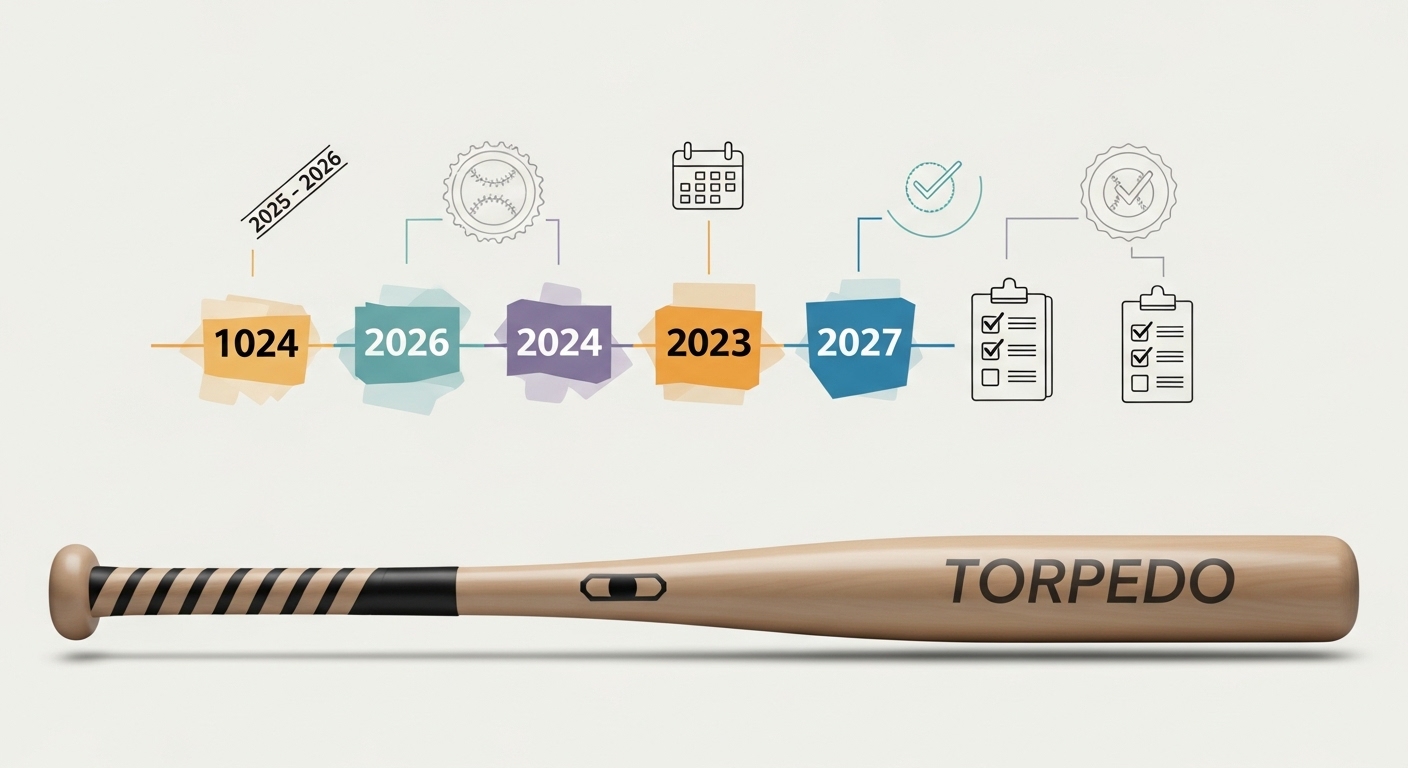
The 2025 NFHS Baseball Rules Committee met June 2–4, 2024, at The Alexander hotel in Indianapolis. Two rule changes were adopted and are effective with the 2025 season. Neither addresses torpedo bats specifically.
| Rule | Change | Effect on Torpedo Bat Users |
|---|---|---|
| Rule 1-3-2c1 | Grip substances expanded: resin, pine tar, or other drying agents now explicitly permitted on non-wood bats, not to exceed 18" from knob base | Direct benefit for non-wood torpedo bat users — wood bat users already had this permission. Now alloy/composite torpedo users can use pine tar or resin for grip without violating NFHS rules. Aligns non-wood with wood standard. |
| Rule 4-4-1c | Forfeit condition expanded: failure to remove an ejected coach now a forfeiture trigger (not just ejected players) | Indirect. Coaches who knowingly allow illegal bat use and are ejected are now subject to a stricter removal standard. Not torpedo-specific but tightens consequences. |
| No torpedo-specific rules | No 2025 change addressed torpedo bat geometry, profile, or mass distribution | The torpedo bat shape is not addressed in the 2025 NFHS rules cycle — it remains governed by the same Rule 1-3-2 standards as all other bats. No new restriction, no new exemption. |
The 2025 grip substance change (Rule 1-3-2c1) is a practical improvement for non-wood torpedo bat users. Before 2025, NFHS allowed pine tar and resin only for wood bats — non-wood bat users could use tape and standard grip spray, but not traditional pine tar. The 2025 change explicitly extends pine tar, resin, and drying agents to non-wood bats. For a player using an alloy or composite torpedo bat, this means they can now use the same grip substances as wood bat users, up to 18 inches from the knob base.
Common High School Torpedo Bat Legal Situations
These are the scenarios that coaches and players encounter most often — and where mistakes happen.
| Situation | Legal? | Rule Reference |
|---|---|---|
| Wood torpedo bat — no stamp | ✅ Legal | NFHS Rule 1-3-2: solid one-piece wood is exempt from BBCOR testing |
| BBCOR-stamped alloy torpedo bat — silkscreened mark | ✅ Legal | Rule 1-3-2: BBCOR stamp + silkscreen = compliant non-wood bat |
| BBCOR-stamped composite torpedo bat (ABI tested, on WSU SSL list) | ✅ Legal | Rule 1-3-2: BBCOR certification covers all materials including composite |
| BBCOR sticker applied after purchase (not from manufacturer) | ❌ Illegal | Rule 1-3-2: 'No BBCOR label, sticker or decal will be accepted.' Must be manufacturer silkscreen. |
| USA Bat-stamped torpedo bat in a high school game | ❌ Illegal | USA Bat stamp does not meet NFHS BBCOR requirement. BBCOR stamp is mandatory for non-wood in high school. |
| USSSA-stamped torpedo bat in a high school game | ❌ Illegal | USSSA 1.15 BPF exceeds BBCOR 0.500 performance limit. Not NFHS-compliant. |
| Bamboo torpedo bat (laminated bamboo, not solid wood) | ⚠️ Needs BBCOR stamp | Bamboo is not solid one-piece wood. Requires BBCOR certification to be legal for high school. |
| Multi-piece laminated wood torpedo bat | ⚠️ Needs BBCOR stamp | Laminated wood is non-wood under NFHS Rule 1-3-2. BBCOR certification required. |
| BBCOR torpedo bat with pine tar/resin applied within 18" of knob | ✅ Legal from 2025 | NEW: Rule 1-3-2c1 (2025) explicitly extends resin/pine tar permission to non-wood bats, not to exceed 18" from knob base. |
| Bat that was BBCOR-certified but has since been decertified by WSU SSL | ❌ Illegal | Decertified bats must be removed from play once state association notifies schools. CIF California publishes all NFHS decertifications — check your state association. |
Penalties for Illegal Bat Use in High School
NFHS Rule 7-4-1a governs illegal bat penalties. Umpires are trained to identify non-compliant bats and required to remove them from play.
| When Discovered | Rule Reference | Penalty |
|---|---|---|
| Before the first pitch of the at-bat | NFHS Rule 7-4-1a | Bat removed. No penalty on play — no pitch thrown yet. Batter uses a legal bat. |
| After the batter has stepped in and been pitched to, but before the next pitch | NFHS Rule 7-4-1a | Umpire may call the batter out. The illegal bat is removed. Any advance by runners stands at umpire's discretion if no out is called. |
| After the batter completes the at-bat and the next batter has taken a pitch | NFHS Rule 7-4-1a | Appeal is lost — the completed play stands. Bat is removed going forward. No retroactive out. |
| Intentional bat tampering (rolling, shaving, corking) | NFHS Rule 7-4-1a + manufacturer note | Ejection. May result in forfeiture. NFHS notes manufacturers may pursue civil or criminal action against bat doctorors. |
| Coach allows illegal bat use knowingly | NFHS Rule 4-4-1c (2025) | Coach ejection. Under 2025 Rule 4-4-1c, failure to remove ejected team personnel can result in forfeiture. |
The timing point is significant: discovering an illegal bat before the first pitch of the at-bat carries no penalty other than bat removal. The penalty escalates if the at-bat has begun. This is why coaches are advised to check every bat at the start of each game — not at the start of each at-bat. Under the 2025 Rule 4-4-1c addition, a coach who is ejected (for example, for arguing after an illegal bat call) and fails to leave the field can trigger a forfeit — a higher-stakes consequence than the original illegal bat penalty.
State Association Variations: When Local Rules Differ
NFHS sets the national standard, but state athletic associations can publish additional guidance, decertification notices, and middle school variations. These are the most relevant examples:
| State / Association | Variation from NFHS Standard | Source / Notes |
|---|---|---|
| California (CIF) | Publishes its own decertification memos; has issued bat compliance clarifications beyond standard NFHS notices | CIF State website maintains its own NFHS Rule Changes & Interpretations page with additional decertification memos. Coaches in CIF states should check this page regularly. |
| Missouri (MSHSAA) — Middle School | Bats 30" and under: USA Bat stamp OR BBCOR stamp accepted at middle school level | MSHSAA allows shorter bats (30" and under) to use USA Bat certification in junior high/middle school — slightly relaxed from full NFHS standard. Full NFHS BBCOR required for high school. |
| Tennessee (TSSAA) — Middle School | Middle school follows the same NFHS standard as high school | TSSAA explicitly states: 'bat rules are the same for middle school as they are for high school.' No relaxation — BBCOR required for all TSSAA levels. |
| Illinois (IESA) — Middle School | Bats 31" and over must be BBCOR. Shorter bats may have state-specific rules. | IESA notes: 'All bats 31 inches and over must meet the NFHS bat guidelines and contain the BBCOR label.' Check IESA website for under-31" guidance. |
| All other states | Follow NFHS Rule 1-3-2 without variation for high school | BBCOR stamp required, permanent silkscreen, -3 drop, ≤2⅝" barrel, ≤36" length. Wood exempt. No state has added torpedo-specific rules. |
The California CIF note is particularly important for torpedo bat compliance: CIF maintains its own bat compliance memo page and has issued specific decertification notices that go beyond the standard NFHS communications. California coaches should check the CIF state website's baseball rules page at the start of every season — not just the NFHS annual rules update.
No state association has issued torpedo-specific restrictions or additional requirements as of early 2026. The torpedo bat is governed by standard Rule 1-3-2 in all 50 states — there is no state where a BBCOR-certified torpedo bat is legal nationally but restricted locally, and no state where an uncertified torpedo is granted a special exemption.
Verifying a Torpedo Bat Is BBCOR Certified Before Purchase
Check the WSU SSL Approved Bat List
ssl.wsu.edu/approved-bats/ — the official NCAA/NFHS BBCOR certified bat database. If a torpedo bat model is on this list, it is certified for high school and college play. Marucci CB15 Torpedo is the primary torpedo-profile bat currently on this list.
Check the bat taper in person
The BBCOR silkscreen mark must be on the barrel — a rectangular mark reading 'BBCOR .50' in a contrasting color. Run your fingernail across it: if it feels raised like a sticker or decal, it does not comply with NFHS Rule 1-3-2.
Check the material label
NFHS requires non-wood bats to be labelled as aluminum/alloy or composite via permanent silkscreen. If you cannot find the material label on the barrel, the bat does not meet the labelling requirement.
Before buying online
Torpedo bat listings on marketplaces like eBay or Facebook Marketplace sometimes include USSSA-stamped bats described as 'tournament bats' — these are not legal for high school. Verify the specific certification stamp before purchasing any used torpedo bat for high school use.
Frequently Asked Questions: Torpedo Bat High School Rules
Is the torpedo bat legal for high school baseball?
Yes. A solid one-piece wood torpedo bat is automatically legal under NFHS Rule 1-3-2 with no stamp required. A non-wood torpedo bat is legal if it carries a BBCOR certification mark permanently silkscreened on the barrel — rectangular, minimum 1" × 1", reading 'BBCOR .50.' No stickers or decals are accepted. The bat must also be -3 drop weight, ≤2⅝" barrel diameter at thickest part, and ≤36" length. No 2025 NFHS rule change addressed torpedo bat geometry or mass distribution.
Does a BBCOR torpedo bat need a special certification different from other BBCOR bats?
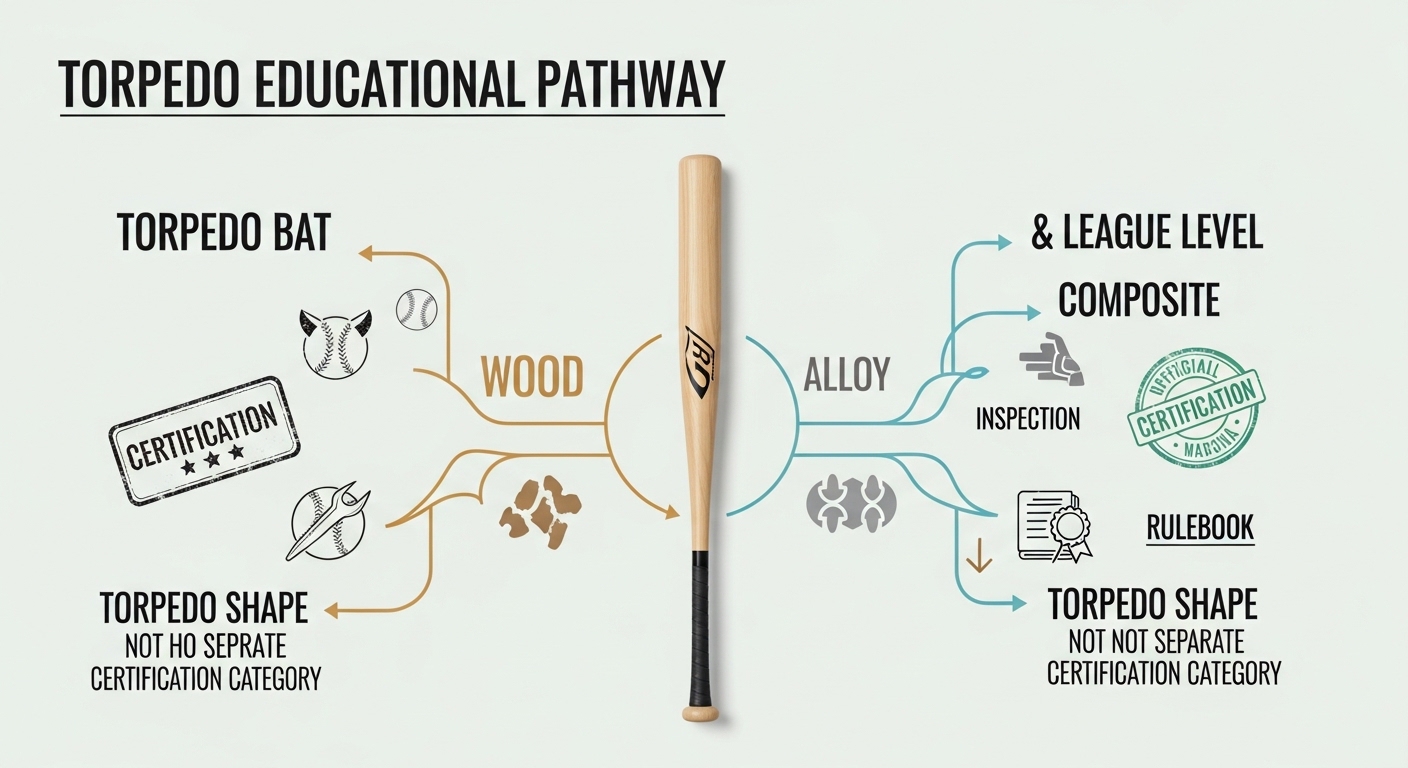
No. A torpedo-profile BBCOR bat is tested and certified under exactly the same standard as any other BBCOR bat — WSU SSL air cannon impact testing at multiple barrel locations, and ABI (Accelerated Break-In) testing for composite models. The barrel profile is not a separate certification category. A BBCOR-stamped torpedo bat that passes WSU SSL testing is fully legal for NFHS high school play without any additional requirements. The key check is whether the specific model appears on the WSU SSL Approved Bat List.
What happens if an umpire finds my torpedo bat illegal in a high school game?
Under NFHS Rule 7-4-1a: if discovered before the at-bat, the bat is removed and no penalty is assessed. If discovered during an at-bat, the umpire may call the batter out and remove the bat — any runner advances may stand or revert at the umpire's discretion. If discovered after the next legal pitch to the following batter, the completed play stands and the bat is removed going forward. Deliberate bat tampering (rolling, shaving, corking a bat) may result in ejection and could expose the tampering party to civil or criminal liability per the NFHS note on manufacturer protections.
Can I use pine tar on a non-wood torpedo bat in high school?
Yes — as of the 2025 NFHS rules cycle. Rule 1-3-2c1 (effective 2025 season) explicitly extended the pine tar, resin, and drying agent permission to non-wood bats, not to exceed 18 inches from the base of the knob. Previously, this permission existed for wood bats only. The 2025 change aligns wood and non-wood bat grip substance rules. One caution: the substance must not extend beyond 18 inches from the knob base — if pine tar extends into the ball-striking area (barrel zone), the bat is illegal regardless of material.
Are tornado bats legal in high school? What about other unusual barrel shapes?
Any solid one-piece wood bat of any profile is legal if it meets dimensional limits (≤2⅝" diameter, ≤42" at the MLB level; ≤36" at the NFHS level). The torpedo bat, cupped-end bat, and various knob designs are all legal under Rule 1-3-2 because the rule governs dimensions and certification, not geometry. Any non-wood bat must carry BBCOR certification regardless of barrel shape. The barrel shape itself is not regulated — performance at all barrel zones is regulated through the BBCOR ceiling.
Continue in the Rules Section
Gallery