⚾ Torpedo Bat vs. Composite Bat: Trampoline Effect, Sweet Spots, and Cold Weather Risk
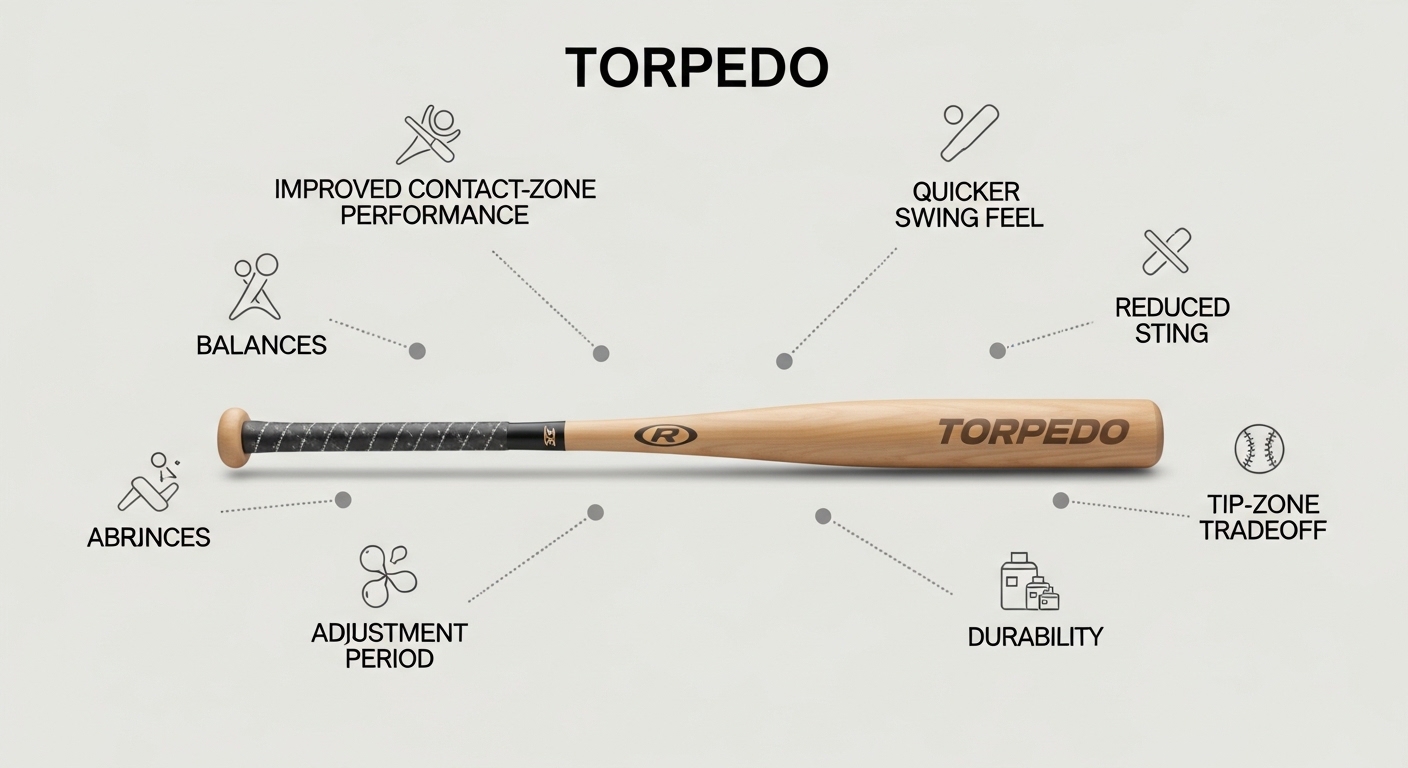
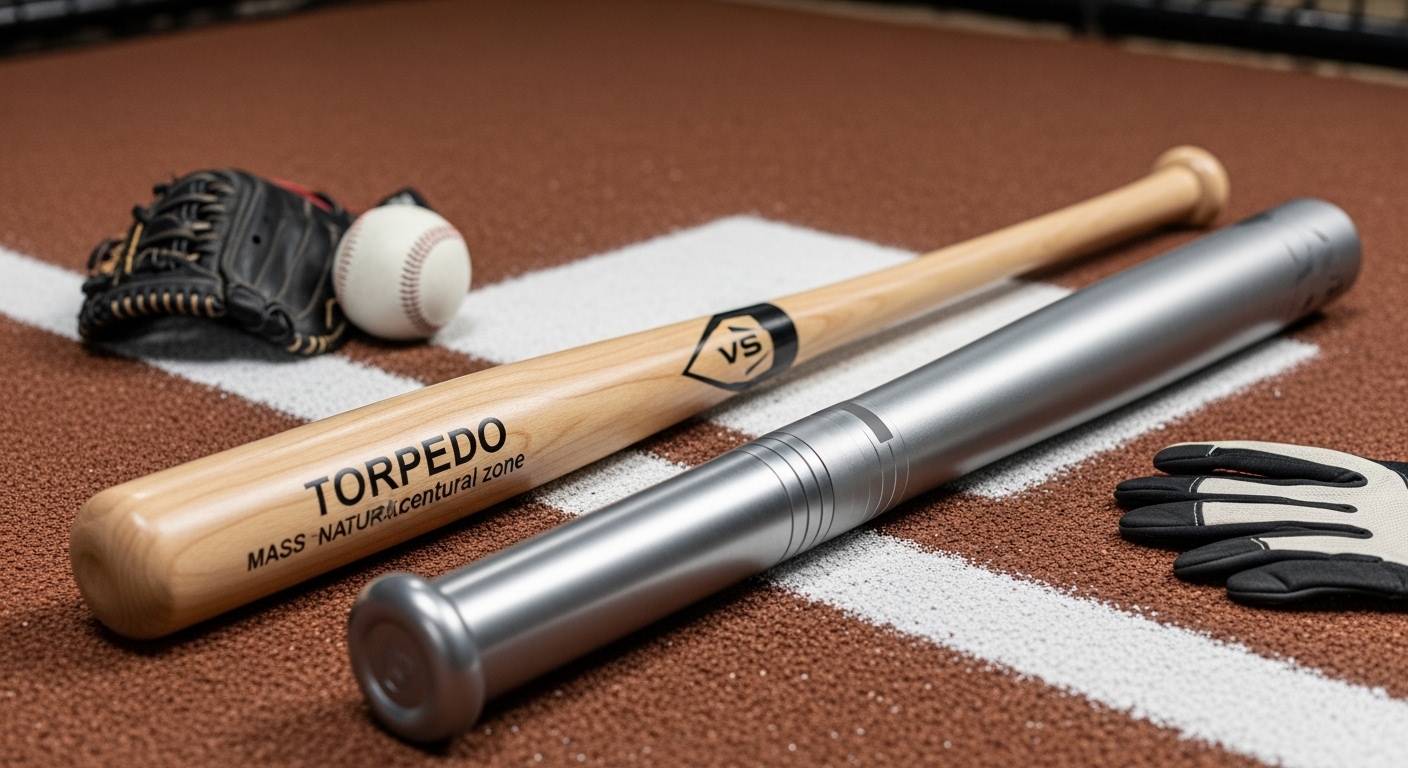
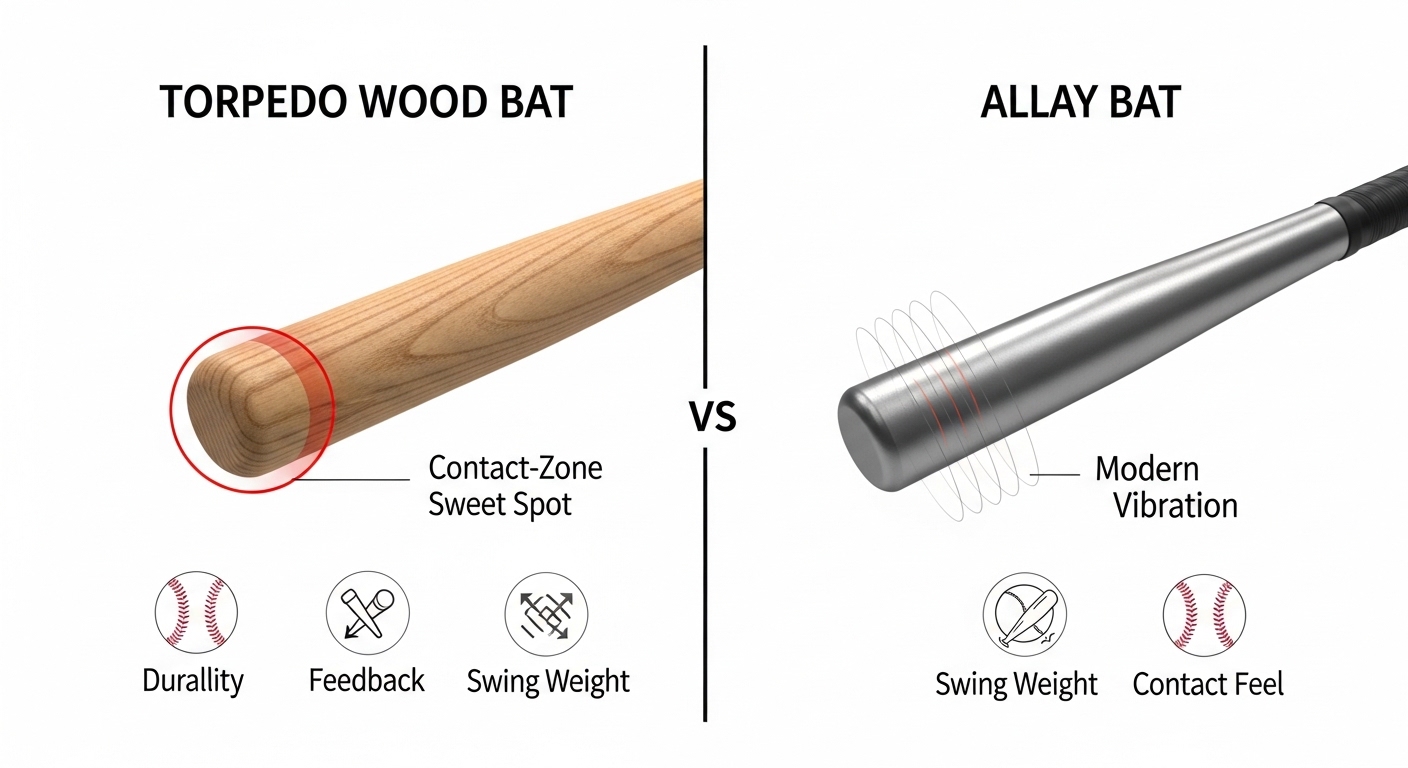
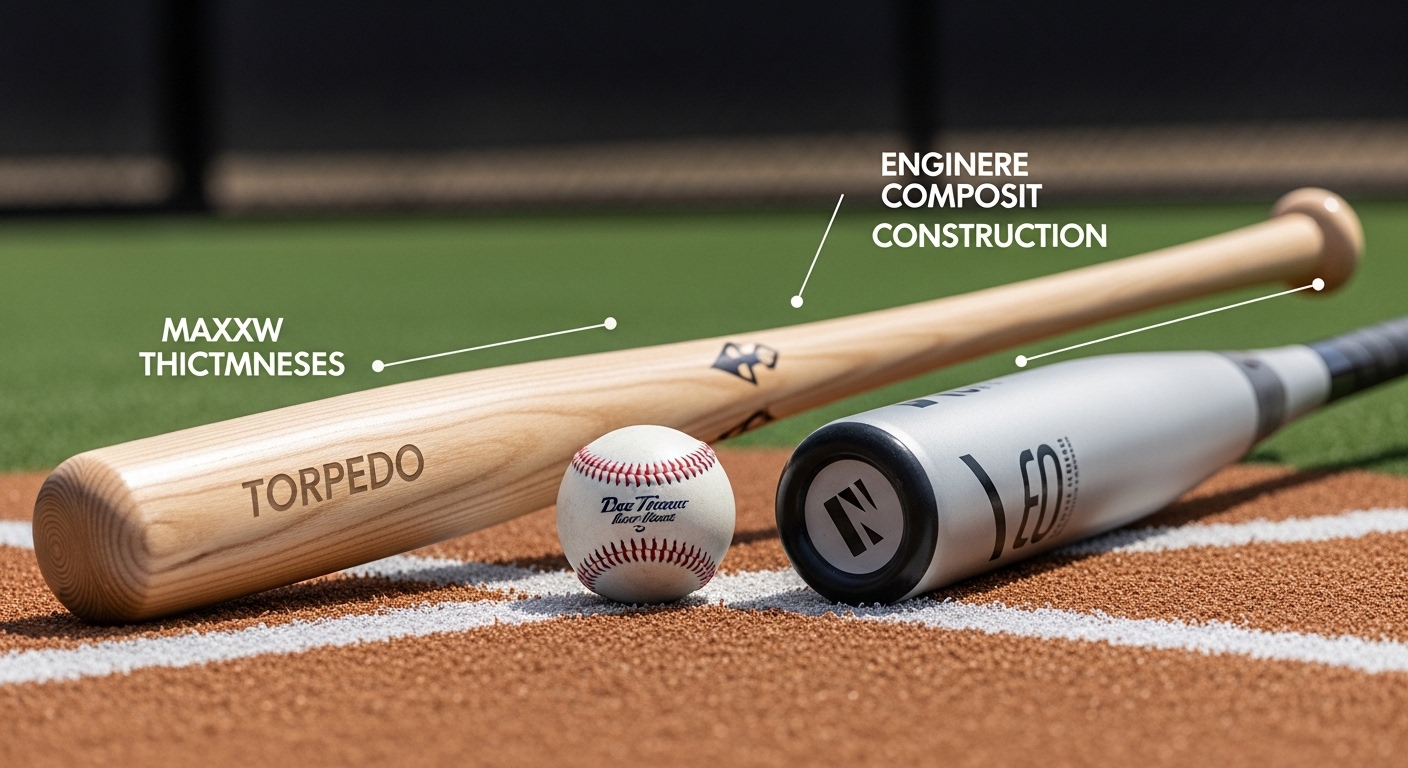
The torpedo bat vs. composite bat comparison has a hidden structure: torpedo is a barrel geometry, not a material. You can have a composite torpedo bat — a composite-barreled bat with a torpedo profile. This page compares wood torpedo (the MLB design) vs. composite-barreled torpedo (BBCOR/USSSA design).
This page covers: Trampoline effect • Sweet spot engineering • Cold weather risk • Break-in periods • 16-category head-to-head • 9-scenario decision guide
📊 Key Numbers: Torpedo Wood vs. Composite at a Glance
🔋 The Trampoline Effect: What Composite Adds That Wood Cannot
The fundamental difference between composite and wood bat physics is the trampoline effect — and understanding it is essential for evaluating what composite adds to the torpedo design.
A solid wood bat barrel is rigid. When a baseball hits it, the ball deforms and springs back — all the energy storage and release happens in the ball, not the bat. This is inherently inefficient because the ball's COR (coefficient of restitution) is relatively low.
A hollow composite barrel is flexible. When a baseball hits it, both the ball and the barrel walls deform and spring back — the barrel stores energy as the walls flex inward, then releases it as they spring back outward, adding energy to the ball at exit. This is the trampoline effect, and it is the primary reason composite bats hit the ball farther than solid wood bats before BBCOR regulations cap the difference.
Under BBCOR regulations: the trampoline effect is constrained to 0.500 collision efficiency — the same ceiling for every certified bat. Within the BBCOR ceiling, the performance difference between composite torpedo and alloy torpedo is minimal. Outside the BBCOR ceiling — in USSSA travel ball — composite torpedoes can be tuned significantly hotter.
📈 Trampoline Effect & BBCOR: What the Certification Actually Means
| Bat Type | Hollow Barrel? | Trampoline? | BBCOR Cap Applied? | Net Effect |
|---|---|---|---|---|
| Wood torpedo | No — solid | None | Exempt — no cap | Performance determined purely by wood physics and torpedo geometry |
| Alloy torpedo (BBCOR) | Yes — hollow | Yes — metal spring-back | Cap at 0.500 | Trampoline up to BBCOR ceiling; torpedo MOI on top |
| Composite torpedo (BBCOR) | Yes — hollow | Yes — composite flex | Cap at 0.500 | Same ceiling as alloy. Larger sweet spot, softer feel, cold risk |
| Composite torpedo (USSSA) | Yes — hollow | Yes — tuned hotter | USSSA limit only — hotter than BBCOR | Hottest legal torpedo option for travel ball |
| Hybrid torpedo (alloy barrel, composite handle) | Yes — alloy barrel | Alloy trampoline | Cap at 0.500 | Hot out of wrapper. No cold-weather composite risk. Less vibration than one-piece alloy. |
Key takeaway: The USSSA composite torpedo is the hottest torpedo bat option available to non-MLB players. USSSA allows higher trampoline effect than BBCOR, and composite can be tuned to that higher limit. A USSSA composite torpedo gives travel ball players both the hotter-than-BBCOR pop and the torpedo's MOI advantage simultaneously.
⚔️ Head-to-Head Comparison: 16 Categories
| Category | Wood Torpedo Bat | Composite Torpedo (BBCOR) | Edge / Notes |
|---|---|---|---|
| BBCOR performance ceiling | No cap — wood physics limit | Capped at 0.500 — same as all BBCOR | Equal in BBCOR leagues; wood uncapped in wood leagues |
| Trampoline effect | None — solid wood | Yes — composite walls spring back (to BBCOR limit) | Composite wins for BBCOR play |
| MOI / swing speed | Full torpedo MOI benefit | Full torpedo MOI benefit | Equal — torpedo geometry applies to both |
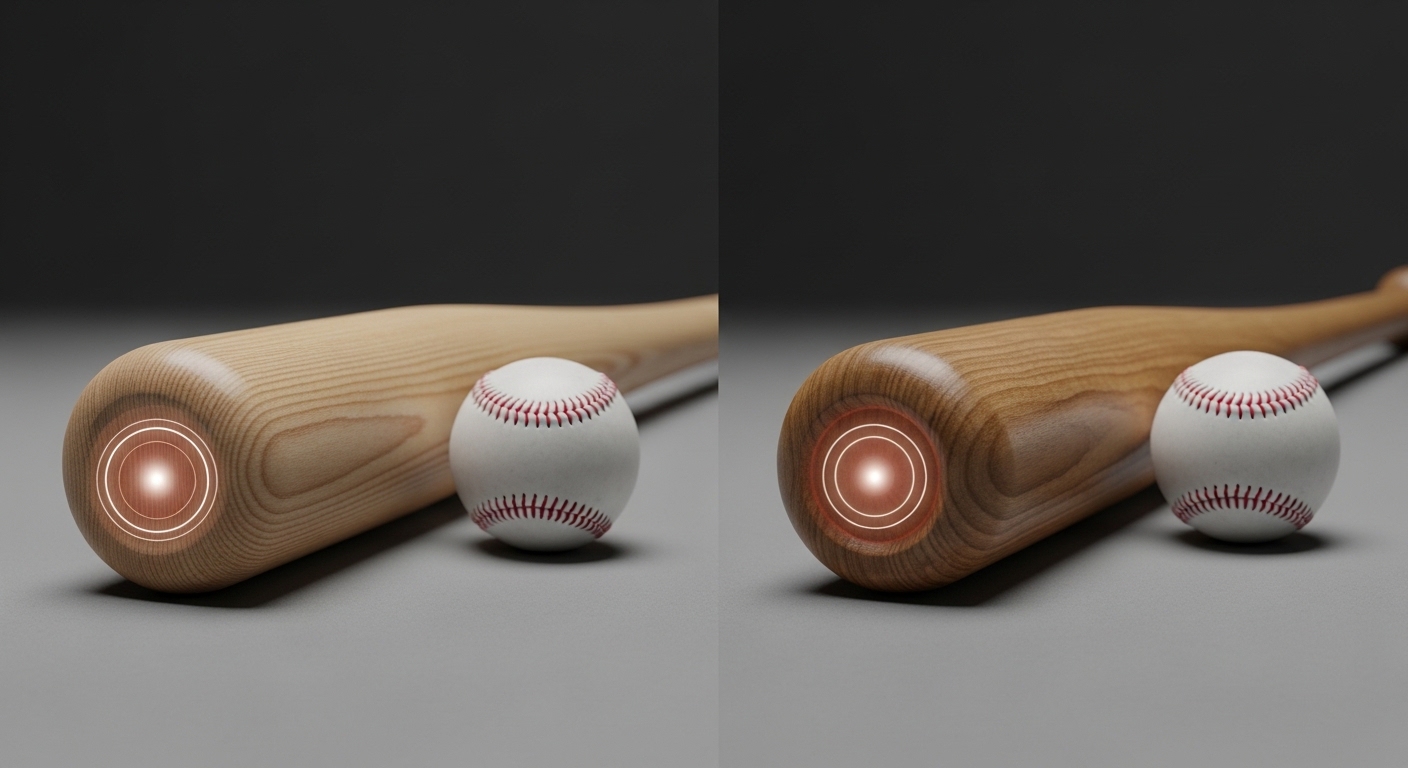
| Sweet spot size | Moderate — solid wood construction | Larger — composite barrel engineering | Composite advantage at BBCOR level |
| Sweet spot definition | Precise — stiff; clear on/off contact feedback | Forgiving — two-piece flex absorbs off-centre hits | Composite more forgiving |
| Vibration on mishits | High — stiff wood transmits sting | Low — composite handle dampens vibration | Composite advantage (two-piece) |
| Break-in period | None — game-ready immediately | Varies — modern designs 'hot out of wrapper'; older need 150–200 hits | Wood immediate; modern composite often immediate too |
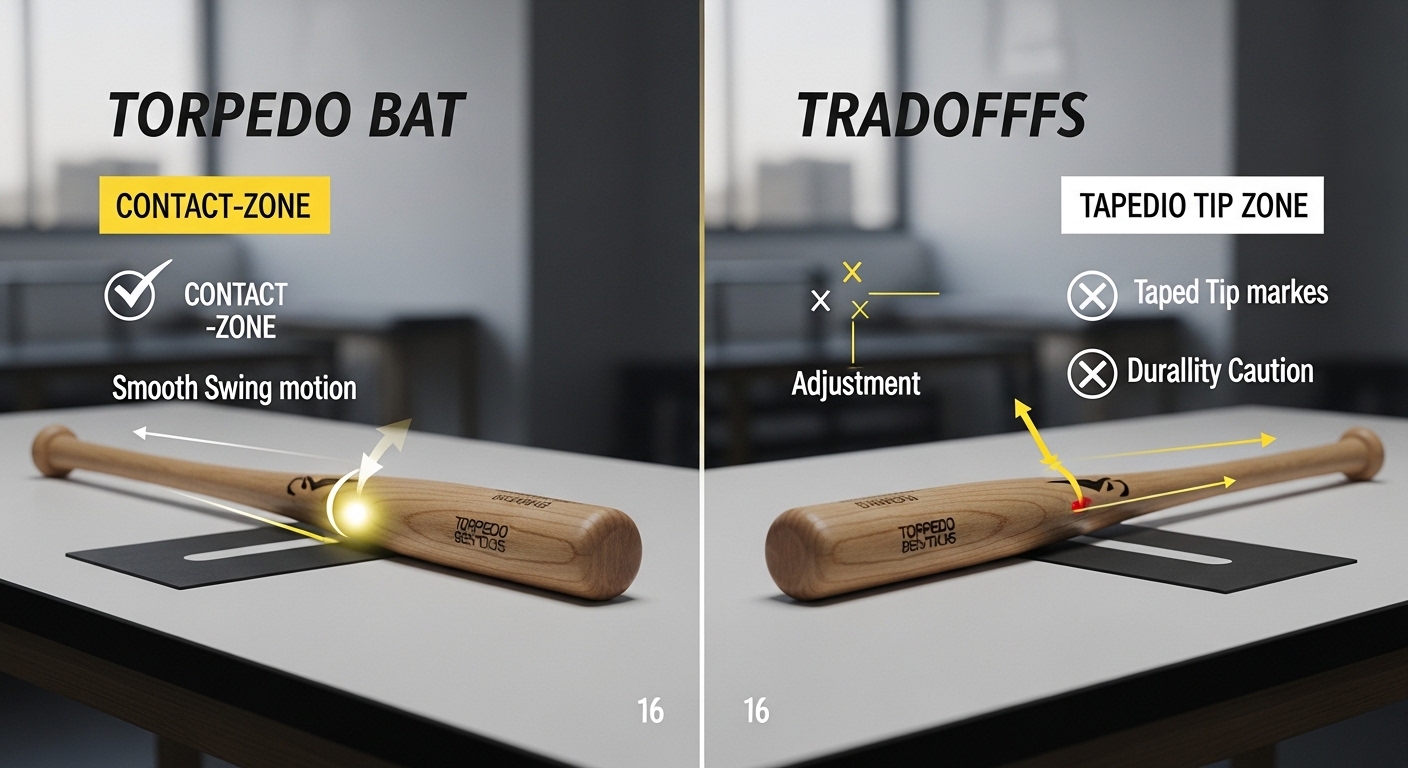
| Cold weather < 60°F | Safe — wood handles any temperature | Risk — composite can crack below 60°F | Wood torpedo wins clearly |
| Durability | Breaks — 3–15 games per bat | Better — 1–2 seasons; can crack if misused | Composite more durable than wood |
| Sound on contact | Crack — classic wood | Composite thud/pop — softer than alloy | Preference only |
| Feel philosophy | Stiff, honest — teaches correct contact | Smooth, forgiving — larger margin for error | Wood better for development; composite for feel |
| Price | $80–$200 per wood bat | $300–$500+ for composite BBCOR torpedo | Wood torpedo much cheaper upfront |
| Long-term season cost | $200–$600/season (replacement breaks) | $200–$300/season (amortised) | Roughly equal long-term |
| League eligibility | Wood-bat leagues only | BBCOR leagues — high school, college | Composite wins for BBCOR play |
| Training feedback quality | Superior — punishes mishits, rewards clean contact | Good — forgiving; some feedback lost | Wood torpedo better training tool |
Three rows that define this comparison: Cold weather (wood wins — composite can crack below 60°F), Sweet spot size (composite wins — engineered barrel flex widens the productive zone), and Training feedback (wood wins — stiff feel teaches correct contact habits faster). The performance row at the BBCOR ceiling is a wash — both hit 0.500.
🎯 The Sweet Spot Question: Composite Engineering vs. Torpedo Geometry
One of the most frequent questions: does composite's larger sweet spot make it a better choice for contact hitters, or does the torpedo geometry achieve something equivalent in wood construction?
🔷 How Composite Achieves a Larger Sweet Spot
Composite bats achieve larger sweet spots through two mechanisms:
- Engineered barrel flex: The barrel walls flex on contact, distributing energy transfer more broadly across the barrel face — making off-centre hits feel and perform better.
- Barrel geometry engineering: Composite construction allows larger barrel diameters and longer barrel lengths within BBCOR limits than solid wood typically achieves.
The result: contact 1–2 inches away from the optimal sweet spot still produces good exit velocity and feel.
🔴 How Torpedo Geometry Widens the Sweet Spot in Wood
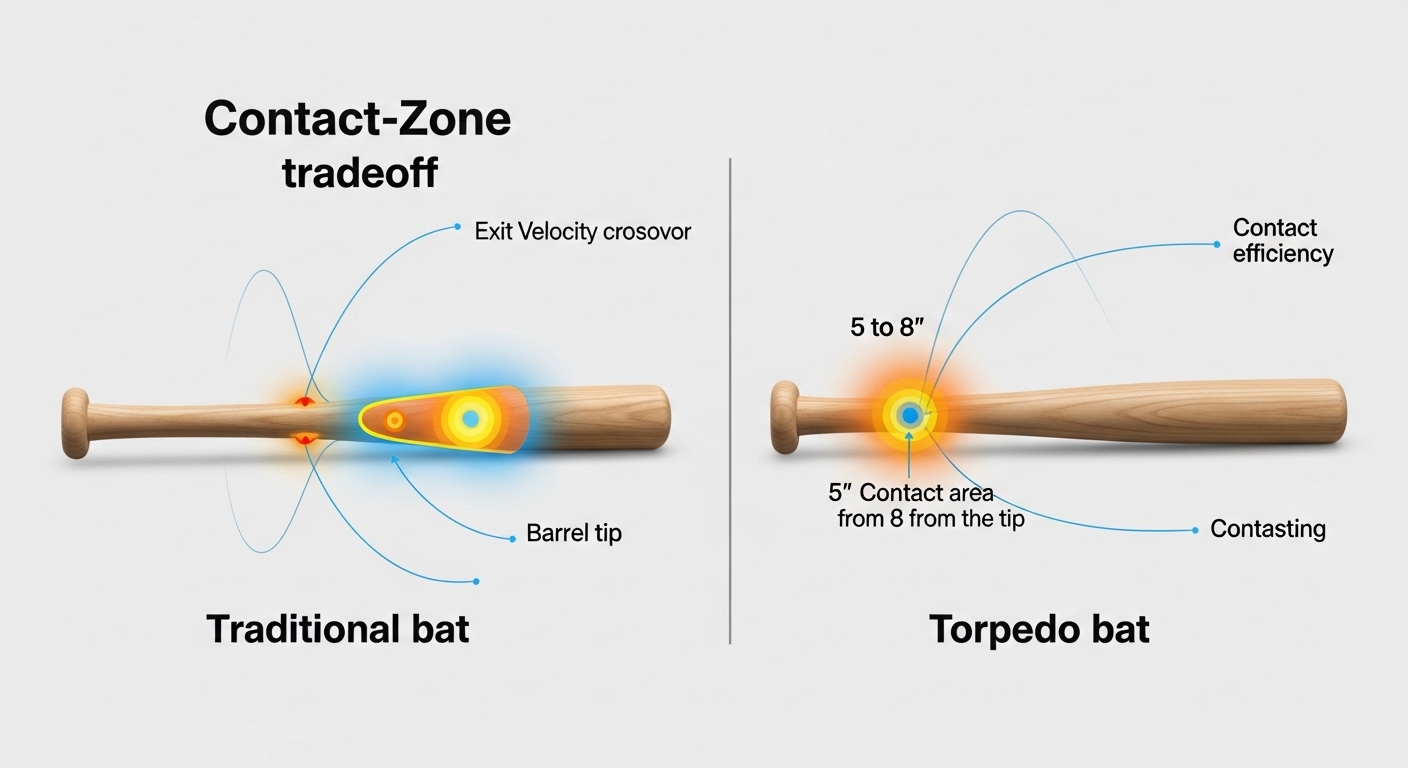
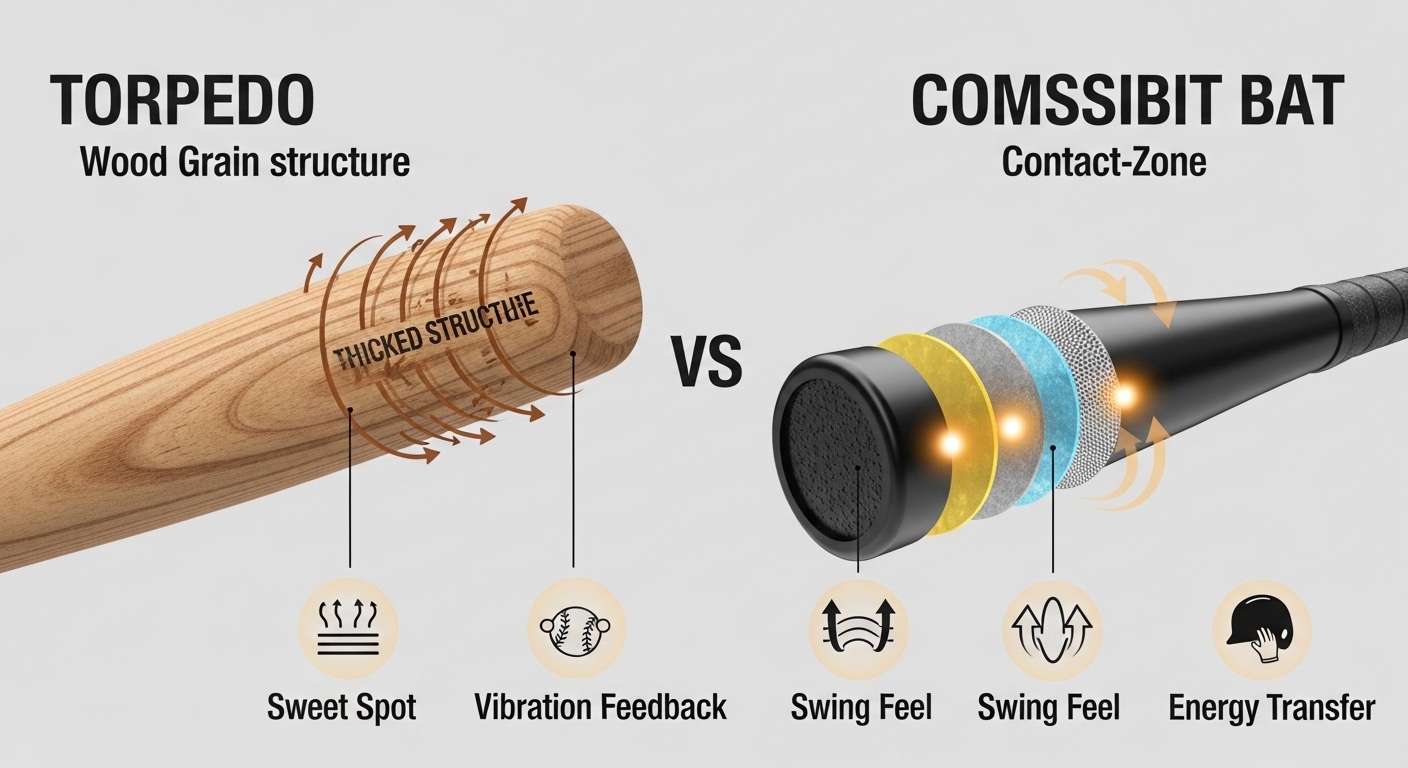
Alan Nathan's simulation finding — that the torpedo bat's high collision efficiency zone is wider than a traditional bat's — is a geometry-driven result independent of material.
- By concentrating mass at the contact zone and shifting vibration nodes toward that zone, the torpedo design produces a broader region of high eA along the barrel.
- This sweet spot widening works in wood just as it does in composite or alloy construction — the physics of mass placement and vibration node migration apply to solid wood the same way.
The torpedo wood bat's sweet spot is wider than a traditional wood bat's, but likely narrower than a well-engineered composite bat's engineered flex sweet spot.
🔄 The Break-In Period: Modern Composites vs. Traditional Wisdom
The "composite bats need 150–200 hits to break in" advice was accurate for earlier composite designs and remains accurate for many USSSA bats. For modern BBCOR composites, the picture has changed.
| Composite Bat Type | Break-In Required? | Swings to Peak | Source / Note |
|---|---|---|---|
| Modern BBCOR composite (Easton Ghost, Rawlings Icon, etc.) | No — hot out of wrapper | 0 (game-ready) | Easton and Miken: modern carbon fiber engineering eliminates break-in requirement. Manufacturers tune composites to BBCOR ceiling from factory. |
| Older composite designs (pre-2022) | Yes — required | 150–200 hits | Traditional protocol: rotate bat 1/4 turn per swing, mix tee/soft toss/BP, avoid cold weather during break-in, no max-effort swings early. |
| USSSA composite (travel ball) | Yes — most designs | 100–200 hits | USSSA bats are tuned hotter — trampoline effect is more pronounced and more sensitive to break-in. Cold weather break-in especially damaging. |
| Composite torpedo (BBCOR) — modern | Likely no — check manufacturer | 0 if modern design | Apply same rule as composite type: check whether manufacturer specifies break-in. Most 2024–2025 premium BBCOR composites do not require it. |
| Wood torpedo | None — always ready | 0 | Solid wood has no break-in requirement by definition. The bat performs at its full potential from the first swing. |
❄️ Cold Weather: The Composite Torpedo's Biggest Weakness
The cold weather risk for composite bats is both real and frequently underweighted by players buying their first composite. Per HB Sports and Bat Digest, composite bats become brittle below approximately 60°F (15°C) because the carbon fiber polymer contracts and stiffens.
A cold baseball — which has a lower COR than a room-temperature baseball — hits the already-stiff composite barrel with higher effective hardness. The combination of a brittle barrel and a harder ball at the same swing speed creates disproportionate structural stress on the composite walls. The result: composite barrels can crack at temperatures that are perfectly safe for alloy or wood bats.
🎯 The practical rule: If you play outdoors in temperatures below 60°F, do not use a composite bat — torpedo or otherwise. Use an alloy torpedo or a wood torpedo. This single rule eliminates composite from consideration for cold-climate high school and college players playing spring ball and early fall season.
🎯 9-Scenario Decision Guide: Composite vs. Wood Torpedo
❓ Frequently Asked Questions: Torpedo Bat vs. Composite
Gallery