Torpedo Bat Components: A Complete Breakdown of Every Part
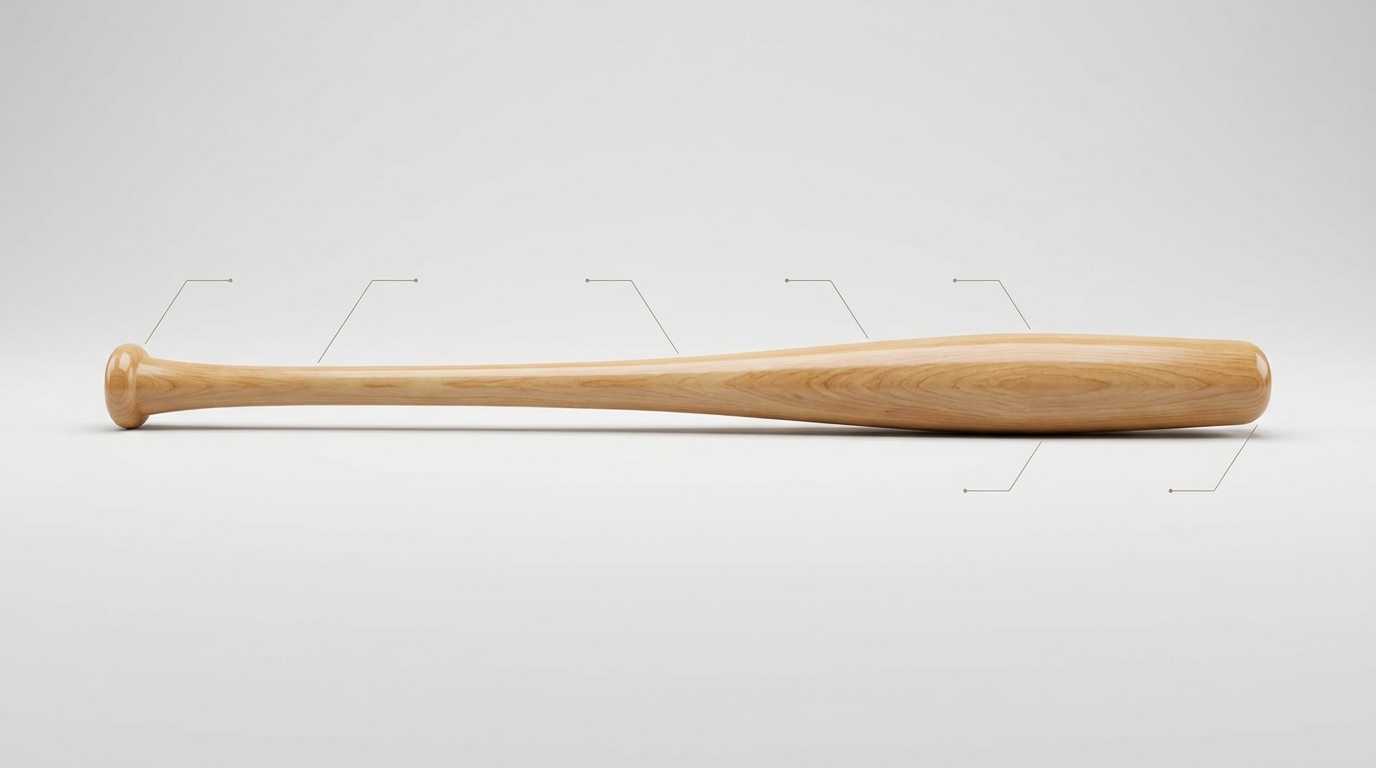
A torpedo bat looks unusual — that bowling-pin silhouette stops people in their tracks. But look past the shape, and you'll find a bat built from the same components as every other wood bat in baseball: a knob, a handle, a taper, a barrel, and an end cap.
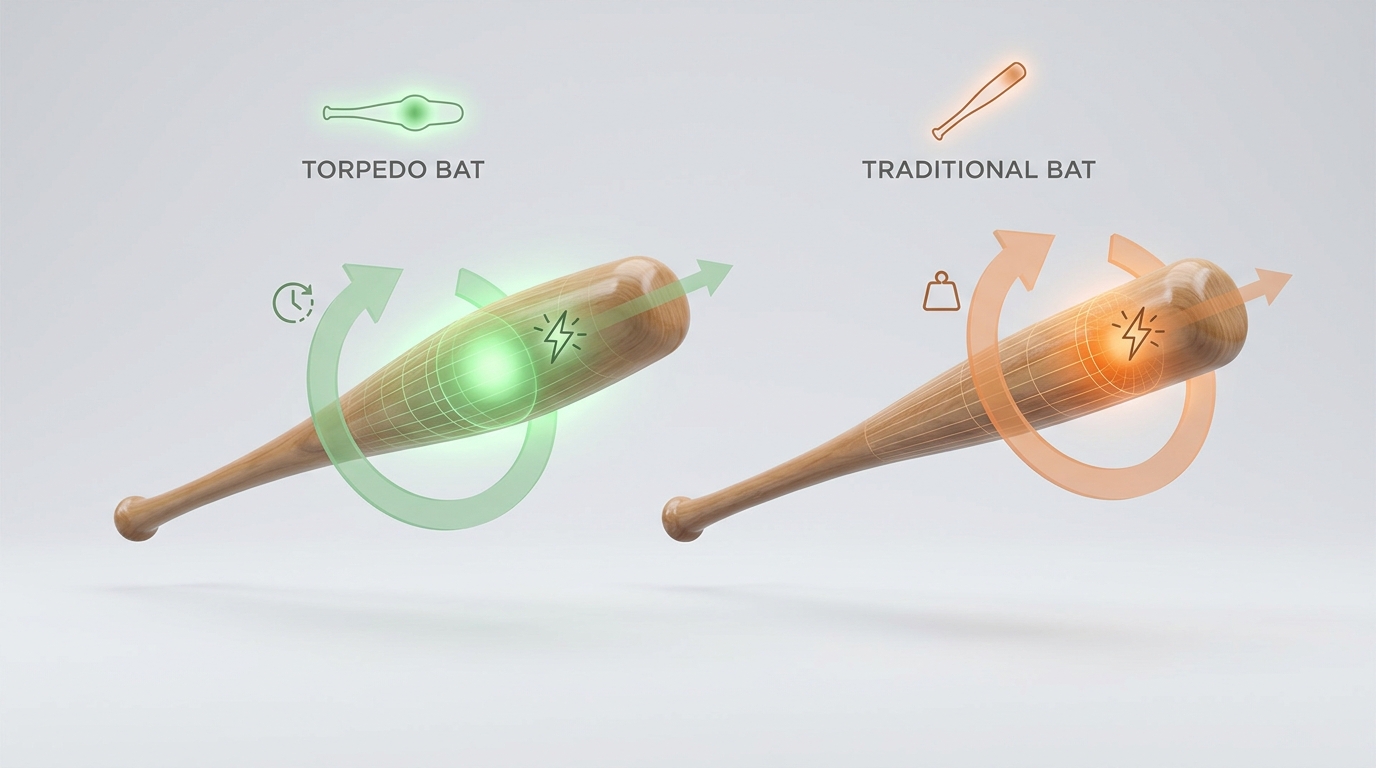
What makes a torpedo bat different is not which components it has. It's what each component does, how each is measured, and how the interplay between them creates the performance advantage.
All specifications reference MLB-grade wood bat standards. Dimensions vary slightly between manufacturers and individual player builds.
Torpedo Bat vs. Traditional Bat: Full Specs Comparison
| Component | Traditional Bat | Torpedo Bat | Performance Impact |
|---|---|---|---|
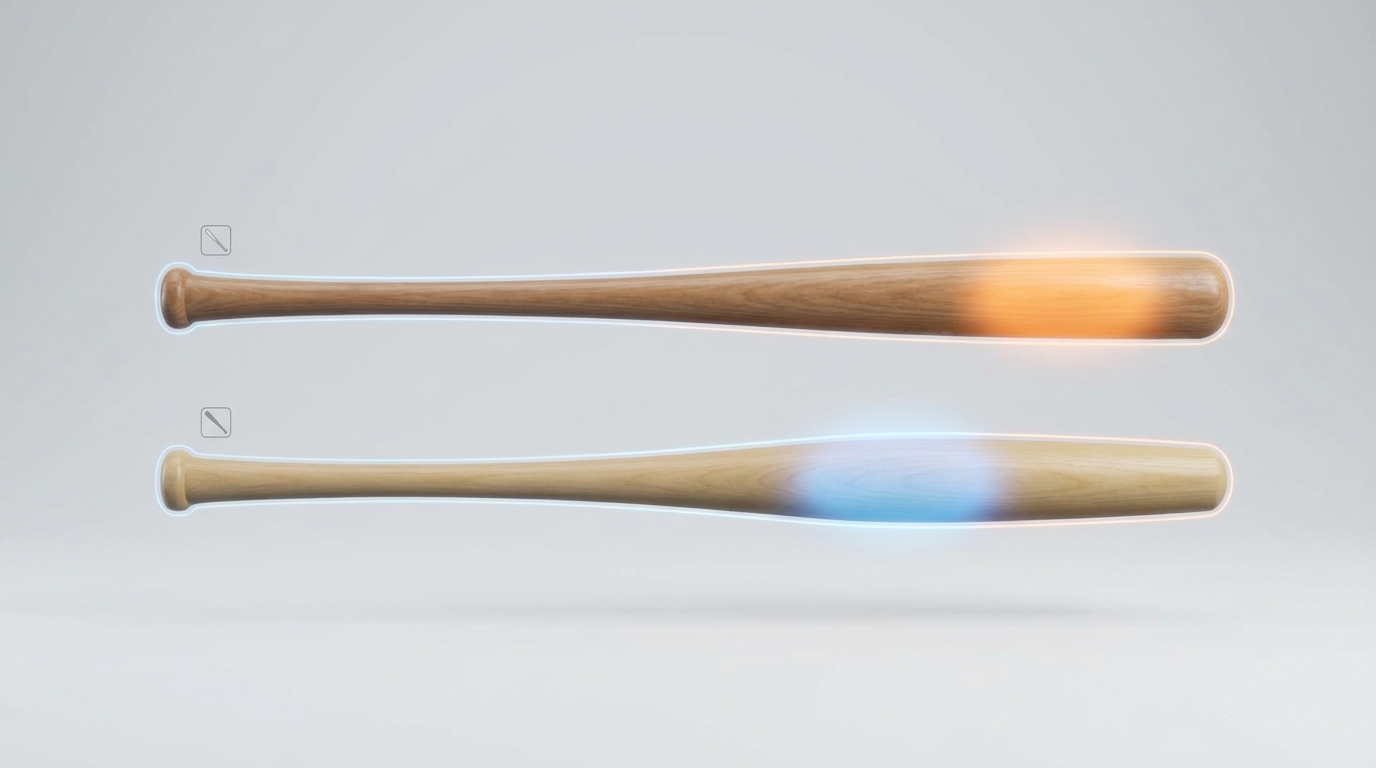
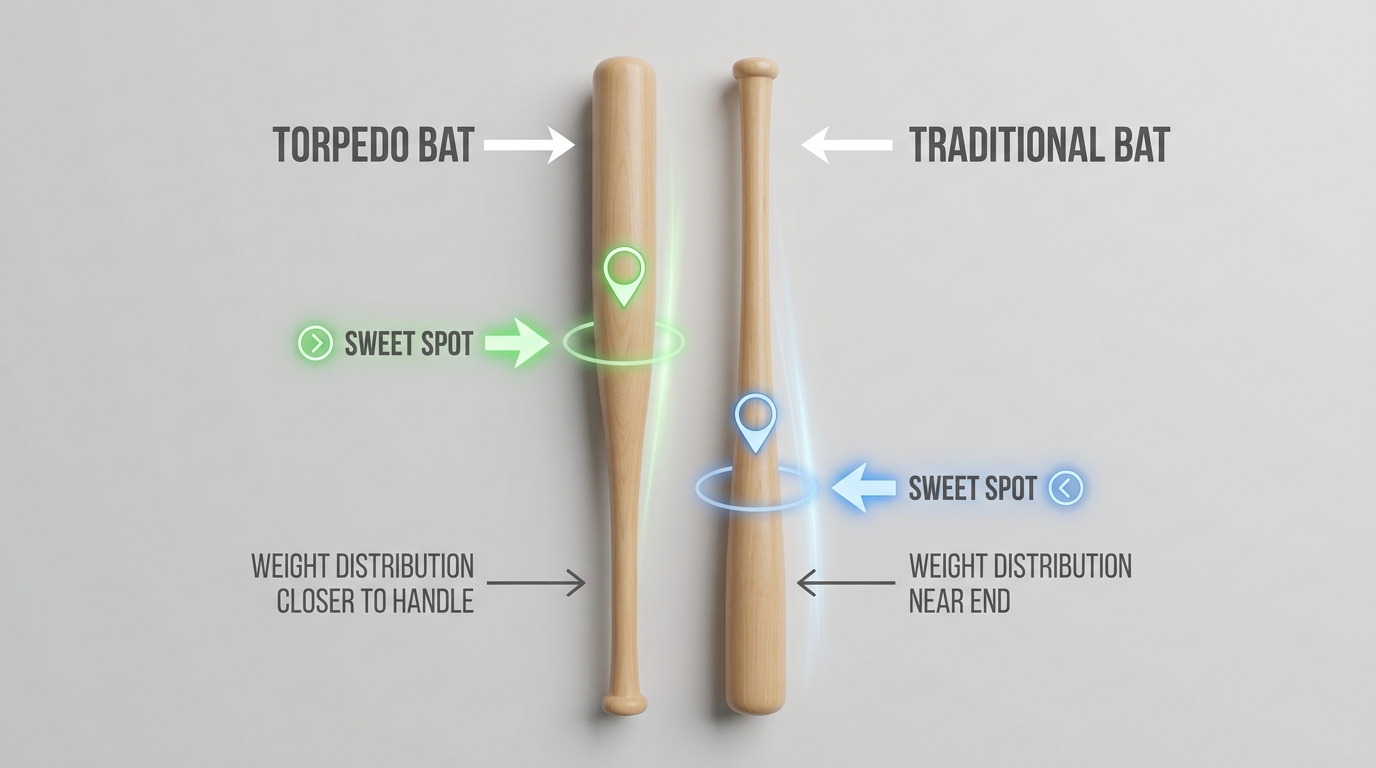
| Barrel Max Diameter | At or near tip | 6–8" from tip | ↑ Sweet spot at contact zone |
| Barrel Taper Profile | Widens end-to-end | Widens then narrows | Creates bowling-pin shape |
| End Cap Area | Heaviest zone | Tapered, lighter | ↓ MOI → ↑ Swing speed |
| Handle Diameter | ~0.93–1.00" | ~0.93" (unchanged) | No change in grip feel |
| Knob Style | Standard/Flared | Standard/Flared | Player preference |
| Overall Length | Up to 42" | Up to 42" (same) | Rule 3.02 compliant |
| Wood Species | Maple, ash, birch | Maple, birch (common) | Density drives pop |
| Manufacturing Method | Lathe + standard template | CNC + player swing data | Millimeter precision |
01 The Barrel — The Heart of the Design
The barrel is the widest, heaviest section of any wood bat — the place where the ball is meant to be hit. On a torpedo bat, the barrel behaves differently.
How the Torpedo Barrel Works
The torpedo barrel reaches its maximum diameter — typically around 2.45 to 2.50 inches — approximately 6 to 8 inches from the end cap. After that peak, the barrel intentionally narrows back down before reaching the tip.
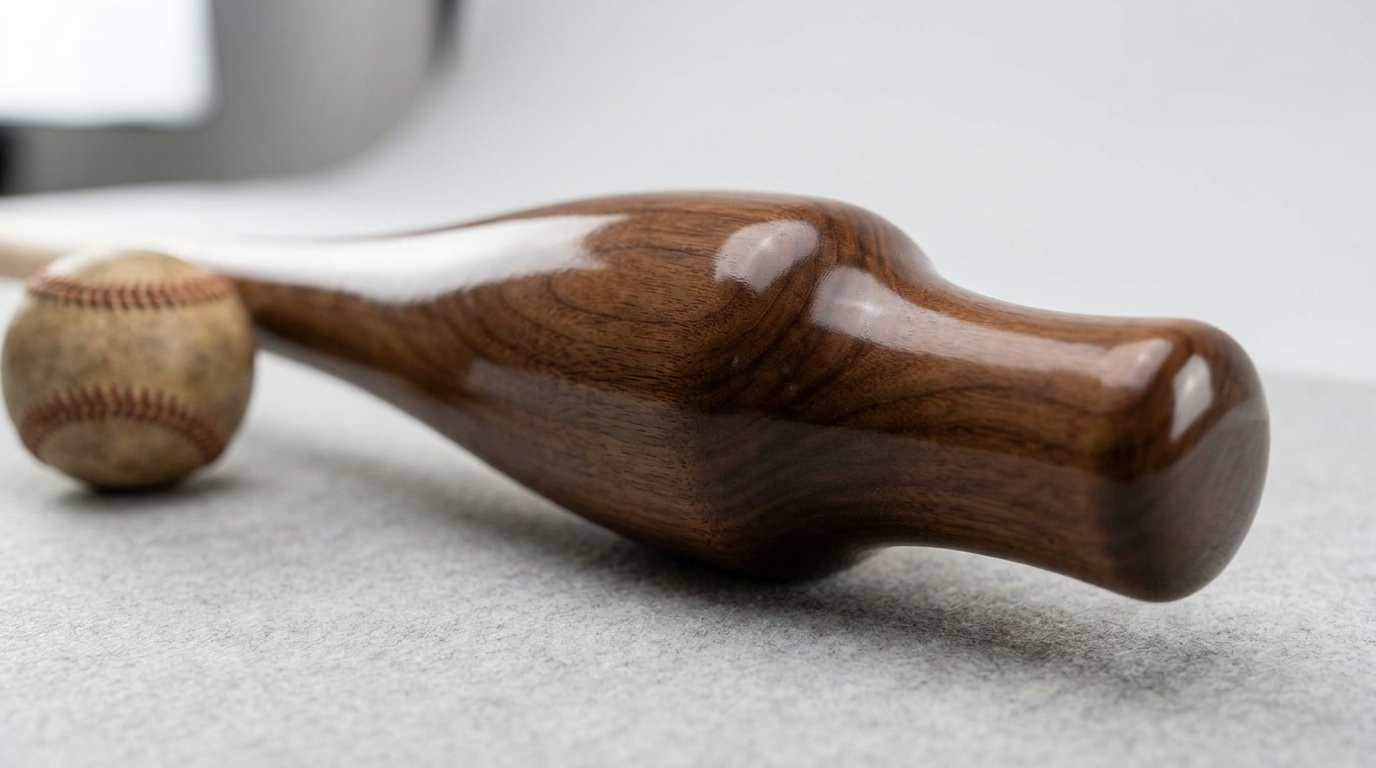
This is the defining feature of the torpedo design: the barrel swells and then tightens again, creating the distinctive bowling-pin shape visible on the bat. This is not decorative. Every inch of that profile is engineered around a specific piece of information: where, on the barrel, does this particular player make contact?
Torpedo Barrel Zone: The Custom Contact Point
Louisville Slugger's torpedo model (TPD1) is manufactured using a CNC machine loaded with thousands of individual measurements, allowing the barrel's peak diameter to be positioned to the millimeter based on a player's swing data.
"Not only are players getting a knob style, handle thickness and taper and swing weight to their choosing, but also a sweet spot that's perfectly crafted to match their unique swing."
— Louisville SluggerThe End Taper
Once the barrel reaches its maximum diameter, it tapers back toward the end cap. This is the "reverse taper" that gives the torpedo its bowling-pin appearance. The amount of wood removed from this end zone is redistributed (in effect) toward the contact zone — lowering overall MOI while keeping total bat weight within the player's preferred range.
Precision matters: Too aggressive and the bat weakens structurally near the tip; too subtle and the mass redistribution loses its effect.
02 The End Cap — The Tip That Changed
Non-Cupped vs. Cupped End Cap
Like traditional wood bats, torpedo bats can be ordered with either a flat end cap or a cupped end — a small hollowed-out indentation at the tip. Cupped ends remove a small amount of weight from the very tip of the bat, reducing swing weight slightly.
Given that torpedo bats already redistribute mass away from the tip through their barrel taper, many torpedo users prefer a non-cupped end to avoid over-thinning that zone. However, player preference determines the final spec.
Structural Importance at the Tip
Because the torpedo taper narrows before the end cap, the structural wood at the tip is thinner than on a traditional bat. This is a real durability consideration.
Manufacturers compensate with higher-density wood billets and premium finishing processes. A torpedo bat hit repeatedly off the very end — where the barrel has narrowed — is more vulnerable to damage at that location than a traditional bat hit in the same spot.
Practical note: The torpedo's thinner end is one reason Tater Baseball recommends their torpedo model be swung at a Drop 2 weight — slightly heavier than standard — to reduce breakage risk at the narrowed tip.
03 The Taper Zone — Where Handle Meets Barrel
Torpedo Taper: Two Transitions Instead of One
A torpedo bat's taper zone is more complex. There are effectively two transitions:
- The conventional handle-to-barrel taper that widens toward the contact zone
- The reverse taper that narrows again toward the end cap
The steepness and positioning of both transitions are engineered to achieve a specific mass distribution profile and MOI outcome.
Taper Type and Player Feel
The taper profile significantly affects how the bat feels in the hands at contact:
Barrel "arrives" smoothly in the zone; preferred for fluid swings
Defined "shelf" before fat barrel; preferred for distinct feedback
04 The Handle — Unchanged, But More Important
Handle Diameter Specs
Handle diameter is typically measured at the thinnest point of the handle. In torpedo bats, handle specifications are largely unchanged from traditional designs:
- Thin handle: ~0.90 to 0.92" — preferred by power hitters for whip; more breakage risk
- Medium handle: ~0.93 to 0.95" — most common across MLB; balance of flex and durability
- Thick handle: ~0.96 to 1.00" — maximum durability; preferred by players who get jammed frequently
Phoenix Bats lists a standard torpedo handle at 0.93 inches — falling in the medium range, consistent with the most common MLB handle spec.
Handle and MOI: A Subtle Connection
While the handle itself doesn't change in the torpedo design, its role in MOI becomes more significant. Because barrel mass has been shifted toward the handle-side of the bat, the transition point where handle mass meets barrel mass is relocated.
This affects the bat's balance point — the center of mass — which typically shifts slightly toward the handle on torpedo bats compared to traditional models. Players who pick up a torpedo bat cold often remark it feels "lighter" or "more balanced," even when the total weight is identical to their standard bat.
05 The Knob — The Foundation of Grip and Control
Knob Styles
On torpedo bats, the knob is manufactured to the same specifications as traditional wood bats — this component is unchanged by the torpedo design philosophy.
Some players combine torpedo barrels with bell knobs to maximize the sense of control and the proximal weight distribution. This pairing amplifies the "lighter feel" effect.
06 Wood Species — The Raw Material
Before any lathe or CNC machine touches the wood, the most fundamental component decision is already made: what species of wood will the bat be made from?
| Wood | Hardness | Flexibility | MLB Use | Best For | Break Style |
|---|---|---|---|---|---|
| Maple | Very High | Low (stiff) | ~65% | Power hitters | Shatters / explodes |
| Birch | High (hardens w/ use) | Medium | ~25% | Contact + power | Cleaner break |
| Ash | Medium | High (flexible) | ~10% | Contact hitters | Flakes/splinters |
Why Maple Dominates Torpedo Bat Production
Approximately 65% of MLB players use maple bats, and the torpedo design has followed that trend. Maple's high density and surface hardness make it ideal for a design that concentrates mass in a narrower zone — dense wood achieves the needed mass in a smaller volume than softer species.
This is especially important in the torpedo's peak contact zone, where maximum wood mass must be packed into the appropriate barrel region without exceeding the 2.61-inch diameter limit.
Birch's Growing Role
Birch has become the fastest-growing species in professional baseball, and it's particularly well-suited to the torpedo design for contact-oriented hitters. Birch starts with high hardness (comparable to maple) but adds natural flex — meaning it's more forgiving on the off-barrel contacts that torpedo bats are designed to handle better.
Its lighter density also makes it easier to achieve the desired bat weight in the torpedo profile without the bat becoming too heavy at the contact zone.
Quality Standards: Ink Dot & Finishing
Ink Dot Certification: All MLB-grade maple and birch bats — including torpedo bats — must pass the ink dot test, which has been required since 2008. An ink dot is applied to the unfinished handle, revealing the slope of grain in the wood. MLB mandates a maximum slope of grain deviation of ≤3 degrees.
Bone Rubbing & Finishing: Most professional torpedo bats undergo bone rubbing — a process in which the bat is repeatedly compressed along its surface with a hard bone or bone-like material. This compresses the outer wood fibers, making the surface harder and more resistant to denting or damage at contact. Major manufacturers including Marucci and Victus apply proprietary finishes (PRO-X and ProPACT respectively) that build on this bone-rubbing process.
How a Torpedo Bat Is Manufactured
Understanding the components is only half the story. How those components are produced — especially for a design this precise — matters.
Billet Selection
A billet is a cylindrical core of wood, typically 37 inches long and 2.75 inches in diameter, cut from a single tree. Billets for torpedo bats are selected with extra care for density and grain consistency, since the mass redistribution requires that the wood in the contact zone be as dense and structurally uniform as possible. The billet is weighed and ink-dot tested before any turning begins.
CNC Precision Turning
Traditional wood bats are turned on a lathe using a template that craftsmen compare the billet against manually. Torpedo bats — at least at the MLB level — are manufactured on CNC (Computer Numerical Control) machines loaded with the player's specific measurements. Louisville Slugger describes this as holding "thousands of measurements, allowing the bat to be precisely shaped down to the millimeter."
Finishing, Hardening, and Quality Control
Once turned, the bat undergoes bone rubbing, paint and decal application, proprietary hardening treatments, and UV light curing (in Louisville Slugger's process). A final quality check verifies diameter measurements against the player's spec and MLB's Rule 3.02 requirements. Only bats that pass both make it to the clubhouse.
Frequently Asked Questions: Torpedo Bat Components
What is the maximum barrel diameter on a torpedo bat?
MLB Rule 3.02 sets the maximum at 2.61 inches for any wood bat. Torpedo bats at the professional level typically run 2.45 to 2.50 inches at their widest point — the same range as many traditional MLB bats. The difference is not the maximum diameter but where that maximum sits on the barrel.
Does the torpedo bat use a different handle than a standard bat?
No. The handle specifications on torpedo bats are the same as traditional wood bats — typically in the 0.90 to 1.00 inch range, with 0.93 inches being the most common in torpedo models. The torpedo's design changes are concentrated entirely in the barrel profile, not the handle.
What wood is best for a torpedo bat?
Maple is the most common choice at the MLB level due to its density and hardness — essential qualities for packing maximum mass into the torpedo's narrower contact zone. Birch is an excellent alternative, especially for contact hitters, because of its combination of high hardness and natural flex that adds forgiveness on off-barrel contact. Ash is less commonly paired with the torpedo profile in professional play.
Are torpedo bats more likely to break than standard bats?
The narrowed end section — where the barrel tapers back before the end cap — is structurally thinner than on a traditional bat. Contact made at the very tip of a torpedo bat carries a higher breakage risk at that location. Professional manufacturers compensate with high-density wood selection, bone rubbing, and proprietary finishing. Players who tend to get jammed frequently or make end-of-bat contact regularly should discuss this tradeoff with their bat manufacturer.
How is a torpedo bat different from a cupped bat?
A cupped bat has a small hollowed-out indentation at the barrel tip that removes weight from the very end — reducing swing weight slightly. A torpedo bat goes much further: it restructures the entire barrel profile, moving peak mass from the tip to the player's natural contact zone and narrowing the barrel again before the tip. A cupped bat makes a small incremental MOI adjustment; a torpedo bat makes a structural redesign. Some torpedo bats also include cupped ends in addition to the torpedo profile.
Gallery