Torpedo Bat Technology: The Complete Engineering Story
The torpedo bat's viral moment was Opening Day 2025 — nine home runs, a franchise record, a Twitter storm. But what made the Yankees' performance possible wasn't a single idea.
It was the convergence of five distinct engineering disciplines, each applied to a 150-year-old piece of wood with a precision the sport had never seen before.
If you've read our What Is a Torpedo Bat and How It Works guides and want to go deeper, this is where the engineering details live.
The Problem That Technology Had to Solve
Before examining the torpedo bat's engineering solutions, it helps to understand the technological failures of traditional bat manufacturing — because the torpedo bat is not just a new design. It is also a correction to a supply chain problem that was costing MLB hitters real performance.
A 2025 analysis by Marquee Sports Network revealed a startling finding: standard MLB bat shipments showed barrel mass variances of up to 1.5 ounces between bats of the same model. That discrepancy — invisible to the naked eye — translates directly to bat speed.
Research shows a 1.5-ounce difference in barrel mass produces a 4 to 5 mph swing speed difference. At a 1:1.2 ratio of bat speed to exit velocity, that's up to 6 mph of exit velocity lost — and the difference between a warning-track flyout and a home run.
"With shipments having as much as 1.5-ounce differences in barrel mass, that has been shown to significantly affect swing speed (4 to 5 mph), which could very well prevent a hitter from timing up a fastball in the first place."
— Marquee Sports Network analysis, April 2025
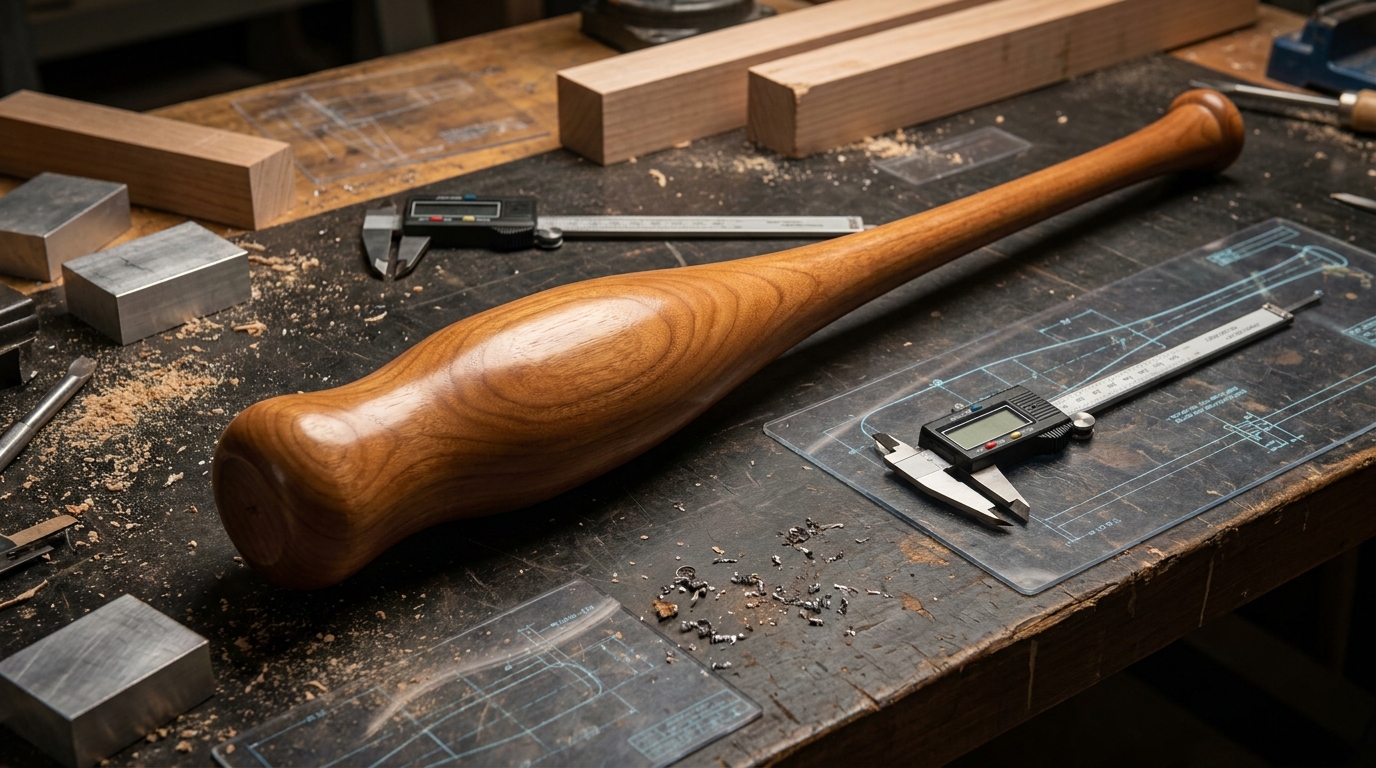
The torpedo bat's data-driven, CNC-manufactured approach doesn't just redesign the barrel — it eliminates this variance by replacing human template-matching with computer-controlled precision, holding measurements to the millimeter across every unit. For many players, the consistency gain alone may rival the design gain.
The Five Technology Dimensions of the Torpedo Bat
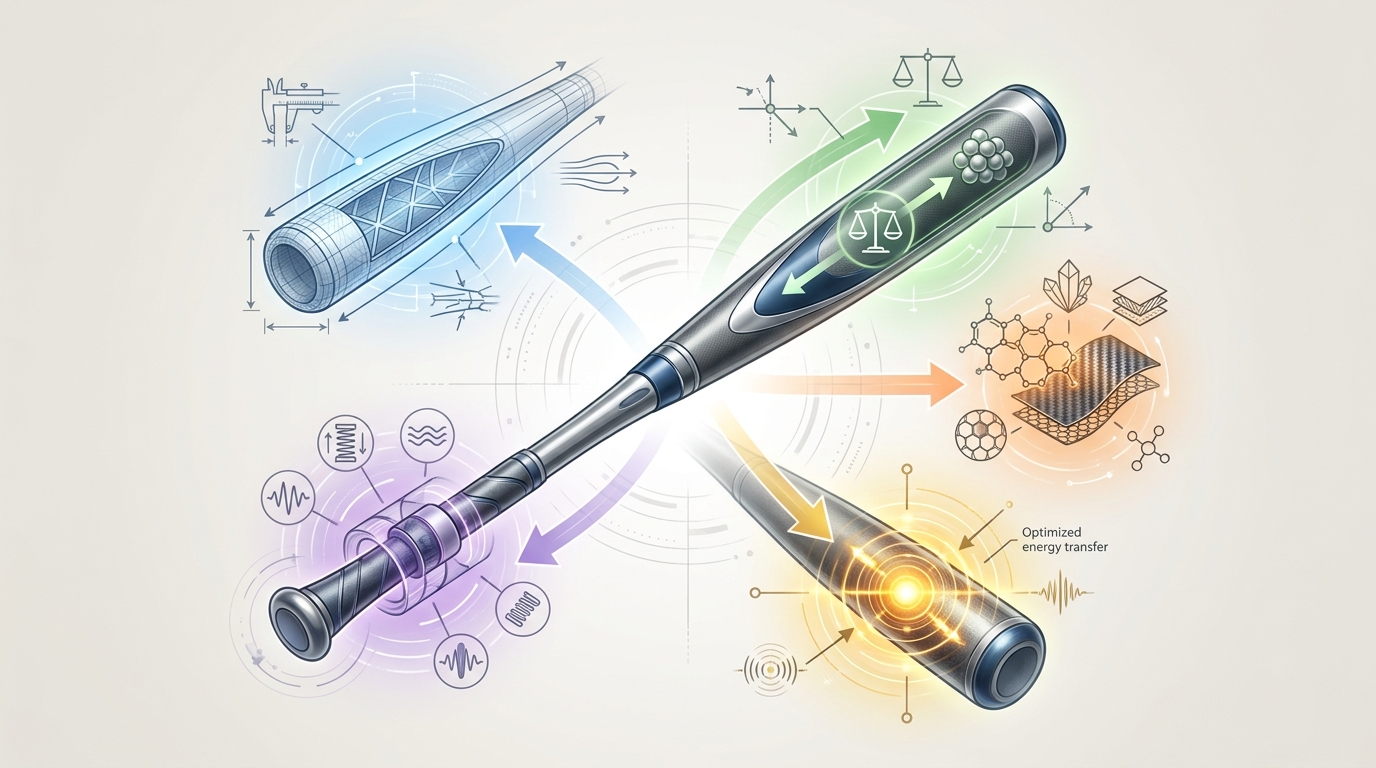
The torpedo bat is not defined by one engineering breakthrough. It is the product of five distinct technological disciplines working in concert. Here is how they fit together:
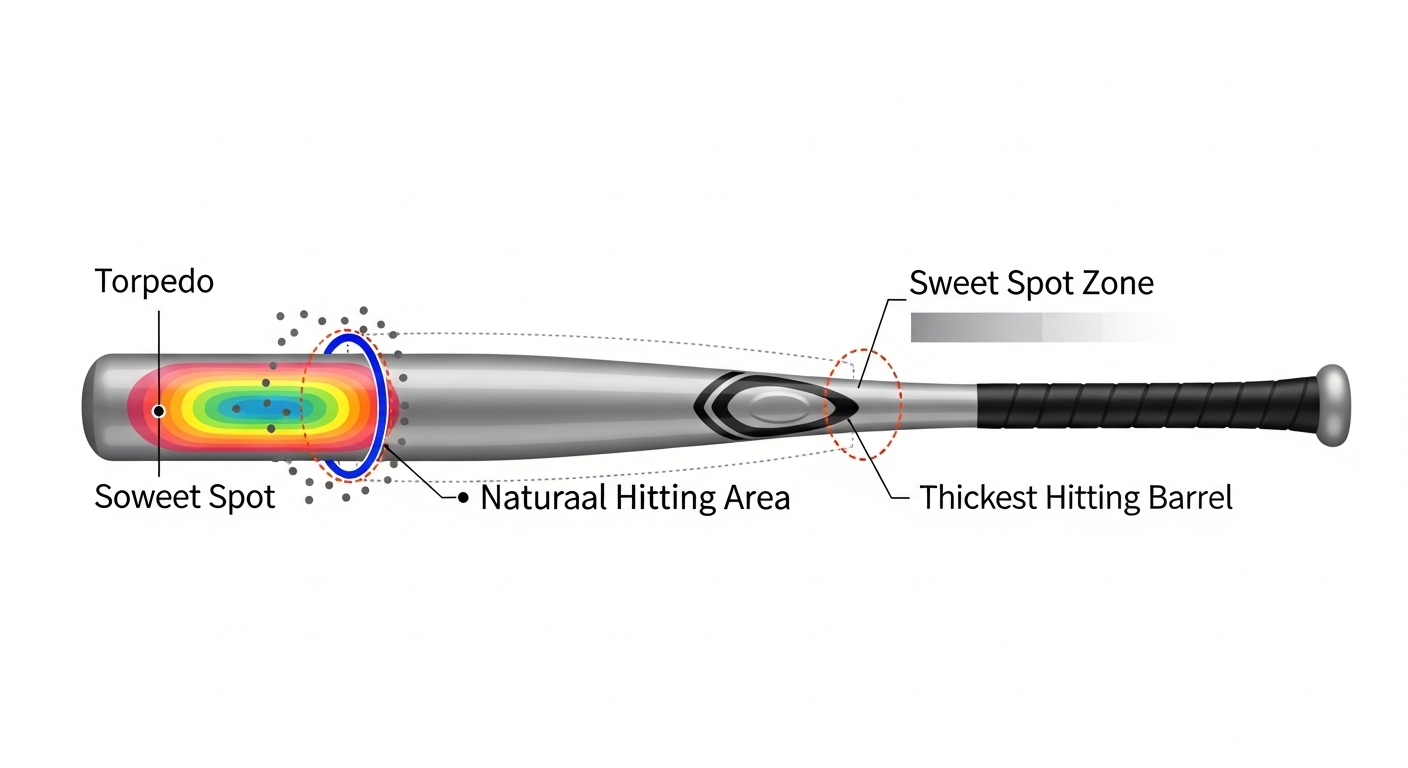
Barrel geometry is the most visible technology dimension — it's what gives the torpedo bat its bowling-pin silhouette. But the geometry is not decorative. It is the precise mathematical result of placing peak barrel diameter exactly at the player's natural contact zone, then calculating the forward and reverse taper slopes needed to maintain legal diameter limits and target bat weight simultaneously.
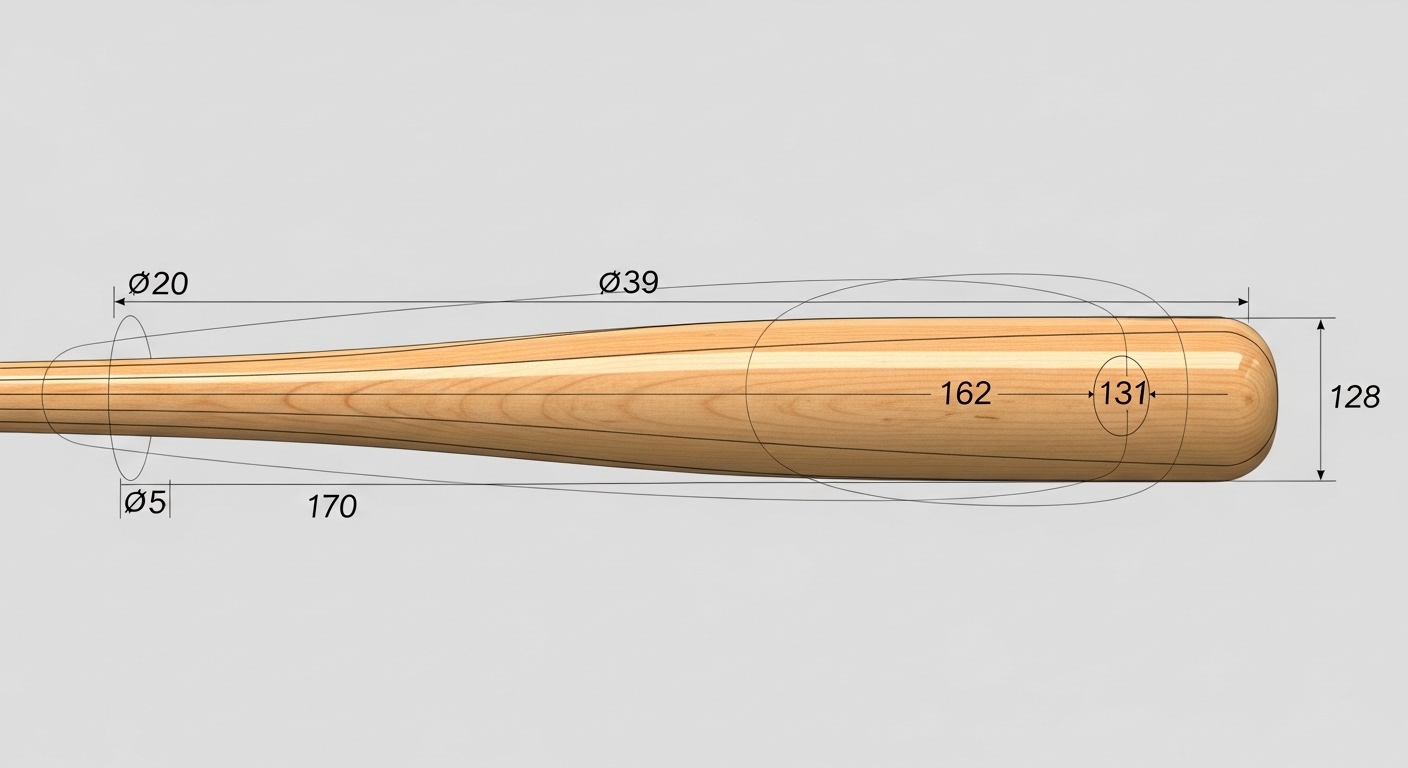
The torpedo barrel reaches maximum diameter — typically 2.45 to 2.50 inches — at a point 6 to 8 inches from the end cap, then tapers back down before the tip. Every millimeter of that profile is held by CNC machinery to tolerances impossible with traditional lathe-and-template methods.
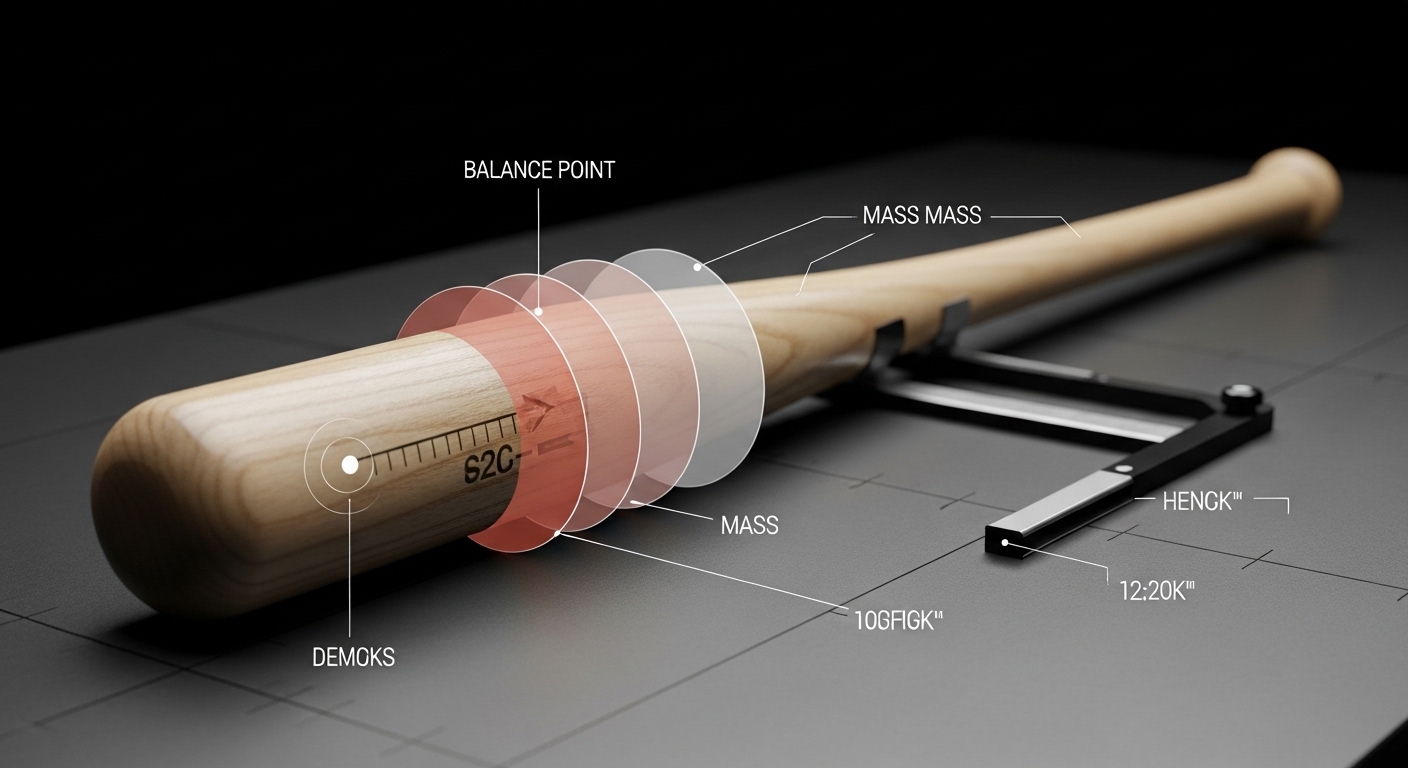
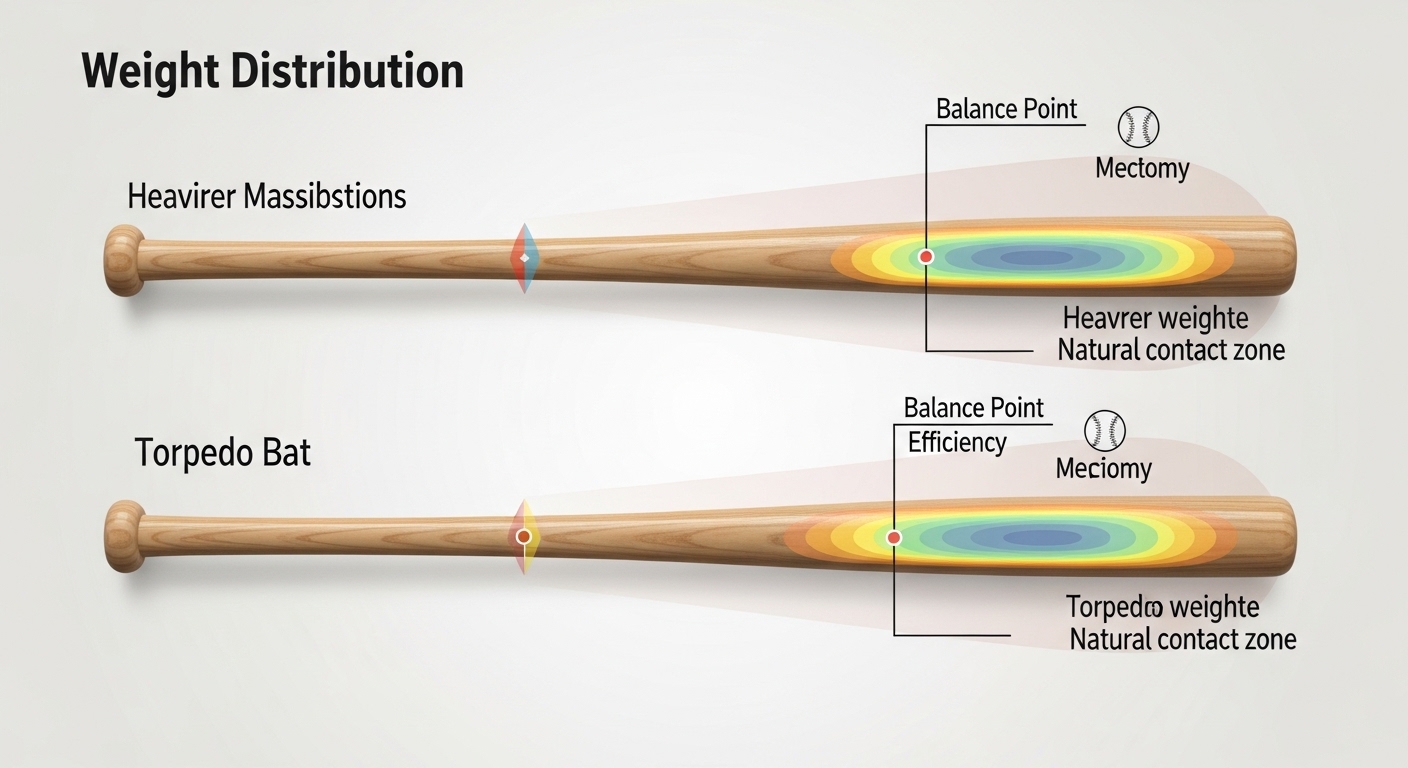
Weight distribution is the physics engine behind the torpedo bat's performance. Once barrel geometry defines where peak diameter sits, engineers calculate a precise "wood budget" — how much wood can be removed from the end zone, how much is added to the contact zone, and how the total weight stays within the player's preferred bat weight.
This calculation involves moment of inertia modeling, effective mass calculations, and center-of-mass targeting. The result is a bat whose balance point sits measurably closer to the hands — producing lower MOI, faster swing speed, and improved bat control without any change to overall bat length or weight.
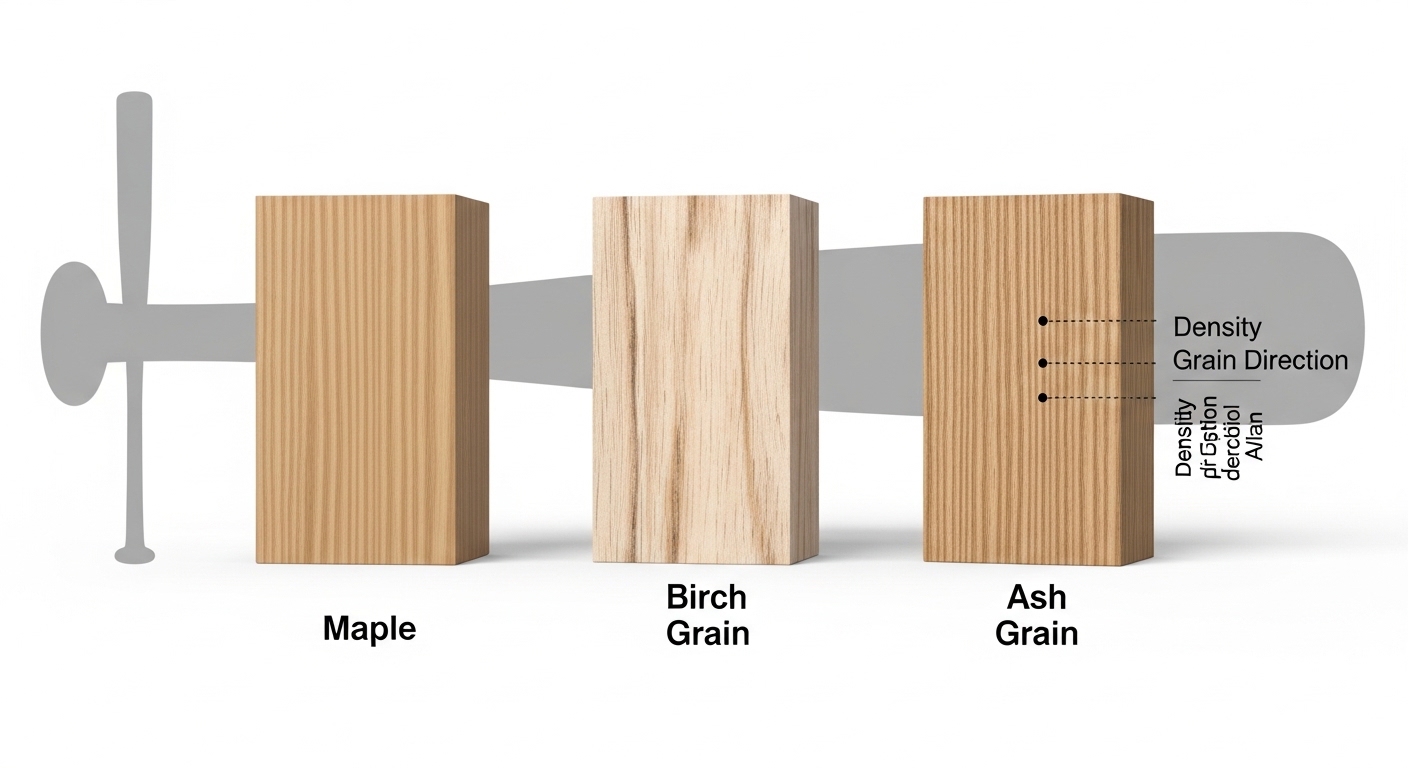
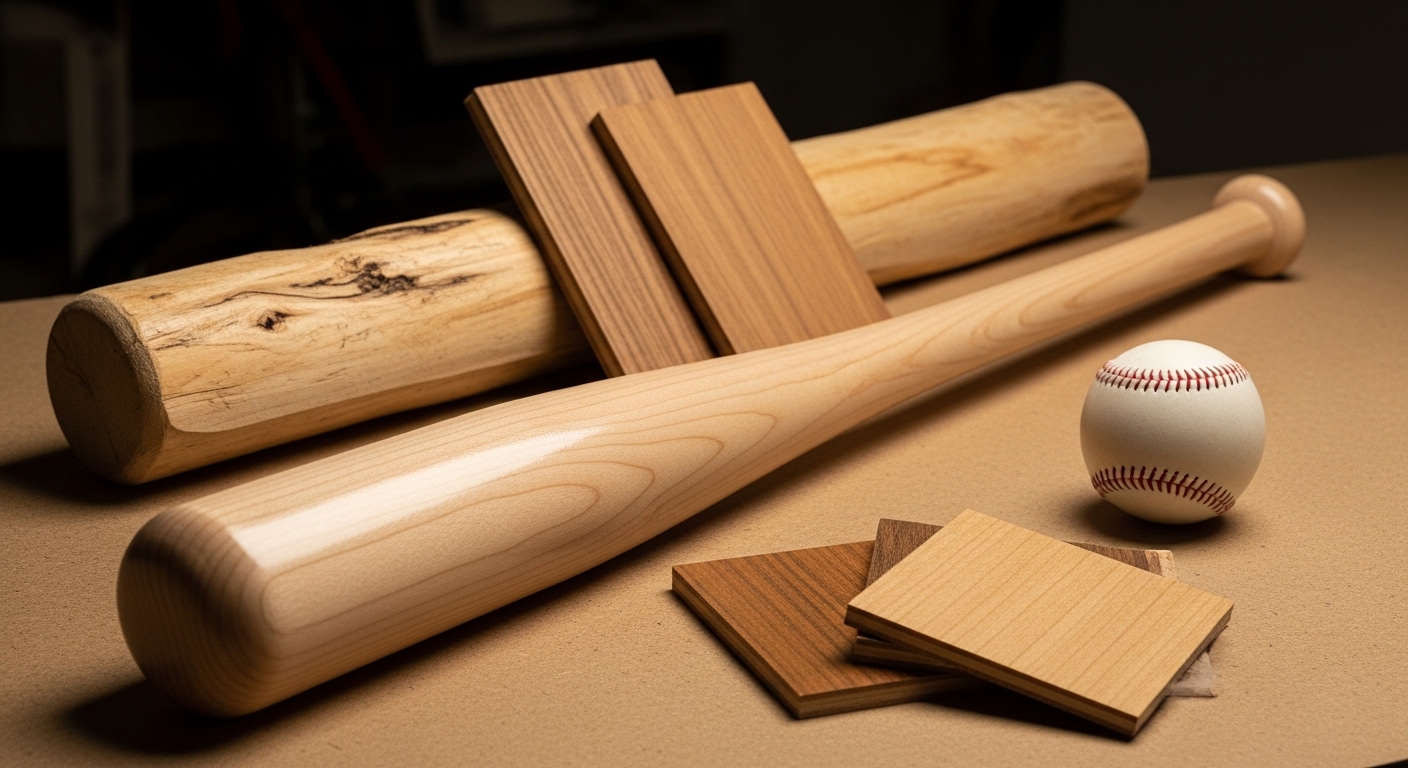
Deep dive: Weight DistributionThe torpedo bat's geometry makes demands of its materials that traditional bats do not face. Packing maximum wood mass into a narrower contact zone — while staying within diameter and weight limits — requires high-density billets with uniform grain structure.
Torpedo bat materials science also includes the finishing processes that protect the design's structural integrity: bone rubbing, PRO-X hardening (Marucci), ProPACT treatment (Victus), and UV curing. These are not cosmetic — they directly affect durability at the bat's narrowed end zone, which is the torpedo design's primary structural vulnerability.
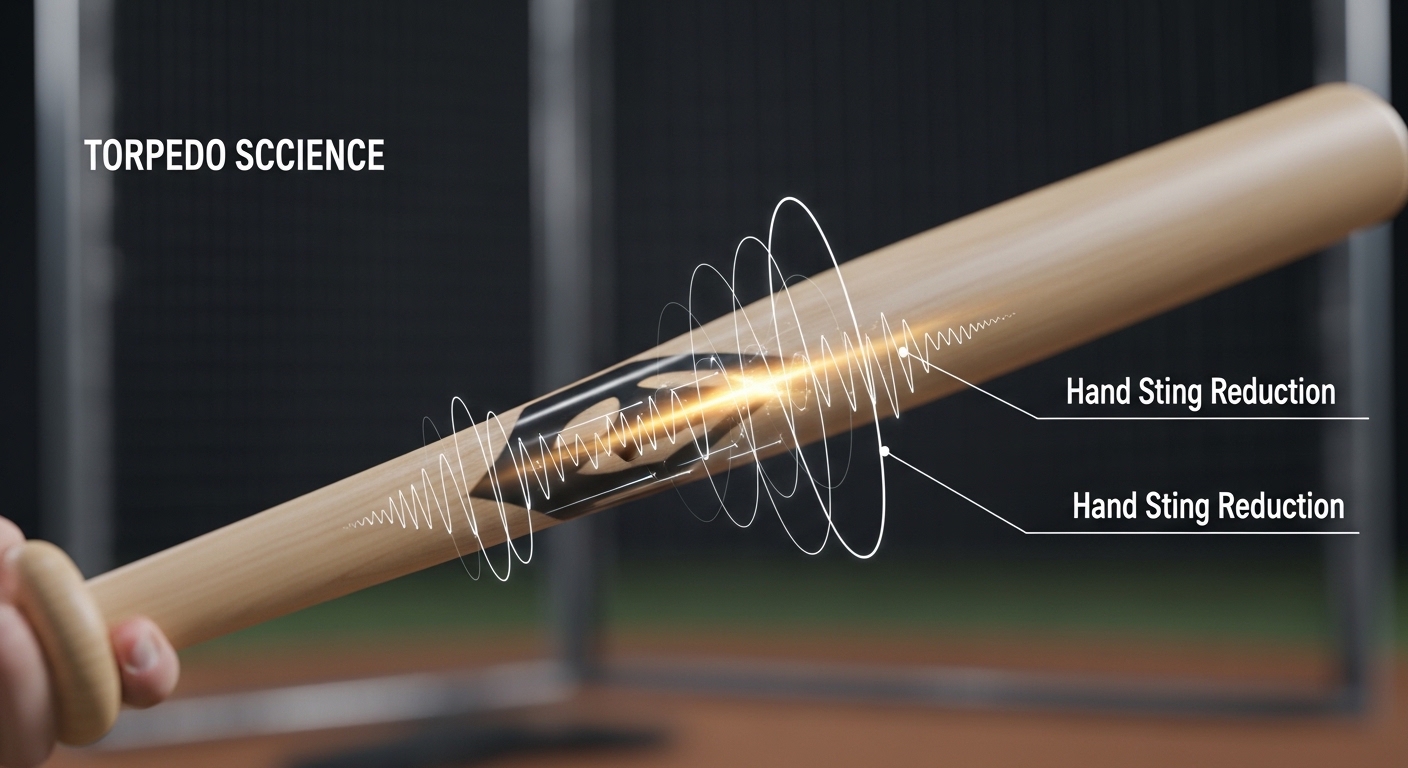
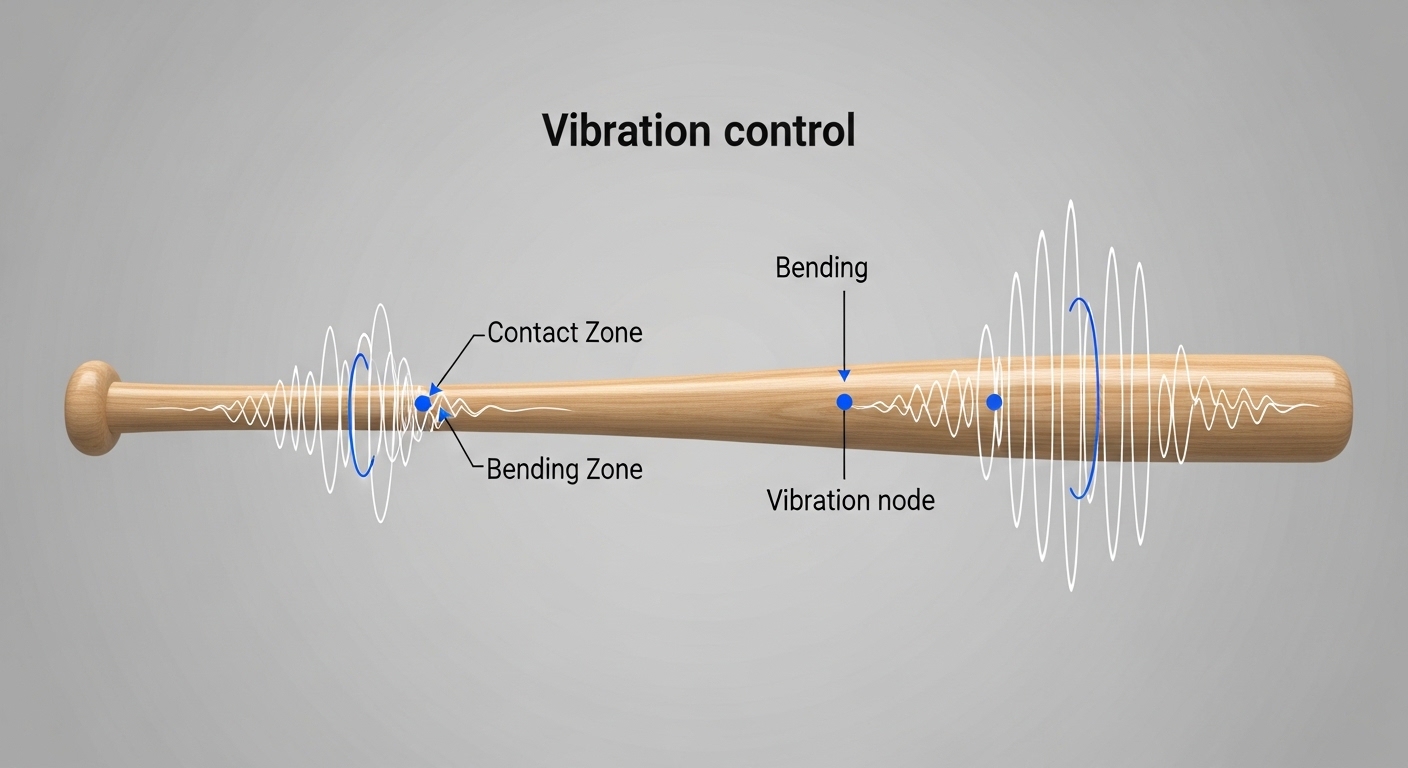
Deep dive: MaterialsThis is the least-discussed but arguably most elegant technology dimension. Every bat has bending vibration modes — patterns of oscillation triggered at the moment of contact. When the ball hits between vibration nodes, energy that should go into the ball is instead lost to bat vibration — and the hitter feels it as sting in the hands.
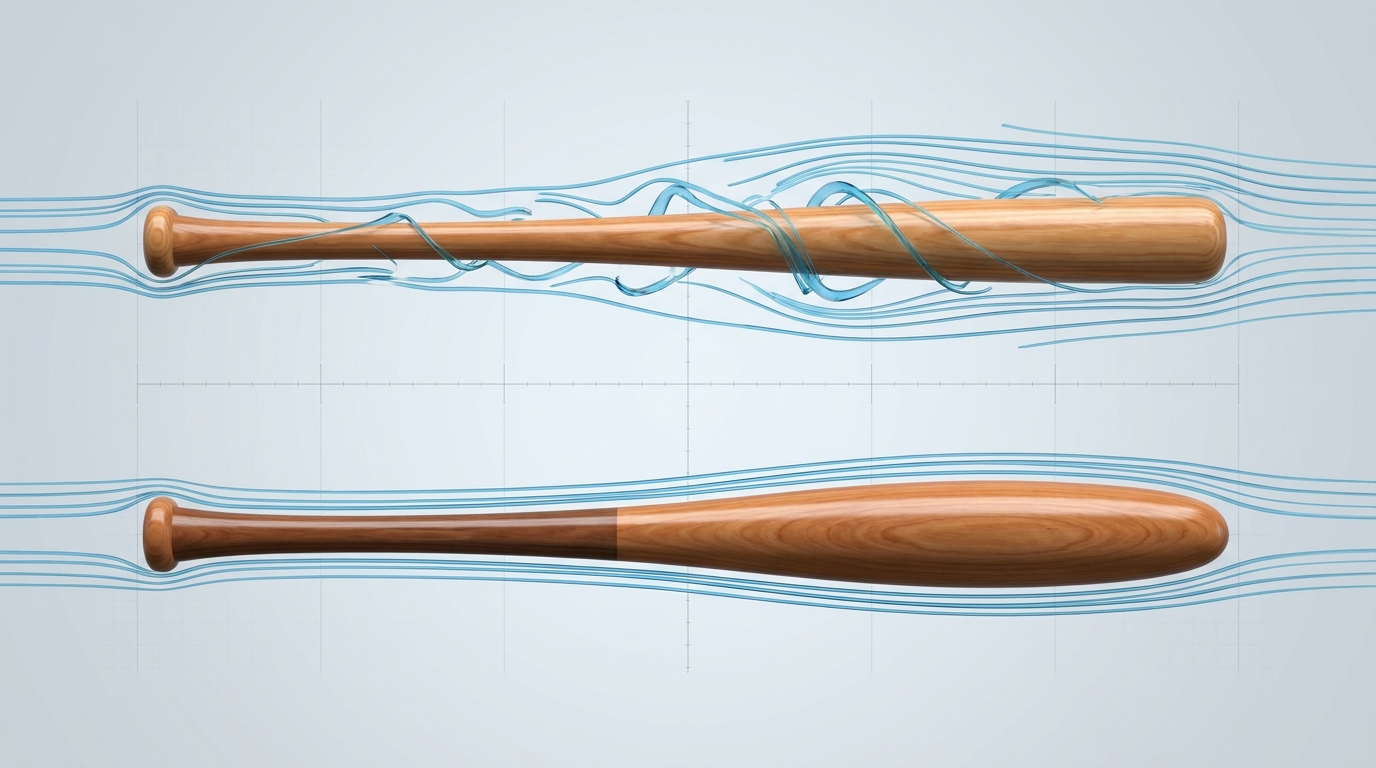
The torpedo bat's mass redistribution has a secondary effect beyond MOI: it shifts the bending vibration node of the barrel. Because the node migrates toward the region of concentrated mass, and because that region now aligns with the player's natural contact zone, more contacts transfer more energy into the ball and less into the bat's vibration modes.
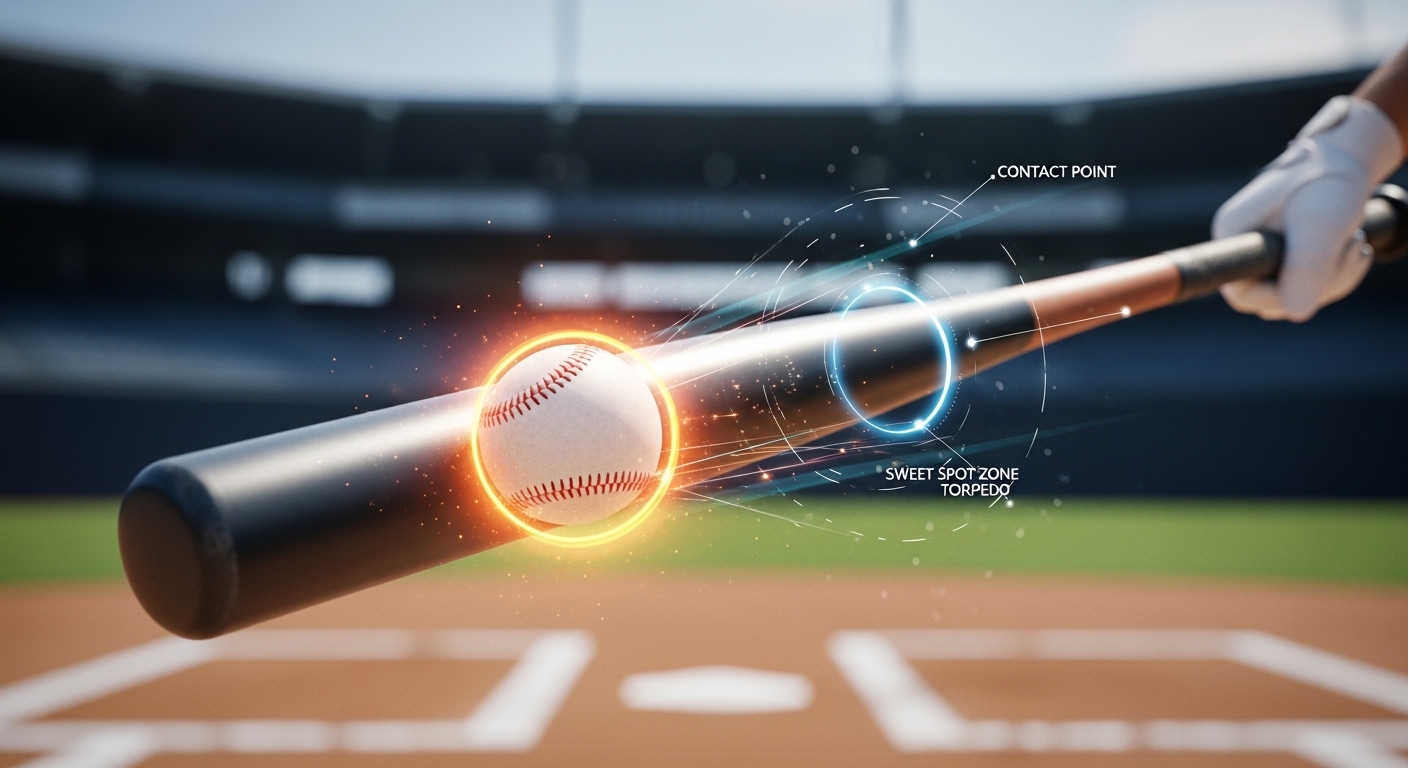
Deep dive: Vibration ControlThe sweet spot science dimension is where all the other technologies converge. It answers the question that is most practically important for any player evaluating a torpedo bat: where exactly is your sweet spot, how wide is it, and how was it determined?
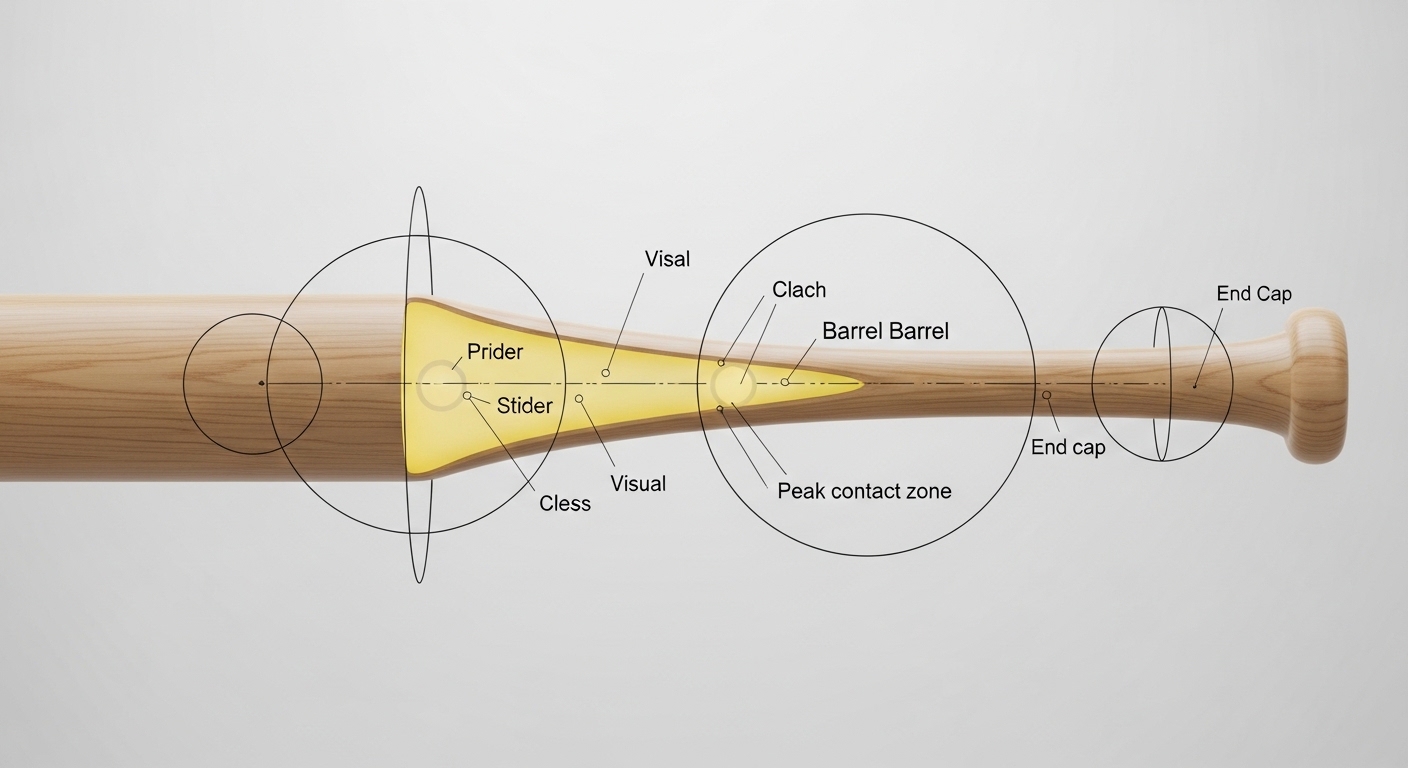
The torpedo bat's sweet spot is not chosen arbitrarily. It begins with Statcast contact zone data — typically 200+ at-bats of batted ball events with contact point tracking — analyzed to identify the player's modal contact location on the barrel. That data point becomes the design input for barrel geometry, which becomes the manufacturing spec. High-speed cameras and bat sensors validate the result. The entire pipeline from data collection to finished bat is a closed-loop engineering process.
Deep dive: Sweet Spot ScienceTorpedo Bat vs. Traditional Bat: Technology Comparison
| Technology Dimension | Traditional Bat | Torpedo Bat | Key Innovation |
|---|---|---|---|
| Barrel Geometry | Standard taper to tip | Reverse taper — widens then narrows | Places peak mass at contact zone |
| Weight Distribution | End-heavy | Contact-zone heavy; data-driven | Lower MOI, faster swing |
| Materials | Maple / ash / birch | High-density maple or birch; premium billets | Dense wood = more pop in narrower zone |
| Vibration Control | Passive (bat shape only) | Node repositioned via geometry | Less sting; more energy to ball |
| Sweet Spot Science | Fixed near tip | Custom-positioned via Statcast data | Sweet spot follows the hitter |
| Manufacturing Method | Lathe + template | CNC + player swing data | Millimeter-precision profile |
The Full Data-to-Bat Engineering Pipeline
One of the defining characteristics of torpedo bat technology is that it turns the bat manufacturing process into a data pipeline. Here is the complete sequence — from first data collection to finished bat:
Collect player contact zone data
Where on the barrel does this hitter make contact across hundreds of at-bats?
Map contact zone to barrel position
Calculate the precise inch-measurement from the barrel tip where peak contact occurs.
Engineer barrel geometry
Calculate peak diameter location, forward and reverse taper slopes, and wood volume budget.
Select billet and verify grain
Match wood density and grain slope to player's contact style and power profile.
CNC turning
Machine cuts the precise torpedo profile, holding thousands of measurement points to millimeter tolerance.
Finishing and hardening
Bone rubbing, proprietary hardening treatments (PRO-X, ProPACT), UV curing, decal application.
Quality control
Final diameter measurement against player spec and MLB Rule 3.02, weight verification.
This pipeline represents a fundamental shift in how baseball equipment is conceived. Traditionally, a player picked from standard profiles. The torpedo bat process inverts that model: the player's performance data generates the bat specification, not the other way around.
The Manufacturers Building Torpedo Bat Technology
The torpedo bat is not a single product from a single company. Multiple MLB-approved manufacturers have developed their own versions, each with proprietary technology dimensions.
Louisville Slugger TPD1
- CNC with thousands of measurement points
- Holds millimeter tolerance
Tater Bat Co. Torpedo Game Bat
- Handcrafted in Cheshire, CT
- CNC lathe; recommends +1 oz over standard weight
Victus Sports Custom Profile
- ProPACT hardening finish
- Hand-split Canadian billets
Marucci Sports Custom Profile
- PRO-X finish
- Bone rubbing process; Baton Rouge facility
Phoenix Bats Custom Profile
- 0.93" standard torpedo handle
- Ohio maple/birch billets
Key detail: "Torpedo bats are made one bat at a time" at Tater's Connecticut facility. This individual production approach — necessary for true customization — is a direct contrast to traditional bat manufacturing, where dozens of identical bats are turned from the same template simultaneously. The technology enables the customization, but it also makes torpedo bats significantly more labor-intensive to produce.
How Torpedo Bat Technology Is Changing the Broader Hitting Landscape
The Pendulum Swing Back to Hitters
For a decade, pitching technology dominated baseball's innovation cycle. Edgertronic high-speed cameras, Rapsodo spin tracking, and biomechanics analysis gave pitchers unprecedented tools. Strikeouts hit record highs. Batting averages fell to 50-year lows.
The torpedo bat represents "the pendulum swinging back" — hitters leveraging the same data-driven approach that had given pitchers their edge.
Bat Monitoring as a New Category
The torpedo bat's dependence on precise weight distribution has accelerated interest in bat monitoring technology. If a 1.5-ounce barrel mass variance costs 4–5 mph of swing speed, then players and teams now have a strong incentive to weigh and measure every bat before use — not just select from a standard profile.
Several MLB teams began implementing bat quality control protocols in 2025 specifically in response to this data.
The Customization Cascade
Louisville Slugger's description of the torpedo bat as offering "a sweet spot perfectly crafted to match your unique swing" is not marketing language — it describes a real manufacturing capability that previously did not exist at this precision level.
As the technology becomes more accessible, it is beginning to filter down into amateur baseball. The next evolution of youth bat fitting may look less like "pick your length and weight" and more like a data-driven specification process built around the individual player's swing profile.
— Marquee Sports Network, April 2025
Frequently Asked Questions: Torpedo Bat Technology
What technology is used to design and manufacture a torpedo bat?
The process uses MLB Statcast contact zone data and high-speed camera footage to identify the player's natural contact location on the barrel. That data generates a CNC manufacturing specification that positions peak barrel diameter at the player's contact zone. CNC lathes then cut the torpedo profile to millimeter precision. Finishing involves bone rubbing, proprietary chemical hardening (PRO-X at Marucci, ProPACT at Victus), and UV curing.
How much more precise is a torpedo bat than a traditional bat?
Traditional bats are produced using lathe-and-template methods that can result in barrel mass variances of up to 1.5 ounces between bats of the same model — enough to cause a 4 to 5 mph swing speed difference. CNC-manufactured torpedo bats hold measurements to the millimeter across every unit, eliminating most of this variance. The precision gain applies both to the torpedo's unique geometry and to the overall consistency of bat-to-bat weight distribution.
Do all torpedo bat manufacturers use the same technology?
No. While all MLB-approved torpedo bat manufacturers use CNC machining and player swing data as inputs, the manufacturing specifications, finishing processes, and billet sourcing differ. Louisville Slugger (TPD1), Marucci (PRO-X finish), Victus (ProPACT), Tater Bat Co., and Phoenix Bats each apply proprietary approaches to materials selection, barrel hardening, and CNC programming. The shared technology is the data-driven design process; the proprietary technology is in the execution.
Is the torpedo bat's technology available to amateur players?
As of 2025, several manufacturers — including Tater Bat Co. and Phoenix Bats — offer torpedo-profile bats to the broader market beyond MLB. However, the full data pipeline (Statcast contact zone analysis → custom CNC spec) is currently most accessible to professional players with access to MLB tracking infrastructure. Amateur players can order torpedo-profile bats in standard configurations, but the hyper-customized individual sweet spot positioning is largely a professional-level capability for now.
How does the torpedo bat connect to broader MLB hitting technology trends?
The torpedo bat is the most visible product of a broader shift in how MLB organizations approach hitting. The same analytics infrastructure — Statcast contact zone tracking, high-speed cameras, bat sensors — that teams use to evaluate hitters is now being used to engineer the equipment itself. The torpedo bat represents the point at which data analysis moved from informing training decisions to directly generating hardware specifications.
Explore the Full Technology Section
From the What Is Torpedo Bat Series
Gallery