Torpedo Bat NCAA College Rules: Rule 1-12 and 2025 Testing Changes
✅ SHORT ANSWER: Yes
The torpedo bat is legal in NCAA college baseball. A solid one-piece wood torpedo bat is automatically exempt from BBCOR testing under Rule 1-12 and requires no stamp. A non-wood torpedo bat must be BBCOR-certified (≤0.500), appear on the WSU SSL NCAA Approved Bat List, and carry a permanent silkscreen mark. At Division I, non-wood bats are now tested daily before each game (2025 rule change). No 2025 rule change addressed torpedo bat geometry.
The torpedo bat attracted immediate NCAA scrutiny after the 2025 Opening Day controversy. Players and coaches at the college level asked whether the design they were watching on MLB broadcasts was something they could use. The answer under NCAA Rule 1-12 is the same as at every other level: yes — with the same certification requirements that apply to any other non-wood bat, and with one additional layer of ongoing game-day testing that does not exist at the high school level.
This page covers NCAA Rule 1-12 in full, the 2025 bat testing protocol changes that affect every college program in every division, the white bat prohibition (an NCAA-only rule that does not exist at the NFHS or youth level), and the experimental bat sensor technology rule that has direct relevance to the data pipeline behind torpedo bat fitting.
NCAA Rule 1-12: The Text That Governs College Bats
NCAA Rule 1-12 states that the bat must be:
Additional provisions under Rule 1-12 for non-wood bats: Non-wood bats must meet BBCOR performance standard ≤0.500; display a permanent BBCOR certification mark on the barrel; not weigh numerically more than three ounces less than length; not be predominantly white or near-white in color (Rule 1-12-d); and pass game-day barrel compression testing per Appendix G of the NCAA Baseball Rules.
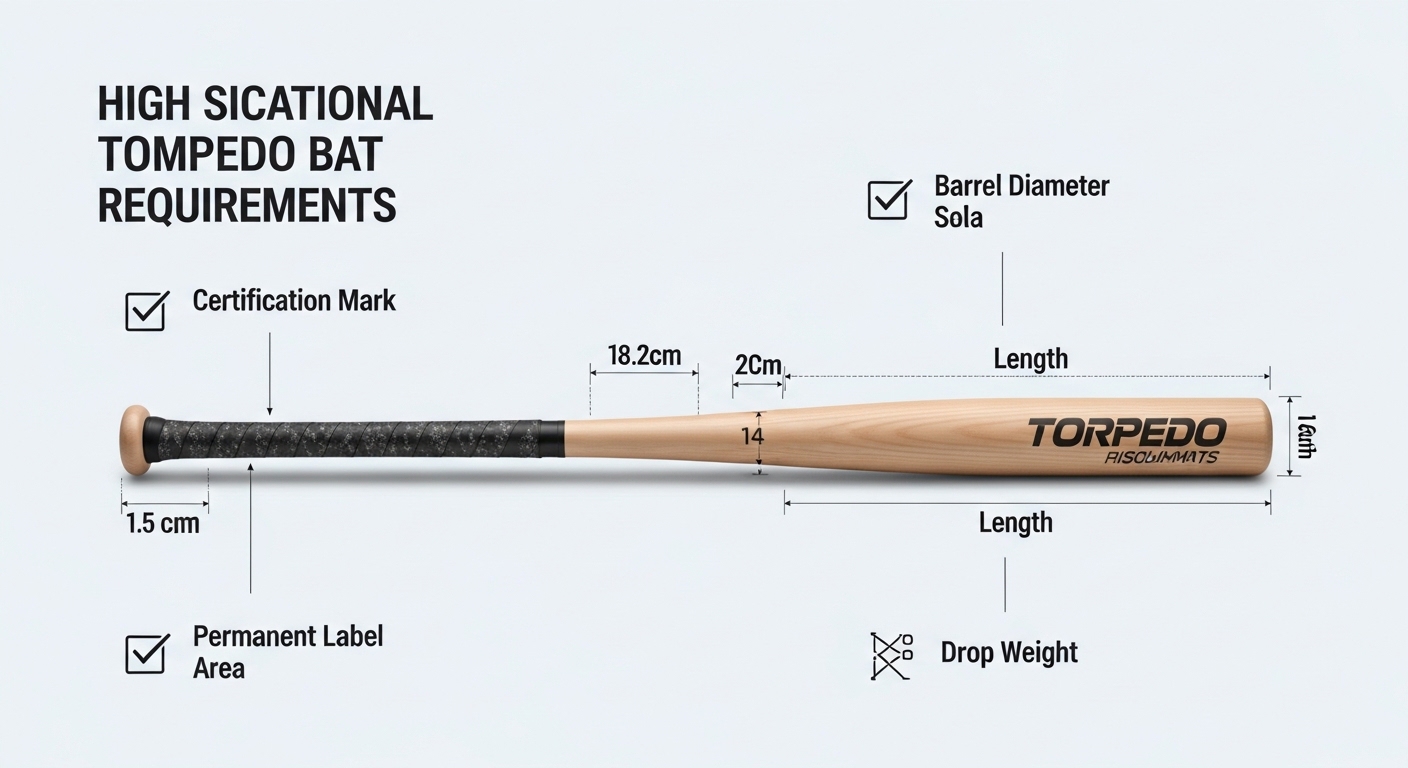
The torpedo bat analysis: "at its thickest part" — identical language to MLB Rule 3.02. A torpedo bat is widest at the contact zone (6–8" from tip). That zone must be ≤2¾" for NCAA compliance (note: this is wider than the NFHS ≤2⅝" limit — NCAA allows a slightly wider barrel). The rule places no restriction on where the thickest point must occur, what the taper profile must look like, or how mass may be distributed along the barrel. Solid one-piece wood is automatically exempt from all BBCOR requirements — wood is the baseline against which BBCOR measures non-wood performance.
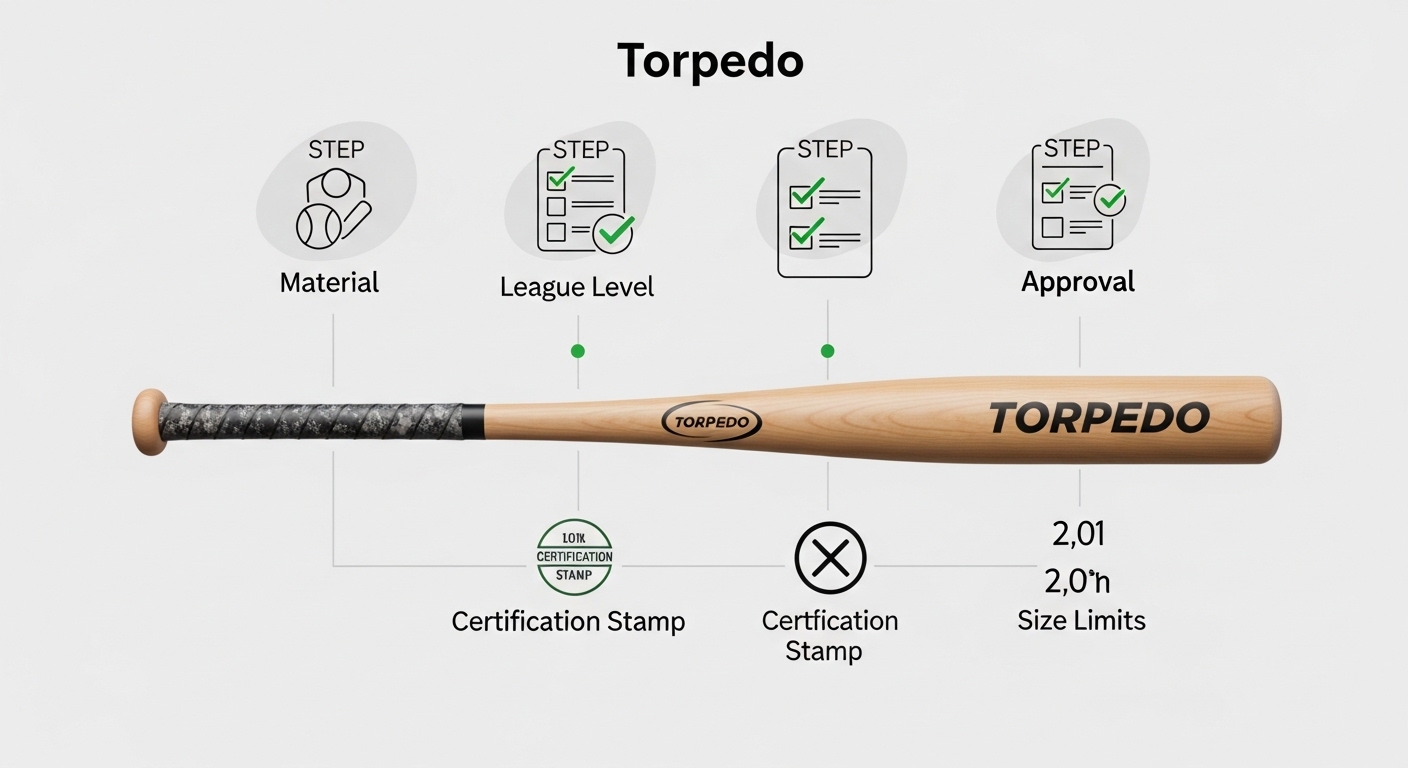
NCAA Rule 1-12 Full Compliance Checklist for Torpedo Bats
| Status | Requirement | Wood Torpedo Bat | Non-Wood Torpedo Bat |
|---|---|---|---|
| ✅ | Smooth, rounded stick — ≤2¾" dia at thickest part | Complies — torpedo widest at 6–8" zone, must be ≤2¾" | Same — ≤2¾" at thickest barrel point |
| ✅ | Not more than 42 inches in length | Standard sizing — most college wood bats are 33"–34" | Same — most BBCOR college bats are 31"–34" |
| ✅ | Direct line from center of knob to center of large end | Standard bat construction requirement — applies to all shapes | Same requirement — torpedo geometry does not disrupt this |
| ✅ | -3 drop weight for non-wood bats | Wood exempt from drop weight restriction | Required for all non-wood bats. A 33" non-wood torpedo must weigh ≥30 oz. |
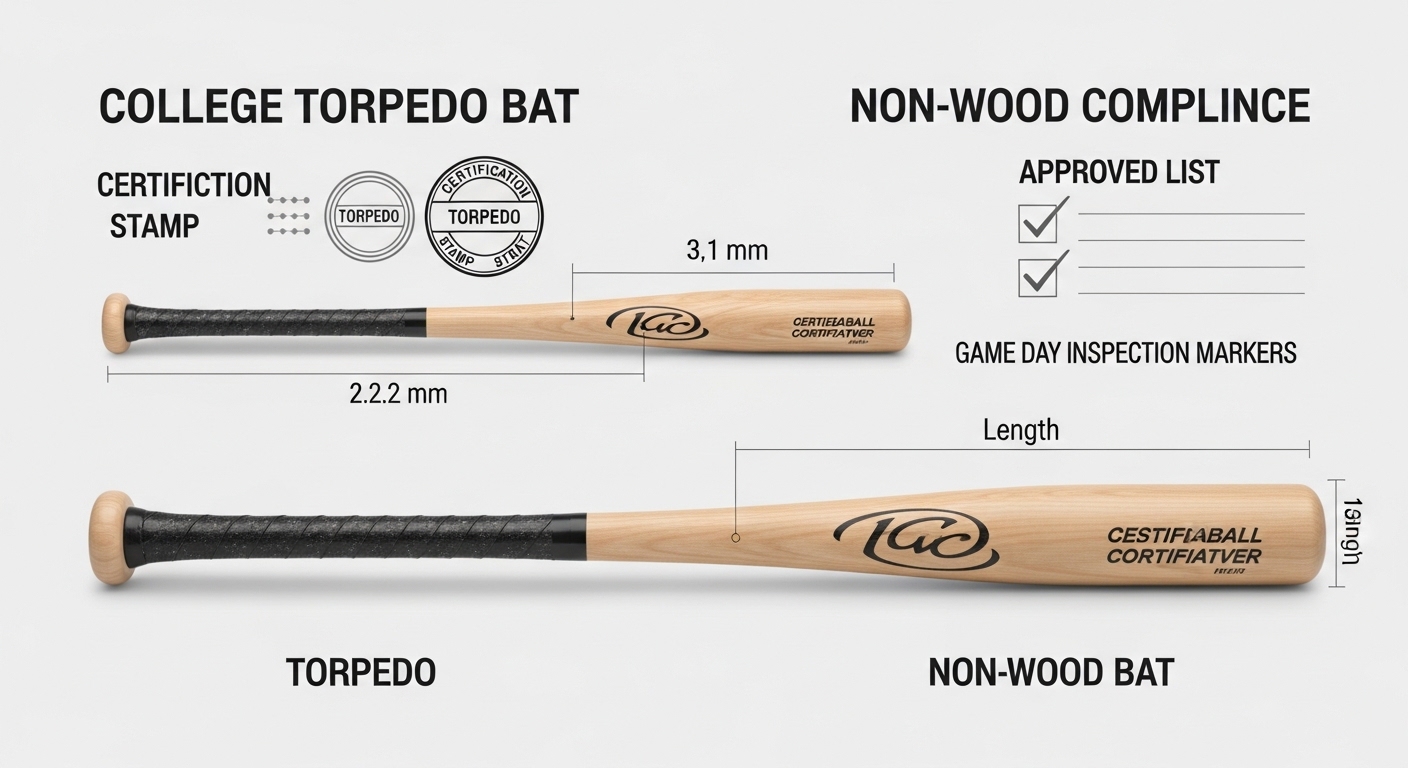
| ✅ | BBCOR certified ≤0.500 — permanent silkscreen | Wood auto-exempt from BBCOR testing (baseline standard) | Required. Model must appear on WSU SSL NCAA Approved Bat List. Mark must be on bat. |
| ❌ | No sticker or decal accepted as BBCOR mark | N/A | Critical: BBCOR mark must be manufacturer silkscreen — same requirement as NFHS |
| ✅ | No foreign substance on bat surface beyond 18" from handle | Pine tar / resin / tape permitted within 18" from handle end | 2025 rule: same 18" limit applies. No substance beyond 18" from handle end. |
| ✅ | Bat must pass game-day testing protocol | Wood bats: visual inspection only — no BBCOR test required | Non-wood bats: barrel compression test at game day (DI: every day; DII/III: each series) |
| ✅ | Bat testing sticker placed on lineup card (2025 new) | Wood — no sticker required | Non-wood: testing sticker from each team's bat testing must appear on lineup card given to umpire before game |
| ✅ | Composite bats must pass ABI protocol | N/A — wood | Required for composite torpedo bats before initial certification. On-field compression test at game day is additional monitoring. |
The 2025 Game-Day Testing Protocol: What Changed and Why It Matters
The most significant 2025 change for college torpedo bat users is not about the torpedo bat itself — it is about the daily testing protocol that now governs all non-wood bats at Division I.
| Testing Dimension | Division I | Divisions II and III |
|---|---|---|
| When tested | Before the start of play on each date of competition (daily) | Before the start of play for each series or single date of competition |
| What is tested | Barrel compression of all non-wood bats the team plans to use that day | Barrel compression of all non-wood bats the team plans to use for the series |
| Test method | Barrel compression device measures stiffness of composite barrel. Bats exceeding compression threshold are removed. | Same compression test — same threshold. |
| What test catches | 'Rolled' bats (illegally broken-in composite bats that have become too lively). Any bat whose barrel has been deliberately softened beyond normal break-in. | Same — catches deliberate bat tampering. Bats that pass ABI in lab but have been further rolled in the field. |
| Sticker requirement | Bat testing sticker from that day's testing placed on lineup card given to umpire (2025 new rule) | Bat testing sticker from that series' testing placed on lineup card (2025 new rule) |
| Wood torpedo bat treatment | Visual inspection only — no compression test. Wood is the baseline. | Same — wood bats are visually inspected but not compression-tested. |
| Torpedo bat implications | A BBCOR-certified alloy torpedo bat is tested via compression at DI level before every game. No special test — same protocol as any alloy BBCOR bat. | A BBCOR-certified composite torpedo bat would be compression-tested before each series. Composite torpedo bats need to be monitored for barrel wear — the compression test catches any that have drifted hot. |
The reasoning behind the DI upgrade from series-based to daily testing: barrel compression testing catches illegally rolled composite bats — bats whose barrels have been deliberately softened beyond normal break-in to increase their BBCOR performance above the 0.500 ceiling. A bat could theoretically be rolled after the series-opening test and used hot for the remaining games in the series under the old protocol. The daily testing requirement closes that window at the DI level.
For torpedo bat users specifically: an alloy torpedo bat is not affected by this concern — alloy bats do not change performance with use and cannot be rolled to increase BBCOR. The daily testing is an administrative requirement but not a practical performance concern. A composite torpedo bat — if any program used one — would need to pass compression testing before every DI game. The same protocol that applies to any composite BBCOR bat applies to a composite torpedo. Currently, alloy torpedo bats are the primary non-wood torpedo design in college competition.
The 2025 NCAA Rule Changes: Full Summary
| Rule Reference | Change | Effect on Torpedo Bat Users |
|---|---|---|
| Rule 1-12-e,g + Appendix G | Division I: bat testing now required before start of play on each date of competition (was: each series). DII/III: unchanged. | Direct: torpedo bat users at DI programs must ensure their alloy/composite torpedo is submitted for compression testing before every game day — not just at the series start. The logistics of game-day bat testing are now a daily operational requirement at DI. |
| Rule 1-12 + Appendix G | Bat testing sticker: the sticker from the bat testing process must be placed on the lineup card given to the umpire before the game. | Administrative requirement. Teams at all divisions must attach the bat testing sticker to the lineup card. Failure to do so could result in the umpire rejecting non-wood bats. Wood torpedo users are not affected. |
| Rule 1-12 | Foreign substance rule tightened: no foreign substance beyond 18 inches from end of handle — language clarified. | Any substance applied to a non-wood torpedo bat must not extend beyond 18" from the handle end. Sticky substances in the barrel zone are prohibited. Grip tape and approved grip spray within 18" remain legal. |
| Experimental Rule — Technology | Use of bat sensor technology for in-game data collection permitted during conference play only (2025 season). Live swing data access prohibited. | Context: torpedo bat fitting relies on Statcast contact zone data — the same data pipeline that could theoretically be enhanced by in-game sensor technology. The experimental rule allows metric sensors on or within bats. Relevant for the future of torpedo bat fitting at the college level — not a current requirement. |
| No torpedo-specific rules | No 2025 NCAA rule change addressed torpedo bat geometry, barrel profile, or mass distribution | The torpedo bat is governed by standard Rule 1-12 in all NCAA divisions — same as all other bats. No new restriction, no new exemption, no new approval process. |
The White Bat Prohibition: An NCAA-Only Rule
One NCAA bat rule has no equivalent at the NFHS level: the prohibition on white or near-white non-wood bats (Rule 1-12-d, effective 2019).
| Bat Color | NCAA Legal? | Notes |
|---|---|---|
| Natural wood color — maple, ash, birch | ✅ Legal | Any natural wood color is permitted. Wood torpedo bats in natural finish are legal regardless of exact color. |
| Colored non-wood bats — any non-white color | ✅ Legal | Black, blue, red, gold, multicolor designs are all permitted. |
| White or near-white non-wood bat | ❌ Prohibited (Rule 1-12-d, since 2019) | Non-wood bats that are predominantly white or near-white are prohibited. Pitchers argued white bats distract from ball tracking. Rule applies NCAA only — not NFHS. |
| Wood torpedo bat — any color including white | ✅ Legal — wood exempt from color rule | Rule 1-12-d prohibits white NON-WOOD bats. Wood bats in any color are permitted. |
The white bat rule was adopted after pitchers complained that white bats made it harder to pick up the ball out of the hitter's hands — white barrel near a white ball creates visual tracking difficulty. For torpedo bat buyers at the college level: any alloy or composite torpedo bat that is predominantly white is illegal in NCAA play — even if it carries a valid BBCOR stamp. This is not a performance rule but a visual rule. The wood torpedo bat is exempt — the white bat prohibition applies specifically to non-wood bats. A natural maple or ash torpedo is legal in any color. Check the bat's color before purchasing for NCAA use.
NCAA vs. NFHS: Key Differences for Torpedo Bat Users
College coaches recruiting high school torpedo bat users, and high school players considering college programs, need to know where the rules differ:
| Rule Dimension | NCAA Rule 1-12 | NFHS Rule 1-3-2 |
|---|---|---|
| Max barrel diameter | 2¾" (wider — same as MLB) | 2⅝" (narrower — standard high school spec) |
| Max length | 42 inches | 36 inches |
| Drop weight | -3 for non-wood | -3 for non-wood |
| BBCOR stamp format | Permanent silkscreen on barrel — rectangular, minimum ½" each side per NCAA protocol | Permanent silkscreen on barrel — rectangular, minimum 1" each side per NFHS Rule 1-3-2 |
| Wood exempt? | Yes — one-piece solid wood is auto-exempt | Yes — one-piece solid wood is auto-exempt |
| Approved bat list | WSU SSL NCAA Approved Bat List — mandatory | WSU SSL list used, but NFHS defers to state associations for monitoring |
| Game-day testing | DI: daily compression test. DII/III: per series. | No standardised game-day testing protocol (umpire inspection only) |
| White bat restriction | ❌ White or near-white bats prohibited (Rule 1-12-d, 2019) | No white bat restriction |
| Experimental bat clause | Allowed with advance NCAA approval — form and process defined | Allowed with advance NFHS/state association approval |
The two most practically significant differences: barrel diameter (2¾" NCAA vs. 2⅝" NFHS) — a torpedo bat legal in NCAA play because its widest point is between 2⅝" and 2¾" would be illegal at the high school level for the same dimensional reason. Most commercial torpedo bats are designed with ≤2⅝" barrels to comply with both standards simultaneously, but players should verify. The second significant difference: white bat prohibition — legal in high school, illegal in NCAA for non-wood bats. Both differences require attention when a player transitions from high school to college.
The Experimental Bat Clause at the College Level
NCAA Rule 1-12 includes an experimental bat clause allowing non-standard bat designs to be used in competition following advance approval from the NCAA Baseball Rules Committee. The approval process requires: written request from the manufacturer or program, a detailed description of the experimental design, a specific competition context (typically a single program or conference willing to conduct the experiment), and post-season data submission to the rules committee.
This clause is historically relevant to torpedo bats: the MLB equivalent of this clause (Rule 3.02's experimental bat provision) was used by the Yankees and their bat suppliers to secure advance approval before the 2025 season. By mid-2025, the torpedo had spread widely enough that the 'experimental' designation no longer applied at the MLB level. At the college level, no formal experimental bat approval for torpedo designs has been filed as of early 2026 — because standard torpedo-profile bats (wood or BBCOR-certified non-wood) are already legal under existing Rule 1-12 without needing any special approval. The experimental clause would only be relevant if a manufacturer wanted to test a design that exceeded the current dimensional or performance limits.
How to Verify a Torpedo Bat Is NCAA-Legal
Check the WSU SSL NCAA Approved Bat List
ssl.wsu.edu/approved-bats/ — the authoritative source for all BBCOR-certified bats approved for NCAA play. If the specific model and length appears on this list, it is approved. If not, it is not legal for NCAA non-wood use. Marucci CB15 Torpedo is the primary torpedo-profile bat currently on this list.
Confirm the barrel is ≤2¾" at its widest
NCAA allows 2¾" vs. NFHS's 2⅝". Most commercial torpedo bats are ≤2⅝" to be dual-legal. Verify the manufacturer spec sheet for the exact max diameter at the widest barrel zone.
Check bat color for NCAA play
Non-wood torpedo bats must not be predominantly white or near-white. Natural wood torpedo bats are exempt from the color rule.
Confirm the silkscreen mark
BBCOR certification mark must be on the barrel — permanent silkscreen, not a sticker. NCAA protocol specifies a minimum ½" × ½" mark (NFHS requires minimum 1" × 1").
For DI players: confirm game-day testing logistics
The bat must be submitted for compression testing before every game day. Check with your program's equipment manager or athletic trainer about the specific testing schedule and submission process at your facility.
Frequently Asked Questions: Torpedo Bat NCAA Rules
Is the torpedo bat legal in college baseball?
Yes. A solid one-piece wood torpedo bat is automatically legal under NCAA Rule 1-12 with no testing or stamp required — wood is the baseline standard. A non-wood torpedo bat is legal if it is BBCOR-certified (≤0.500 BBCOR), appears on the WSU SSL NCAA Approved Bat List, carries a permanent silkscreen BBCOR mark on the barrel, and is -3 drop weight. At Division I, the bat must also pass daily barrel compression testing before each game. No 2025 rule change addressed torpedo bat geometry or mass distribution.
What is the 2025 NCAA bat testing change and how does it affect torpedo bat users?
The 2025 change (Rule 1-12-e,g + Appendix G) upgraded Division I bat testing from series-based to daily — non-wood bats must now be tested before the start of play on each date of competition at DI. Divisions II and III remain at series-based testing. The change also requires a bat testing sticker from the testing process to appear on the lineup card given to the umpire before the game. For alloy torpedo bat users, this is an administrative requirement — alloy bats do not change performance with use and cannot be rolled. For composite torpedo bat users, the daily test monitors barrel compression to catch any bats that have drifted hot beyond the BBCOR ceiling.
Are white torpedo bats legal in college baseball?
Only if wood. Rule 1-12-d (effective 2019) prohibits non-wood bats that are predominantly white or near-white in NCAA play. Wood torpedo bats are exempt from this color rule — a natural maple or ash torpedo in any color, including white, is legal. A white alloy or composite torpedo bat is illegal in NCAA play regardless of certification. This rule does not exist at the NFHS high school level — the same white non-wood torpedo bat that is illegal in college is legal at the high school level with a valid BBCOR stamp.
Does a college player need a different torpedo bat than a high school player?
Usually not — but there are two rules to check. First, barrel diameter: NCAA allows ≤2¾" at the widest barrel point; NFHS allows only ≤2⅝". Most commercial torpedo bats are ≤2⅝" (designed to be dual-legal), but verify the spec sheet for any bat used at both levels. Second, color: non-wood white bats are legal in high school, illegal in college. If a high school player uses a white non-wood torpedo, that bat is not NCAA-legal. For most commercially available alloy torpedo bats (such as the Marucci CB15 Torpedo in BBCOR), the bat is legal at both levels — but always verify the specific model on the WSU SSL approved bat list before assuming college eligibility.
What is the bat sensor experimental rule and what does it mean for torpedo fitting?
The 2025 NCAA experimental rule permitted interested conferences to allow metric sensors or data collection devices on or within bats during conference play (not postseason). Live access to swing data during the game remained prohibited — the sensors collect data that can be reviewed after play. The relevance to torpedo fitting: Aaron Leanhardt's torpedo bat fitting pipeline uses Statcast contact zone data to build individually fitted bats. An in-bat sensor that tracks contact location precisely would, in principle, allow college programs to build the same kind of contact zone data that drives MLB torpedo fitting — enabling college players to receive genuinely fitted torpedo bats rather than generic contact-zone-leaning designs. The experimental rule is a first step toward that future, though it is not a current requirement.
Continue in the Rules Section
Gallery