Torpedo Bat Weight Distribution: How Mass Engineering Builds a Better Bat
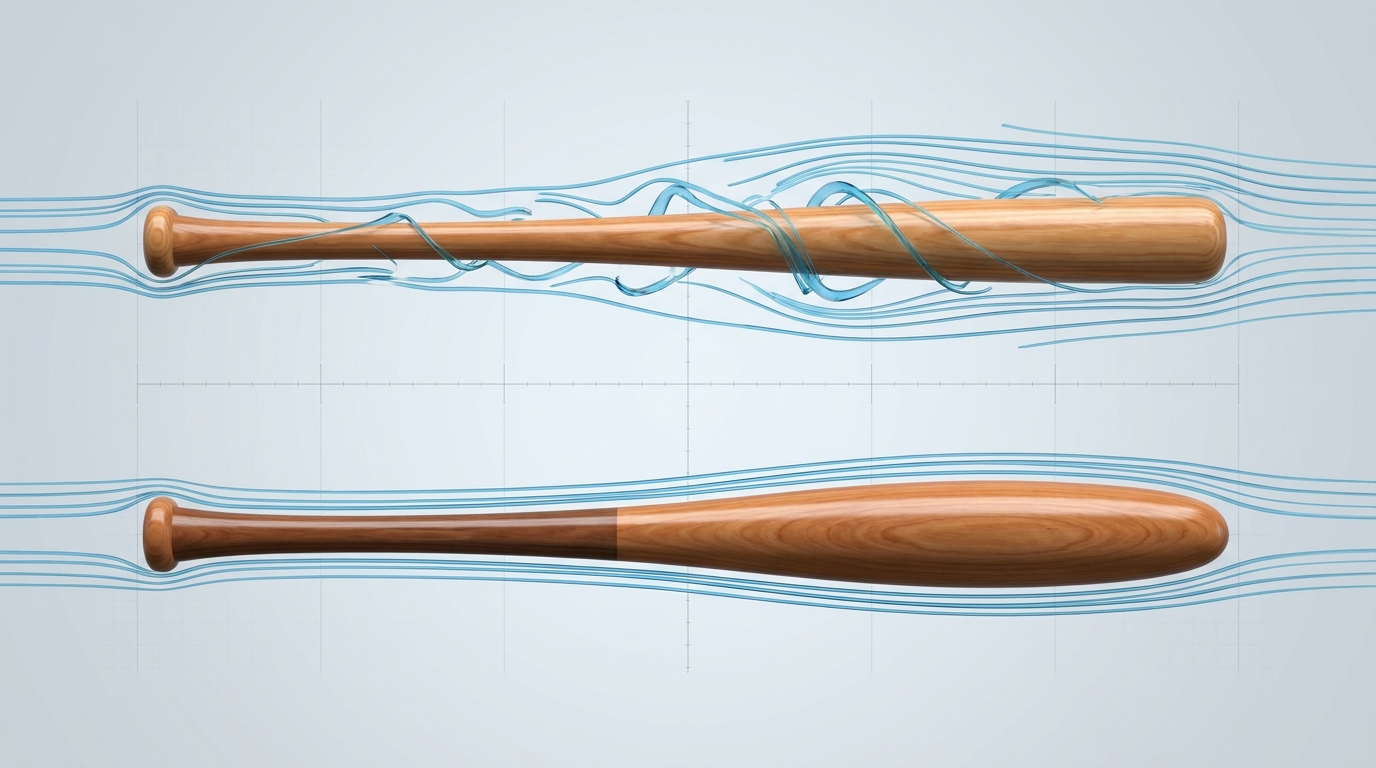
Every baseball bat has the same basic mass budget: length and total weight are fixed by player preference and rule. What changes between bats is not how much mass there is, but where it lives.
For 150 years, that question had one answer — as far toward the tip as the wood could carry it. The torpedo bat gave that question a new answer: wherever the hitter actually makes contact.
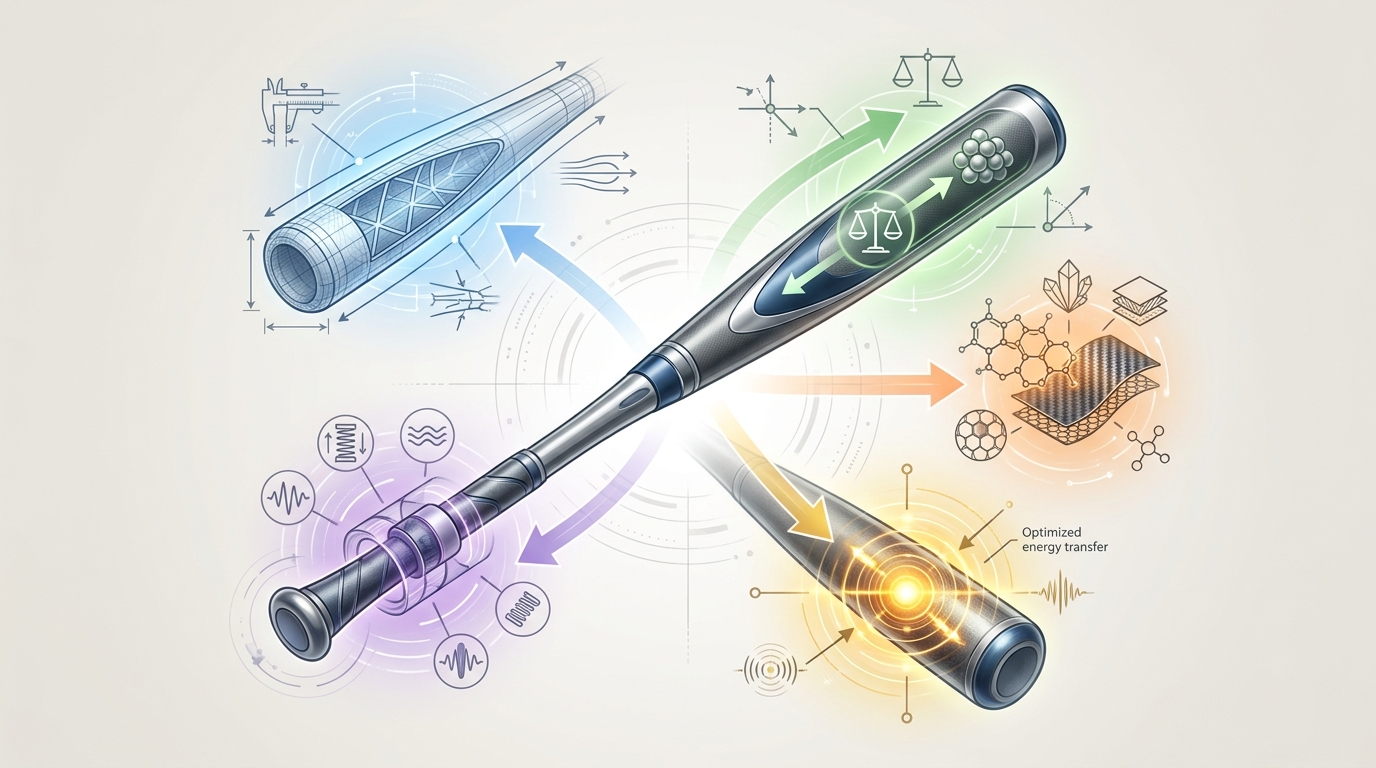
This page covers the engineering execution of that mass redistribution — the wood budget concept, the moment of inertia calculations, and the balance point shift.
The Numbers at a Glance
The Wood Budget: How Mass Redistribution Is Calculated
The term "wood budget" is not an official engineering term — but it captures the zero-sum reality of bat mass engineering precisely. Every gram of wood added to the contact zone must come from somewhere.
The wood budget calculation for a torpedo bat involves three inputs and one hard constraint:
- Input 1 — Target weight: The player's preferred bat weight (e.g., 31 oz for a 34-inch bat). This is fixed.
- Input 2 — Target contact zone: The player's Statcast-derived contact zone location (e.g., 7 inches from the tip). This sets where mass must be concentrated.
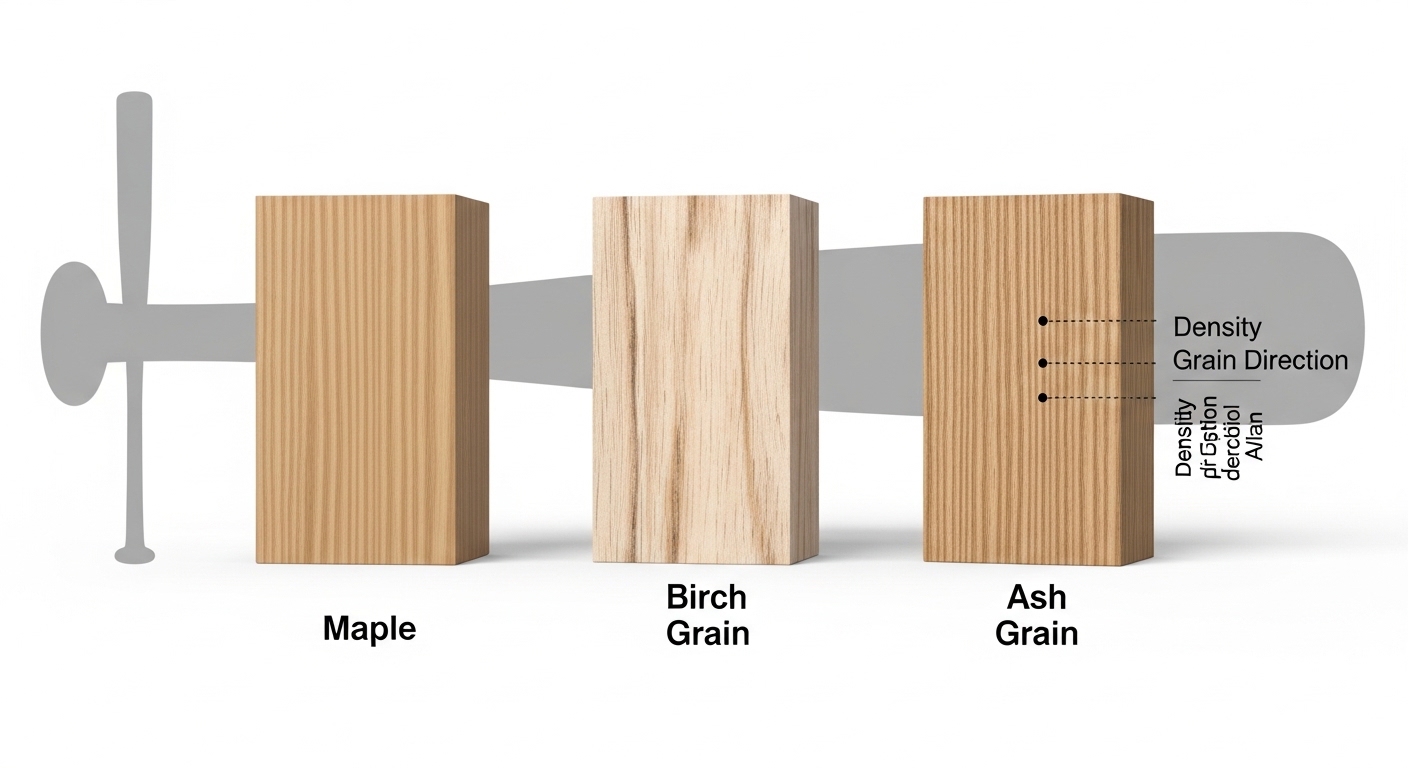
- Input 3 — Wood density: The density of the selected billet (maple, birch, or ash), expressed in lbs/ft³.
- Constraint — Max diameter: MLB Rule 3.02 caps barrel diameter at 2.61 inches. This limits how much volume — and therefore mass — can be placed at any given point.
| Design Decision | Wood Removed From | Wood Added To | Net Weight Effect |
|---|---|---|---|
| Reverse taper at tip | End tip zone (0–4") | Contact zone (4–9") | Net zero — within ±0.25 oz |
| Forward taper steepness | Handle-barrel transition | N/A — redistributes inward | Moves balance point slightly |
| Cup end (optional) | Tip hollow (~0.3–0.5 oz) | N/A — not redistributed | Small net weight reduction |
| Bell knob (optional) | N/A | Knob base (+1–2 oz) | Increases total weight — must be factored |
| Wood density selection | N/A | Denser billet = same size, more mass | Critical for contact zone mass target |
Where the Mass Goes: The Four Zones of a Torpedo Bat
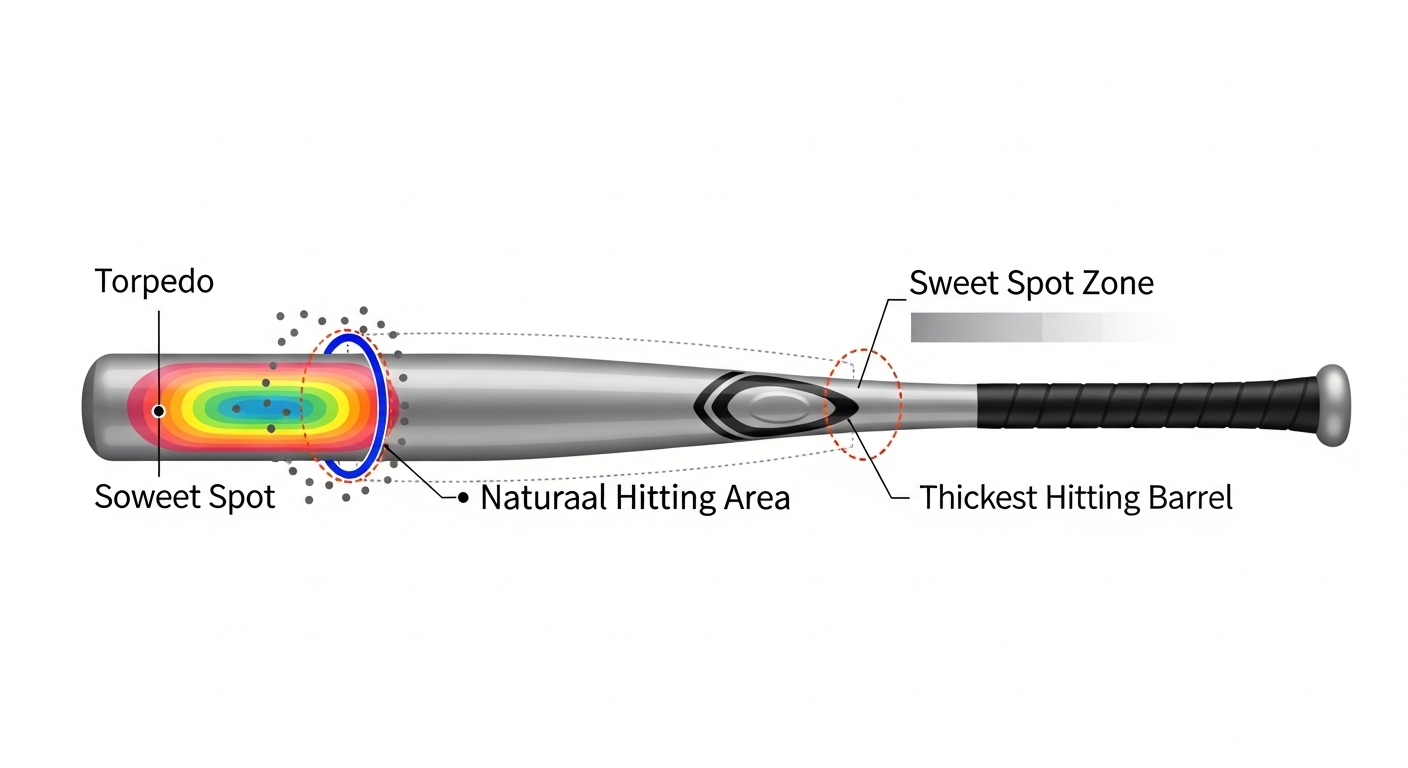
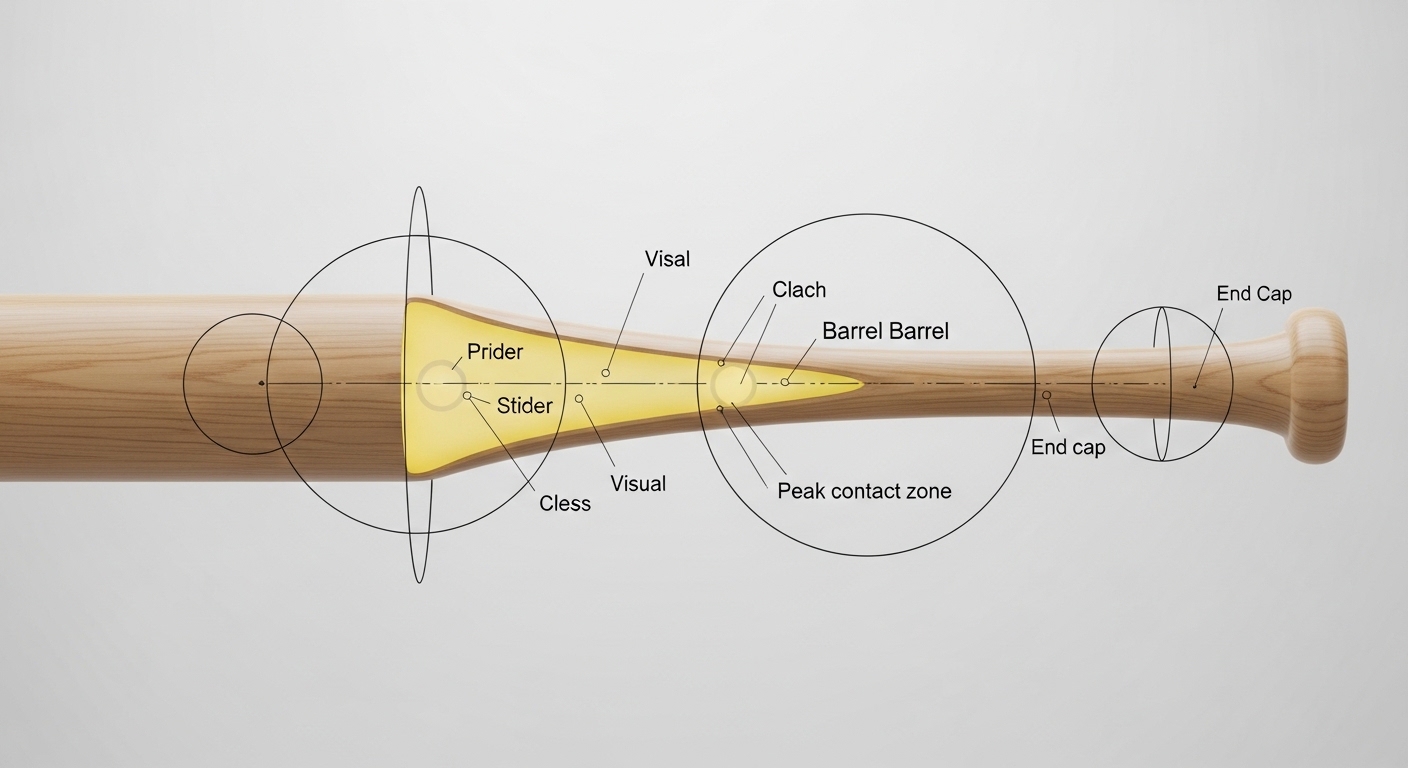
A torpedo bat's mass is distributed across four functionally distinct zones. Understanding each zone's role explains both the bat's performance advantages and its structural tradeoffs.
| Bat Zone | Location | Traditional Mass | Torpedo Mass | Performance Effect |
|---|---|---|---|---|
| End tip zone | 0–4" from tip | Heaviest zone | Lighter — mass removed | ↓ MOI, ↑ swing speed |
| Contact zone | 4–9" from tip | Medium mass | Heaviest — mass added | ↑ Collision efficiency |
| Transition zone | 9–14" from tip | Transitioning | Approximately same | Neutral — unchanged |
| Handle zone | 14"+ from tip | Lightest zone | Approximately same | Neutral — unchanged |
| Knob | At handle base | Standard | Standard (or bell knob) | Player preference only |
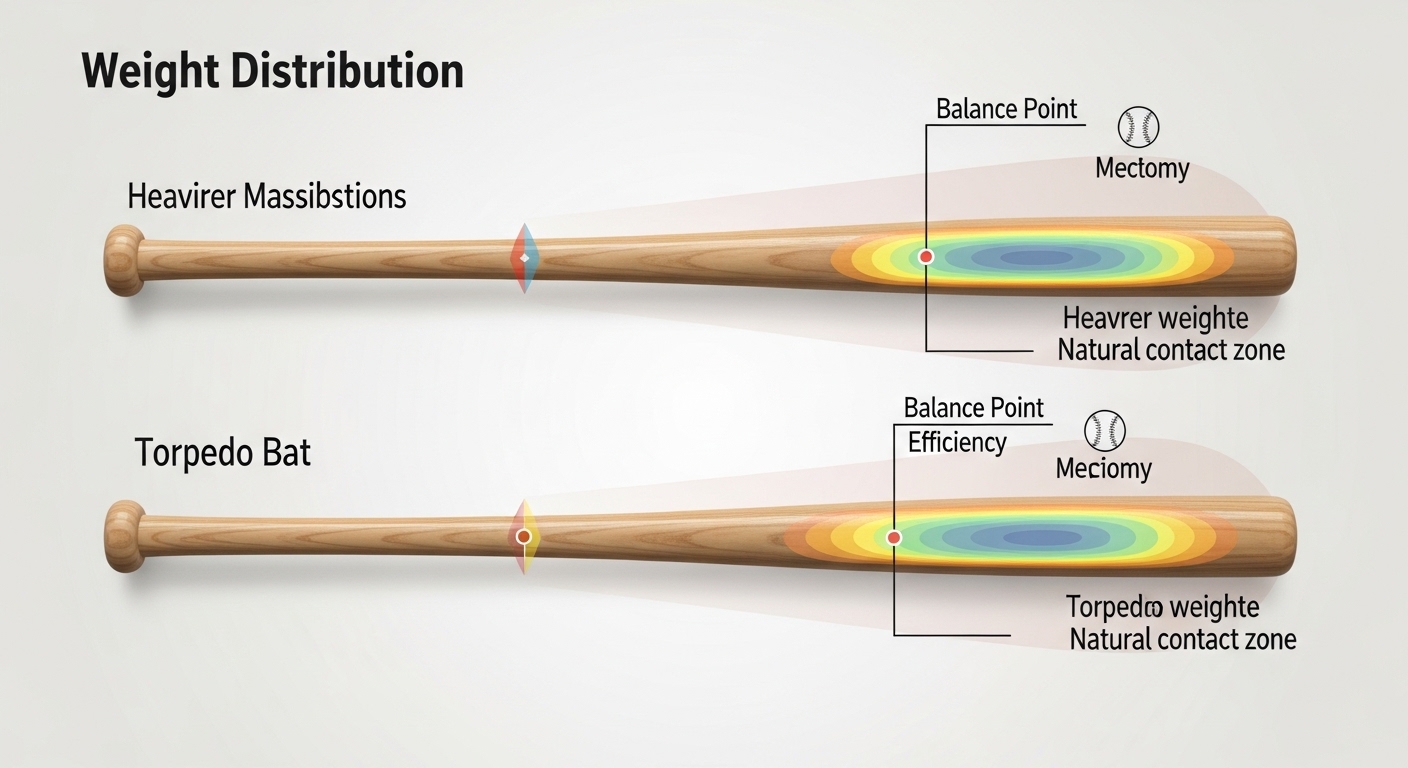
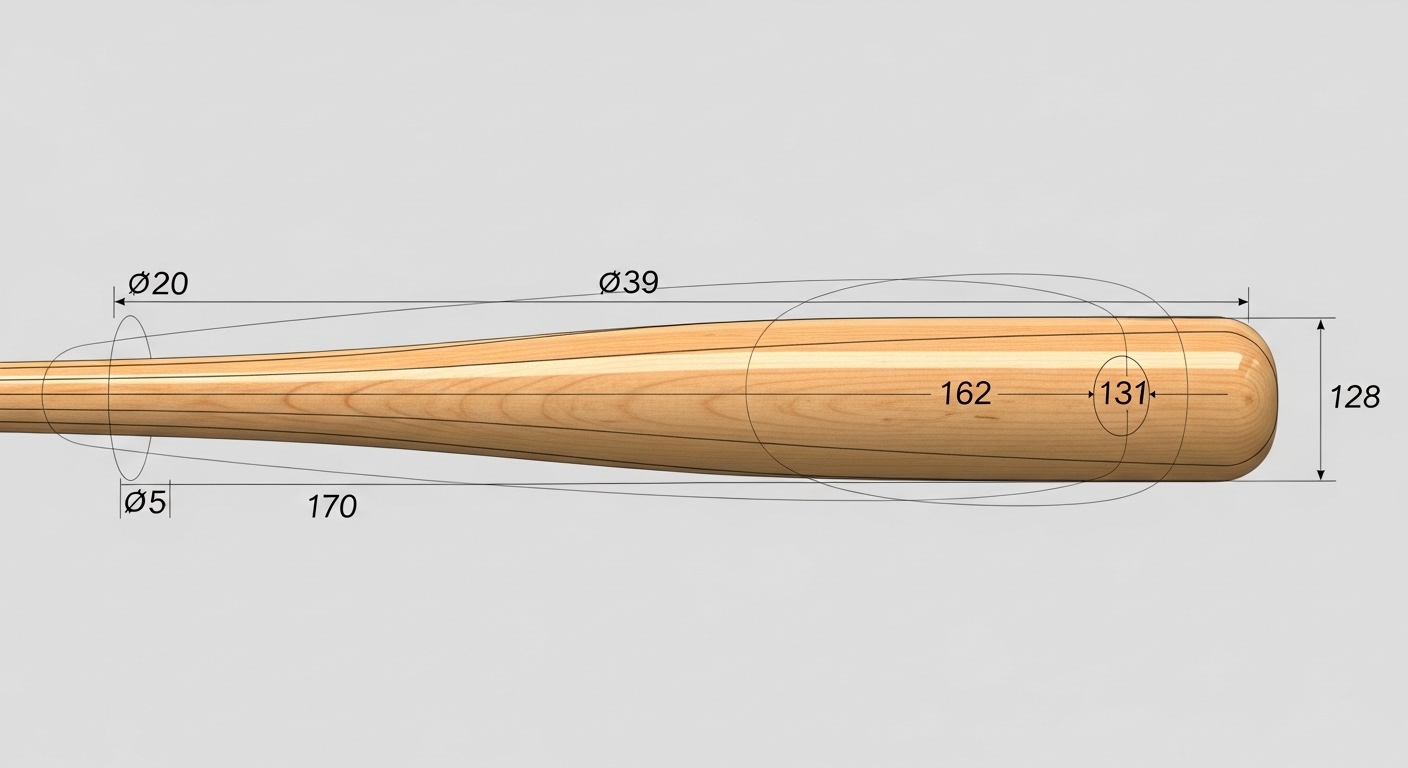
The critical row is the contact zone: the 4–9 inch region from the tip where the torpedo bat concentrates its maximum mass. On a traditional bat, this zone carries medium mass. On a torpedo bat, this is the heaviest zone of the bat, engineered to maximize collision efficiency at exactly the location where the player's data shows they make contact most frequently.
The Surprising MOI Finding: Identical Swing Weight, Different Performance
Here is the most counterintuitive finding in the torpedo bat research — one that fundamentally changes how we should think about weight distribution in baseball bats.
Alan Nathan, Professor Emeritus of Physics at the University of Illinois, obtained actual diameter profiles of both a conventional and a torpedo bat used by the same MLB player. The bats were 33.5 inches long, weighing 31.5 oz (conventional) and 32.1 oz (torpedo). Nathan calculated the MOI for both. His finding: "Remarkably, it's identical for the two bats." He added: "I suspect that that feature was a design goal rather than an accident."
This is profound. It means the two bats will be swung at essentially the same speed and feel the same in the hands. There is no swing speed advantage to the torpedo bat in this specific build. And yet the torpedo bat still produces better performance inside the sweet spot — because the gain is not from swinging faster. It is from making better contact when the ball lands in the contact zone.
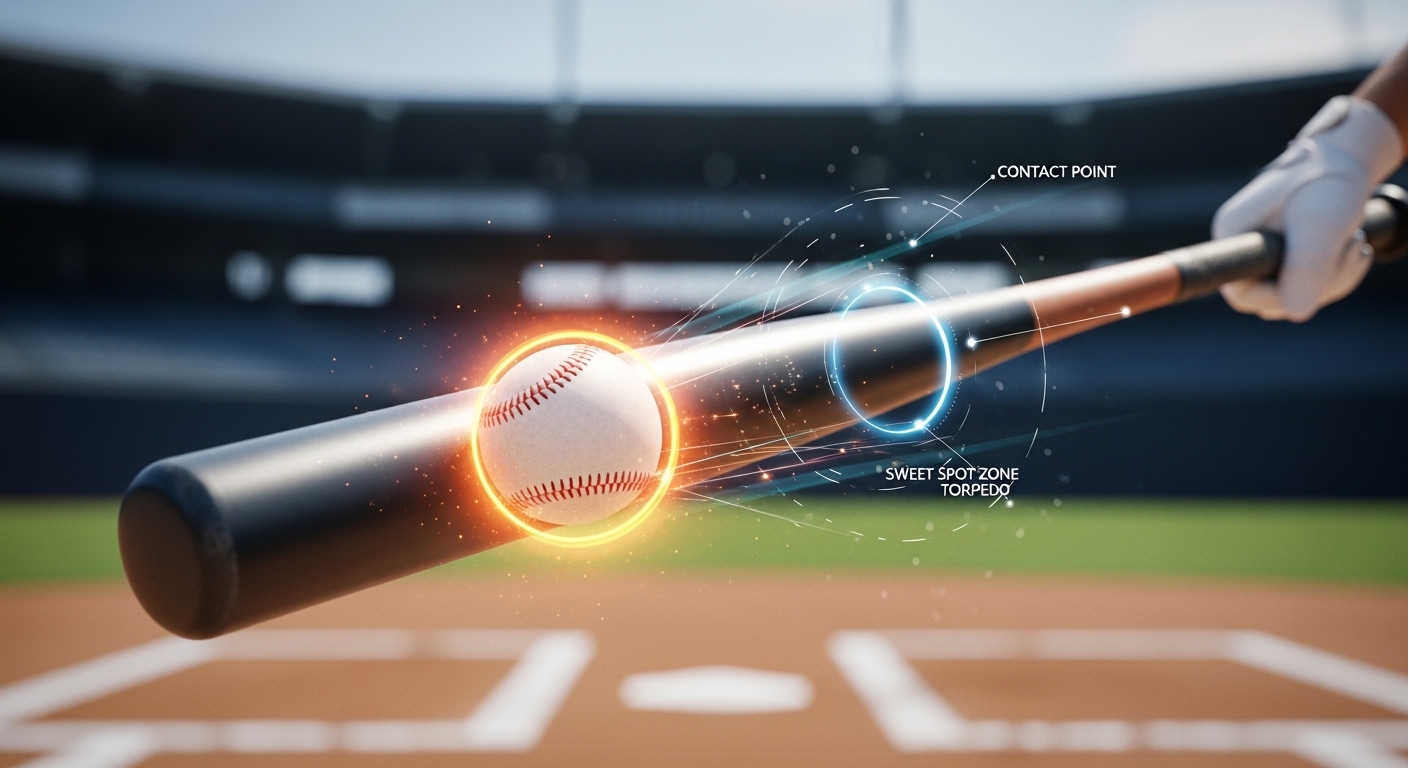
This reveals a second, distinct mechanism by which weight distribution improves performance: even when MOI is held constant, placing mass at the contact zone increases collision efficiency there — the ratio of energy transferred from bat to ball at that location. You don't need to swing faster if you're transferring more energy per swing.
| Mass Configuration | Balance Point | MOI (oz·in²) | Swing Feel | Trade-off |
|---|---|---|---|---|
| End-loaded (tip heavy) | High — near tip | ~9,000–10,000+ | Heavy, slow | Max momentum; hardest to swing |
| Standard MLB bat | ~22–24" from knob | ~8,000–9,000 | Traditional feel | Balanced; conventional |
| Torpedo bat (Nathan data) | ~21–23" from knob | ~8,000–9,000 (identical) | Lighter feel — same weight | Same MOI; better contact zone |
| Knob-loaded bat | Low — near hands | ~7,000–7,500 | Very light feel | Easy swing; lowest mass at contact |
| Torpedo (some builds) | Slightly lower than standard | ~7,500–8,500 (varies) | Noticeably lighter feel | Balance depends on build goal |
The Balance Point Shift: Why Torpedo Bats Feel Lighter
One of the most consistent reports from players who pick up a torpedo bat for the first time is that it feels lighter than their standard bat — even when the two bats have identical total weight. This is not a placebo effect. It is a measurable consequence of the balance point shift created by mass redistribution.
The balance point (also called center of gravity or center of mass) is the location on the bat where it would balance horizontally on a single support point. For a standard 34-inch MLB bat, the balance point typically falls between 22 and 28 inches from the knob — roughly in the lower two-thirds of the bat, biased toward the barrel.
On a torpedo bat, the reverse taper removes mass from the tip and the forward taper repositions the mass concentration inward. The net effect is a balance point that sits slightly closer to the hands than on a traditional bat of the same total weight. Even a shift of 0.5–1.0 inch closer to the knob produces a measurably different perception of swing weight, because MOI scales with the square of distance from the pivot point.
How Weight Distribution Is Measured: The Pendulum Swing Test
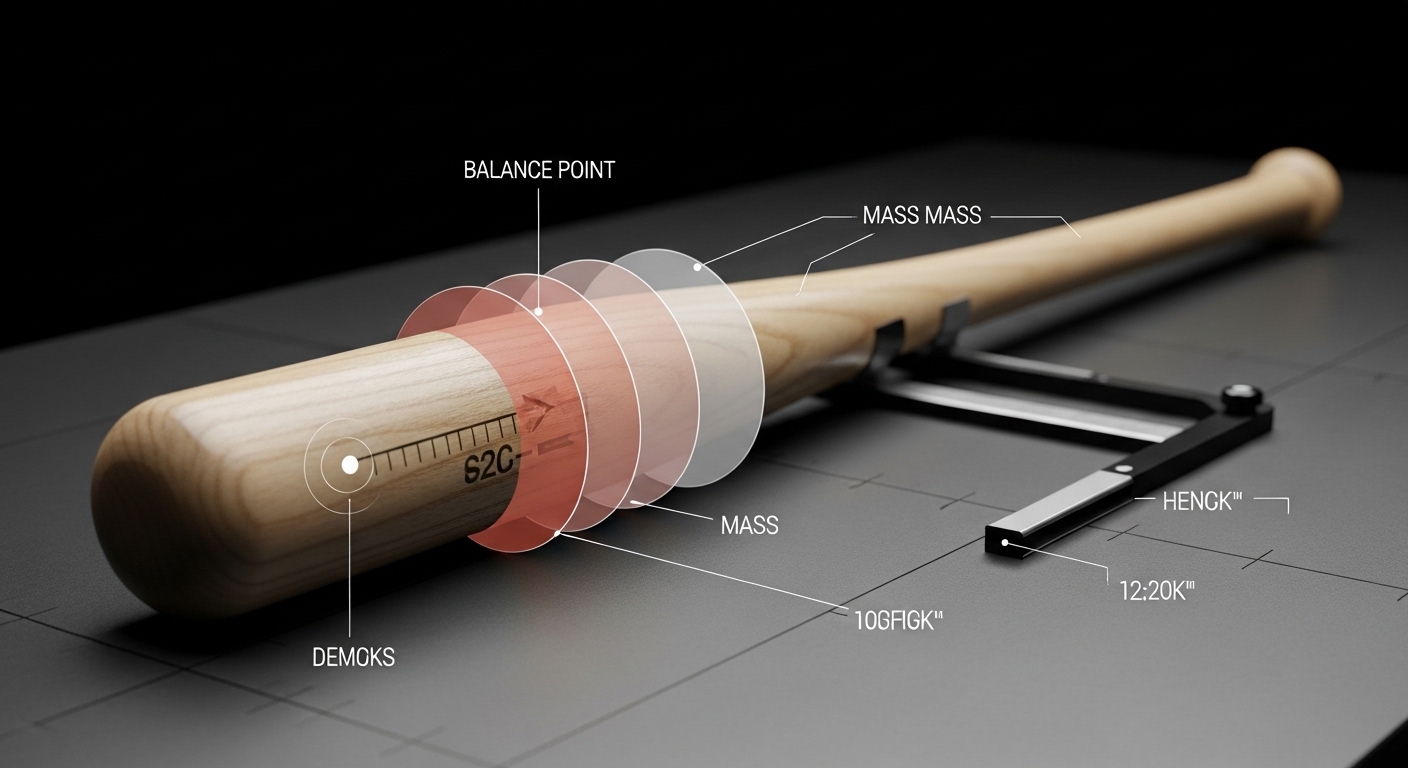
Weight distribution in baseball bats is not measured by simply weighing the bat. The pendulum-swing test — also called the pendulum oscillation test — is the standard method used by bat manufacturers and MLB-certified testing labs to measure MOI with precision.
How the Pendulum Test Works
The bat is suspended at a pivot point 6 inches from the knob and allowed to swing freely as a pendulum. The period of oscillation (time per full swing cycle) is measured precisely. MOI is then calculated using the formula:
Where W = bat weight (oz), g = 386 in/s², BP = balance point distance from pivot (in), t = oscillation period (seconds)
The result is expressed in oz·in² — an unusual unit that reflects the interaction of mass quantity and mass distribution distance. For a 34-inch MLB bat, MOI values typically range from 7,000 to 10,000 oz·in² depending on how end-loaded or handle-loaded the bat is.
What the Pendulum Test Reveals About Torpedo Bats
ESPN's reporting on torpedo bat manufacturing specifically noted that the pendulum test was used to verify bat balance during development: the more balanced a bat, the more it oscillates on the pendulum. Traditional bats — with their end-heavy distribution — oscillated relatively little. Torpedo bats, with mass moved toward the handle-side, showed notably higher oscillation rates, confirming the balance point shift.
Real-World Weight Distribution Results: Yankees Bat Speed Data
The theoretical weight distribution engineering is validated by the real-world bat speed data collected from the five Yankees players who adopted torpedo bats heading into 2025.
| Player | 2024 Bat Speed | 2025 Bat Speed | Gain | Estimated EV Gain |
|---|---|---|---|---|
| Anthony Volpe | ~71.5 mph | ~74.5 mph | +3.0 mph | ~+3.6 mph EV |
| Cody Bellinger | ~73.0 mph | ~75.5 mph | +2.5 mph | ~+3.0 mph EV |
| Austin Wells | ~72.0 mph | ~74.0 mph | +2.0 mph | ~+2.4 mph EV |
| Jazz Chisholm Jr. | ~74.5 mph | ~75.6 mph | +1.1 mph | ~+1.3 mph EV |
| Paul Goldschmidt | ~73.2 mph | ~73.5 mph | +0.3 mph | ~+0.4 mph EV |
The range of gains — from +0.3 mph (Goldschmidt) to +3.0 mph (Volpe) — is instructive. It reflects that the weight distribution benefit varies by player. Players whose swing mechanics already produce near-maximum bat acceleration for their strength profile (like Goldschmidt) gain less from the MOI reduction. Players whose swing speed has room to grow with reduced swing weight (like Volpe) gain the most.
Frequently Asked Questions: Torpedo Bat Weight Distribution
Does the torpedo bat weigh more or less than a standard bat?
Neither — torpedo bats are manufactured to the same weight as the player's standard bat. Alan Nathan's actual measurement of a real MLB torpedo bat found it weighed 32.1 oz versus 31.5 oz for the same player's conventional bat — a 0.6 oz difference that falls within normal manufacturing tolerance. The player targets a specific total weight, and the torpedo profile is engineered to achieve that weight with a different mass distribution, not a different total mass.
If MOI can be identical between a torpedo and standard bat, what is the advantage?
When MOI is held equal — as in Nathan's real-world sample — the torpedo bat's advantage comes entirely from improved collision efficiency at the contact zone: more mass is behind the ball at the location where the player typically makes contact. This is a distinct performance mechanism from the MOI/swing speed gain. The torpedo bat therefore has two independent weight distribution advantages, and a carefully engineered build can deliver both simultaneously or trade one for the other depending on the player's needs.
What is the wood budget in torpedo bat manufacturing?
The wood budget is the zero-sum constraint that governs torpedo bat mass redistribution: every gram of wood added to the contact zone must be removed from elsewhere — primarily the end tip zone — to keep total bat weight within the player's target. Engineers calculate the barrel profile that achieves the contact zone mass target, verifies it against the weight budget using the wood's known density, and generates the CNC program accordingly. The wood budget is tighter for higher-density maple builds than for birch, because maple achieves the contact zone mass target in a smaller wood volume.
How does the balance point shift affect swing mechanics?
A lower balance point (closer to the hands) makes the bat feel lighter and easier to accelerate, even when total weight is unchanged. Players often describe this as improved bat control and the ability to stay back on off-speed pitches longer before committing to the swing. The balance point shift also slightly reduces the bat's resistance to mid-swing adjustments — making it marginally easier to cover inside pitches that the hitter was initially set up for outside.
Why do bats with the same model number have different weight distributions?
Traditional bat manufacturing using lathe-and-template methods produces inherent barrel mass variance of up to 1.5 oz between ostensibly identical bats. This variance comes from natural wood density variation, human template-matching skill, and lathe calibration differences. A CNC-manufactured torpedo bat eliminates most of this variance by encoding the exact weight distribution profile digitally and reproducing it to ±0.01 inch tolerance — meaning every torpedo bat of the same spec delivers the same mass distribution, not just approximately the same.
Continue Exploring Torpedo Bat Technology
Gallery