⚾ Torpedo Bat vs. Traditional Bat: The Complete 2025 Data Comparison
The torpedo bat wins at one location along the barrel, loses at another, and the outcome for any individual hitter depends entirely on which location they contact most often.
This page presents: EV crossover data • Balance & feel differences • Real-world wRC+ outcomes • 14-category head-to-head specs • 10-profile "Should I Switch?" framework
📊 Key Numbers: Torpedo vs. Traditional at a Glance
🔨 The Core Physics: The Sledgehammer Principle
"If you put the weight at the end of the sledgehammer, it takes a lot of energy to get it to swing — but it goes really far when you make contact at the head. If you bring that weight down toward the handle, it gets easier and easier to swing, but the sledgehammer becomes less effective when you make contact on the end because there's less mass there."
— Scott Drake, President of PFS-TECO (MLB bat inspection)
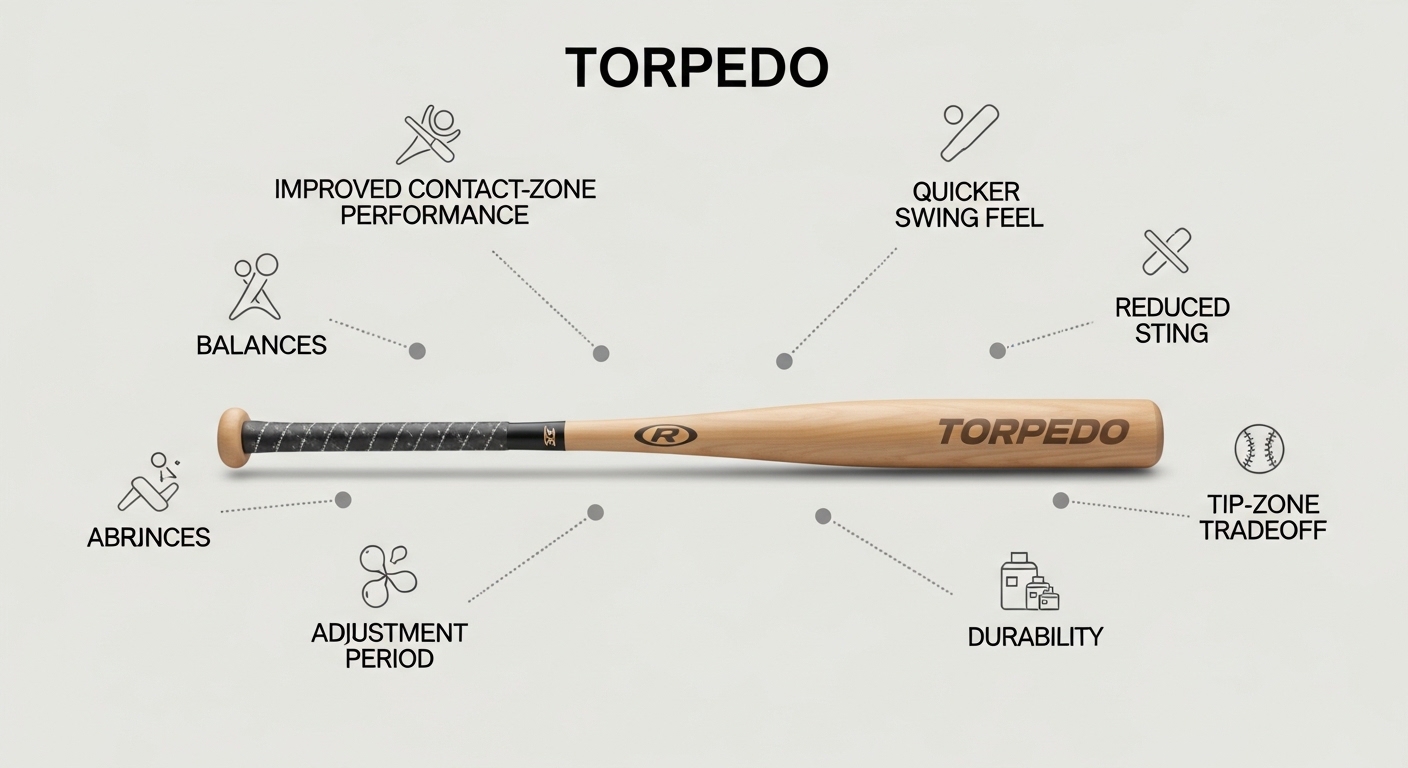
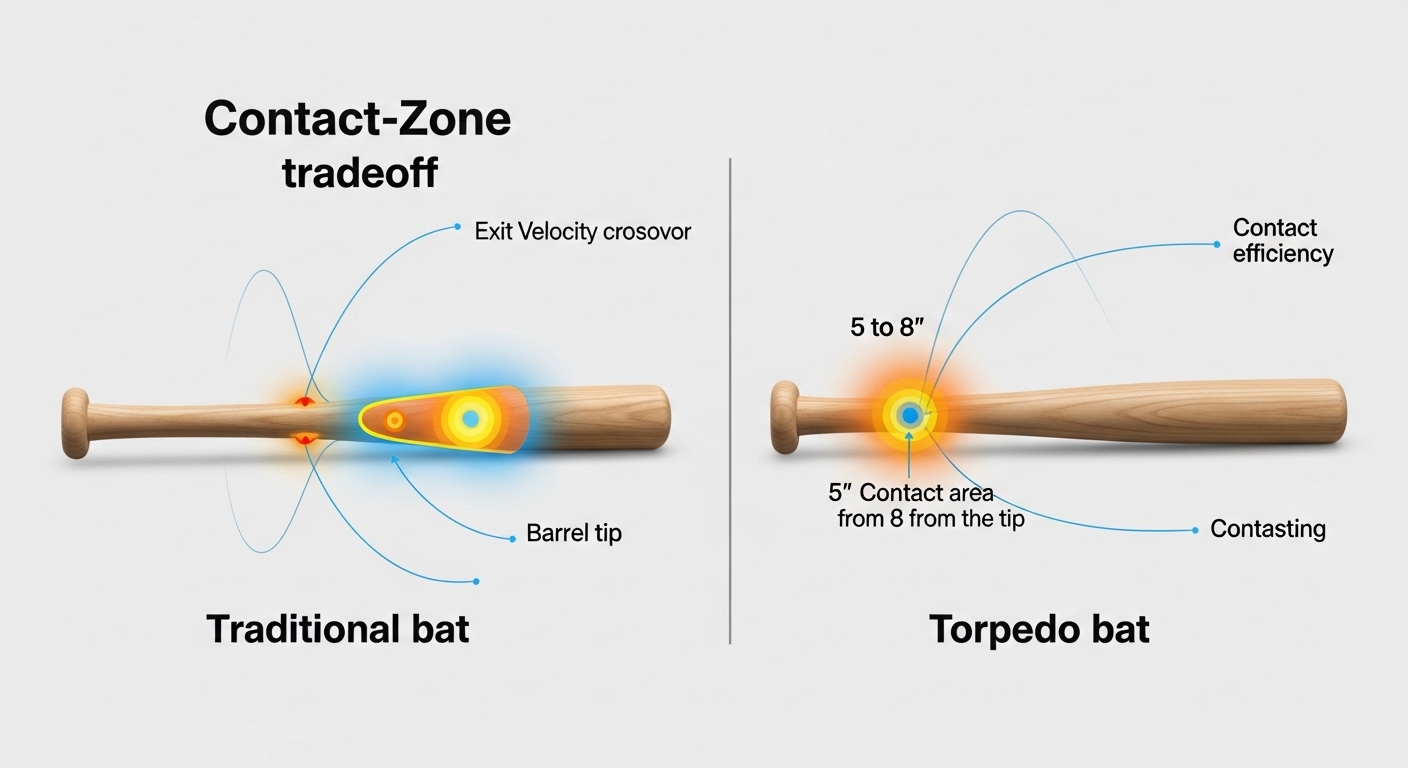
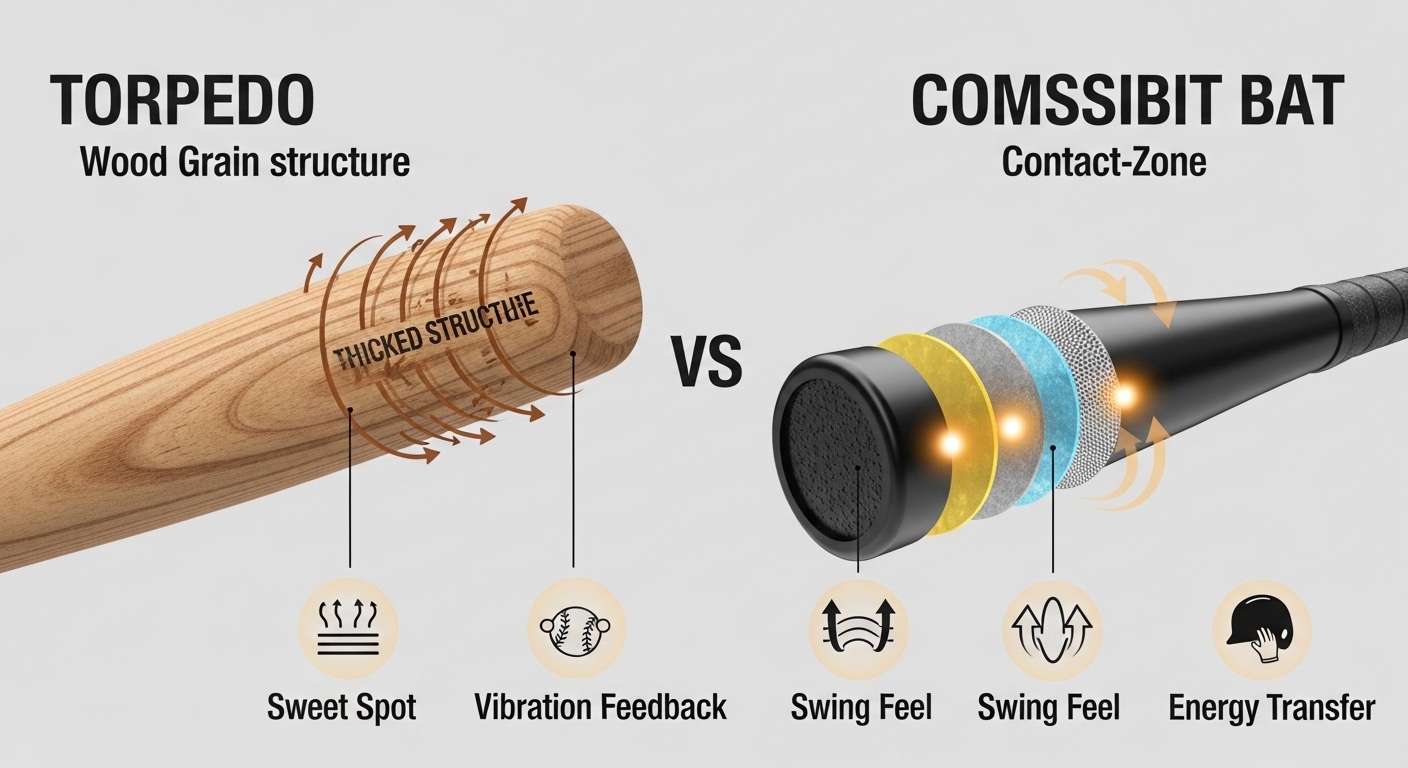
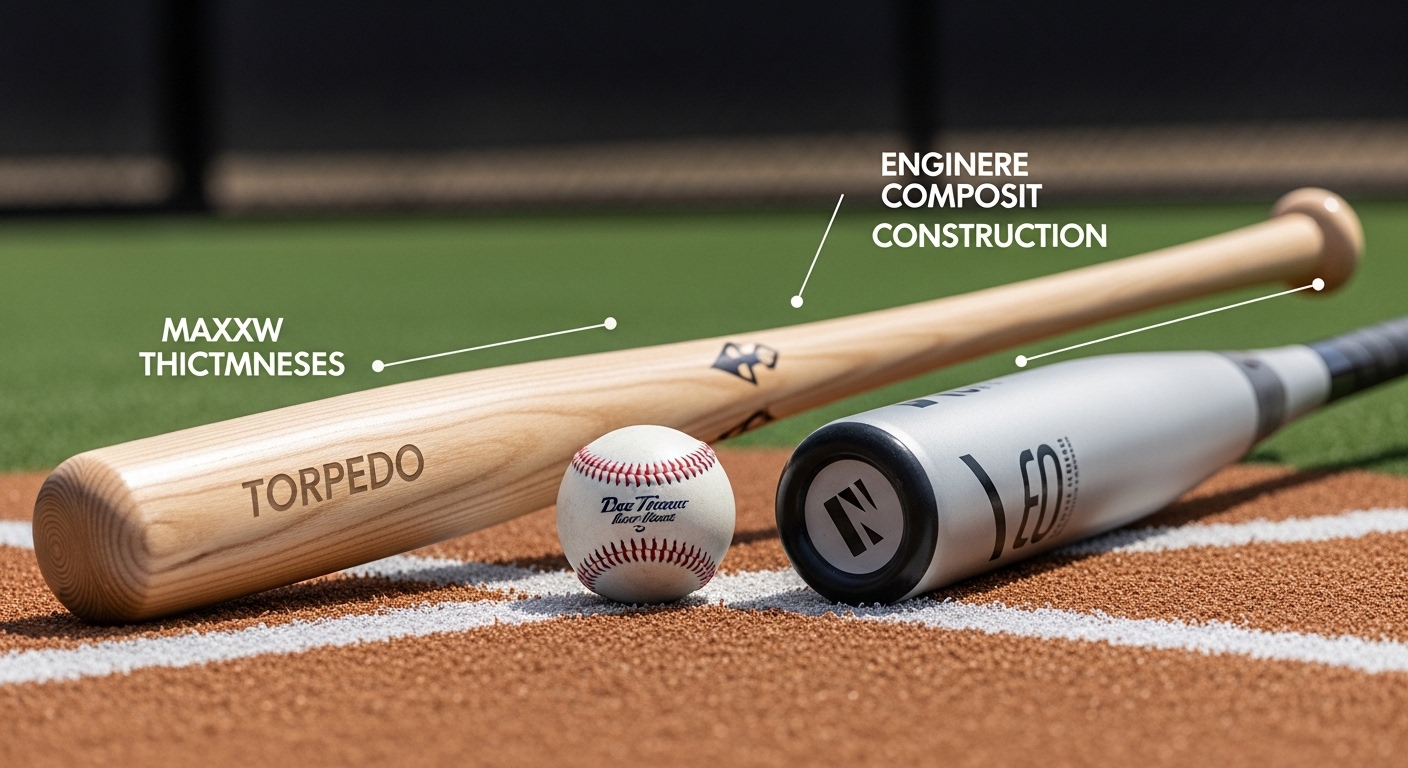
The torpedo bat is a deliberate shift toward the handle end of that spectrum. By removing mass from the barrel tip and concentrating it at the contact zone (5–8 inches from the tip), it trades tip-zone performance for contact-zone performance, and trades end-loaded swing momentum for lower MOI — a quicker, more controllable bat that arrives at the contact zone faster and can be adjusted later in the pitch trajectory.
Alan Nathan's FanGraphs analysis: the torpedo bat makes the swing "quicker" — allowing players to wait longer before committing to a swing, with greater adjustability mid-swing when pitchers change arm angle or the ball moves late.
📈 The EV Crossover: Where Torpedo Wins and Where It Loses
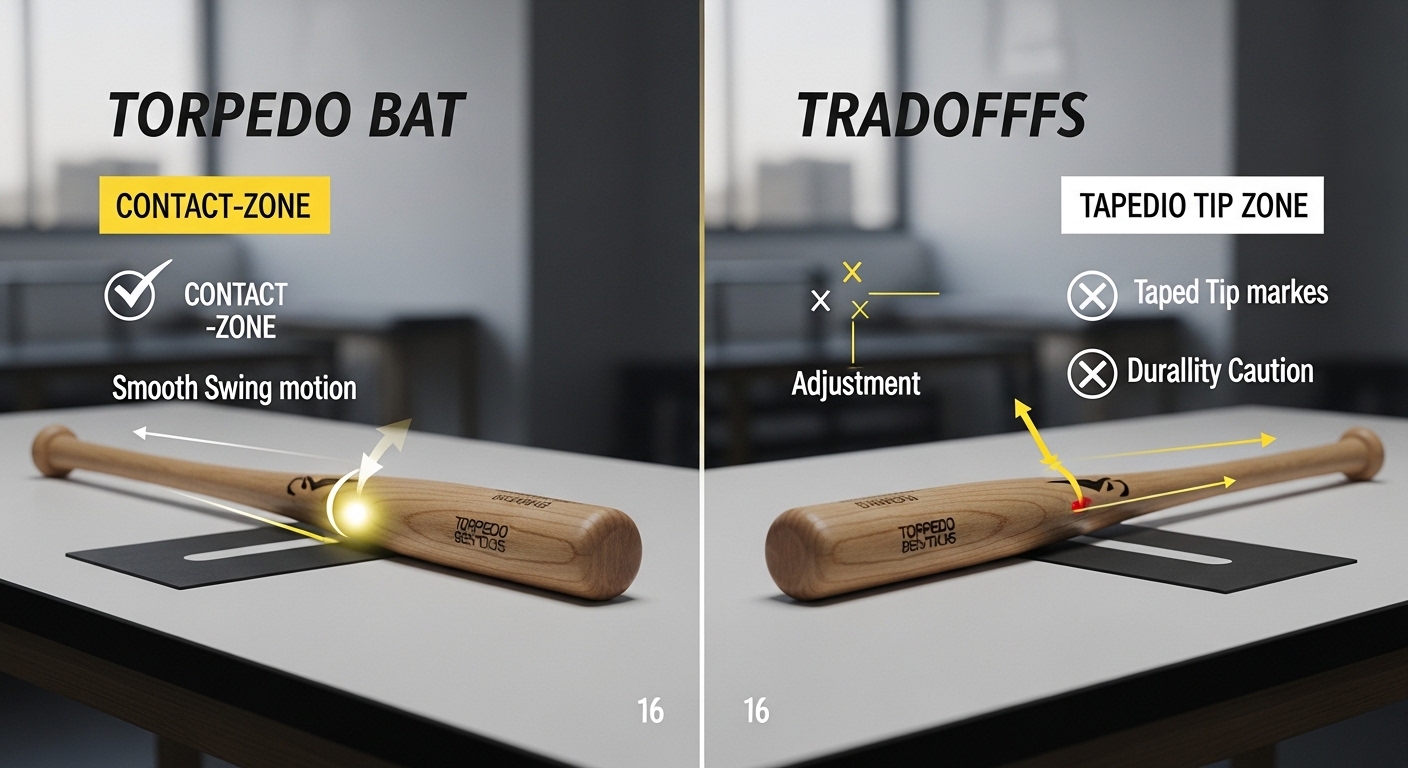
Nathan's simulation produced a precise result: the torpedo bat's EV curve crosses the traditional bat's EV curve at approximately 5–6 inches from the barrel tip. Inside that crossing point (closer to the tip), the traditional bat produces higher EV. Outside it (toward the handle), the torpedo bat produces higher EV, with peak advantage at the 6–8 inch zone.
| Barrel Zone | Distance from Tip | Traditional EV | Torpedo EV | Winner |
|---|---|---|---|---|
| Tip zone | 0–3" | Higher (peak mass) | Lower (narrowed) | Traditional |
| Transition zone | 3–5" | Moderate | Rising fast | ≈ Equal |
| Crossover point | ~5–6" | EV curves intersect here | Neither — equal | |
| Contact zone | 6–8" (modal MLB) | Good | +5–7% higher (BPL) | ✅ Torpedo |
| Inner barrel | 8–12" | Declining | Similar | ≈ Equal |
Why this matters: Statcast tracking shows the modal MLB contact location falls at 4–6 inches from the barrel tip, with substantial clustering extending to 8 inches. For the majority of MLB hitters, the torpedo's peak mass zone overlaps with their natural contact distribution — which is why 61% of the 18-player study showed EV gains. The 39% who showed declines are players whose contact distribution skews more toward the tip.
⚔️ Head-to-Head Comparison: 14 Categories
| Category | Traditional Wood Bat | Torpedo Wood Bat | Edge |
|---|---|---|---|
| EV at contact zone (5–8") | Good — adequate mass | Higher — +5–7% (BPL barrel map) | ✅ Torpedo wins |
| EV at barrel tip (0–3") | Higher — peak mass at tip | Lower — 2–3% less (Nathan sim.) | ✅ Traditional wins |
| Sweet spot width | Standard — defined EV peak | Wider — Nathan's 'non-trivial' finding | ✅ Torpedo |
| Bat speed (MOI reduction) | Baseline MOI | +1–3 mph for most players | ✅ Torpedo (if <78 mph) |
| Bat speed — already elite (80+ mph) | Minimal difference | Minimal MOI gain remaining | — Even |
| Balance / swing feel | End-loaded momentum through zone | Hand-loaded — quicker, more controllable | ✅ Torpedo (personal preference) |
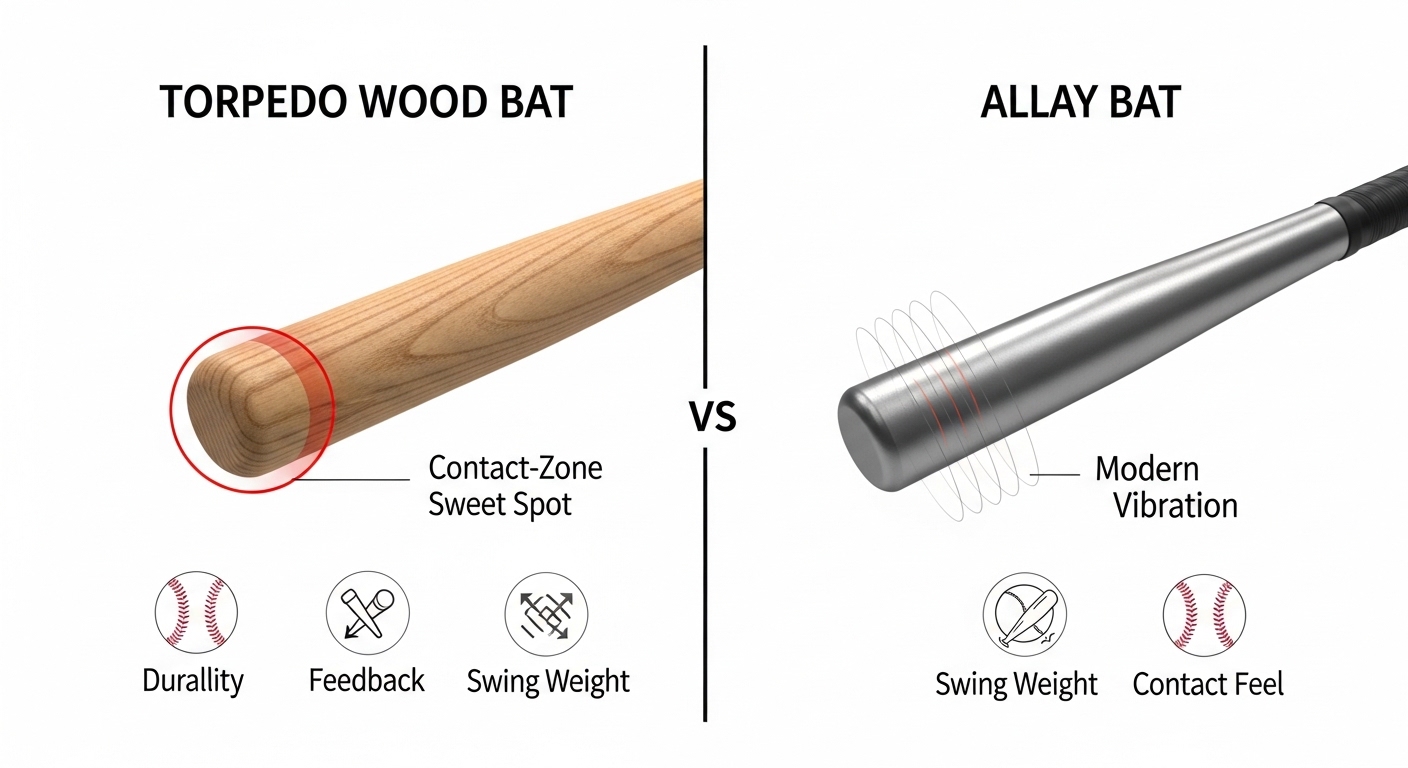
| Sting on mishits | Higher — tip contact especially | Less sting — vibration nodes shifted | ✅ Torpedo |
| Tip-zone durability | Stronger tip — more mass | Narrowed tip — breakage risk | ✅ Traditional |
| Wood material options | Maple, ash, birch — all available | Maple, ash, birch — all available | — Even |
| Legal status (MLB / wood-bat) | Universal — decades of precedent | Legal — Rule 3.02 compliant | — Even: both fully legal |
| Adjustment period required | None — established muscle memory | Yes — 1–3 weeks typically | ✅ Traditional |
| Price | $80–$250 (retail wood bat) | $100–$350+ (torpedo premium) | — Traditional slightly cheaper |
| Data-fitted versions available | Custom profiles available | Statcast-fitted (MLB); standardized (retail) | ✅ Torpedo (at MLB level) |
| Training use flexibility | Standard training tool | Excellent for tee/BP work — reinforces contact zone | ✅ Torpedo for development |
Two most important rows for most hitters: EV at contact zone (torpedo wins by 5–7%) and adjustment period (traditional wins — no adjustment needed). The adjustment period is a real performance cost. Matt Shaw switched back mid-game after one at-bat. Dansby Swanson committed to a multi-week sample. The physics advantage only manifests after muscle memory recalibrates — typically 1–3 weeks of consistent use.
🎯 Feel, Balance, and Feedback: What Players Actually Describe
Performance data tells you what the bat does. Player feedback tells you what it feels like — and feel is a genuine performance variable, not just a comfort preference. A bat that feels wrong at the plate costs swing quality in ways that no physics model captures.
What Changes When You Pick Up a Torpedo Bat
- Balance point shift: Traditional bats balance closer to the barrel; torpedo bats balance closer to the handle. When held at the knob, the torpedo feels lighter at the barrel end and heavier toward your hands.
- "Quicker" feel: JustBats describes this as giving some hitters a sense of "quickness and precision they don't always feel with a regular bat" — and gives others the unsettling feeling that the bat "doesn't carry the same momentum out front."
- Contact feedback: Because vibration nodes shift toward the contact zone, near-miss contacts in that zone produce less sting and vibration. Mark Canha: the torpedo is "not as ringy" closer to the label.
The Feel Divide: Power Hitters vs. Contact Hitters
JustBats identifies the divide clearly: contact hitters often adjust quickly, while players who generate power by relying on barrel weight might need more time — or may never find the torpedo's balance comfortable. Authentic Bats frames it as the design not being one-size-fits-all: their torpedo build "maintains wood bat integrity while improving swing efficiency for players who want faster acceleration without sacrificing feel" — but they also "continue to build traditional profiles for hitters who prefer classic balance."
🗣️ What Players Said: The Full Feedback Spectrum
Direct from ESPN's April 2025 roundup of player and coach responses — the most comprehensive single-source collection of torpedo bat vs. traditional bat feel feedback available.
| Player | What They Said | Feeling Described | Verdict |
|---|---|---|---|
| Mark Canha (KCR) | "It's not as ringy when I get it closer to the label, which I like." | Less sting / better feedback | ✅ Positive |
| Colson Montgomery (CWS) | "When I had to use a normal bat, I felt like there was too much weight at the end." | Traditional feels heavy now | 🔄 Converted |
| Matt Shaw (CHC) | "The weight felt a little heavier. The ball feedback wasn't as good." | Torpedo felt heavier, less responsive | ❌ Negative — switched back |
| Dansby Swanson (CHC) | "It's not the perfect product... but there is definitely validity in everything." | Cautious — committing to sample | 🤔 Open-minded |
| Nolan Schanuel (LAA) | "I mostly miss on the inner side — I'd be more than willing to try it." | Self-diagnosed contact zone mismatch | 🎯 Strong candidate |
| Max Muncy (LAD) | "It felt good. The swing felt good." | Positive feel — brief trial | ✅ Positive (small sample) |
| Andrew Benintendi (CWS) | "I've used the same bat for nine years. I think I'll stick with that." | Not interested — loyalty to traditional | ⏭️ Declined |
The Nolan Schanuel insight: Schanuel diagnosed his own swing — "I mostly miss on the inner side of the barrel" — and immediately connected it to the torpedo design. That is exactly the self-analysis every hitter should do before switching. He is describing a contact zone that sits between the traditional bat's sweet spot and the handle — precisely where the torpedo's peak mass moves to. His intuition is correct: the torpedo bat would likely improve his contact quality because it places mass where he is already hitting.
❓ Should I Switch? A 10-Profile Decision Framework
Use this table to match your hitting profile against the torpedo bat's known performance characteristics. The answer is not universal — it is profile-specific.
❓ Frequently Asked Questions: Torpedo Bat vs. Traditional Bat
Gallery