⚖️ Torpedo Bat Pros and Cons: The Honest 2025 Scorecard
Most torpedo bat pros-and-cons lists are marketing dressed up as analysis. They list advantages without data, skip real disadvantages, and leave readers no better equipped to decide. This page is different. Every pro has a specific data source. Every con has a specific data source. And three of the cons come from the same data sources that establish the pros — because the honest picture requires both sides of the same dataset.
The bottom line: The torpedo bat is genuinely effective for roughly 60% of hitters whose contact zone and bat speed profile matches the design, and genuinely counterproductive for a meaningful minority who do not. It is not a universal upgrade. It is a precision tool.
📊 The Numbers at a Glance
📋 The Master Scorecard: Every Pro and Con With Its Evidence
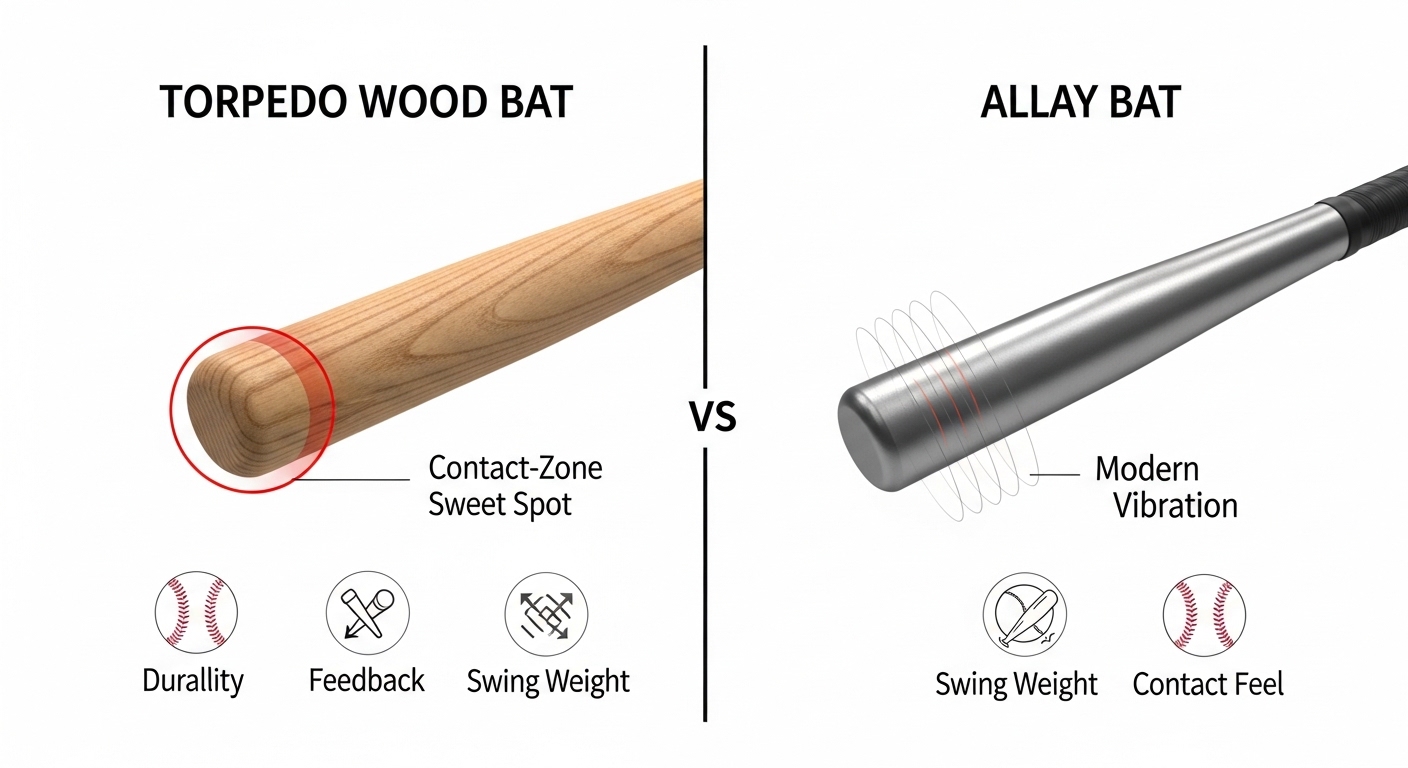
This table covers 12 pros and 10 cons. Each row cites the specific data source. Read across the 'Evidence Source' column — every claim is traceable.
| Pro / Con | Magnitude | Evidence Source | |
|---|---|---|---|
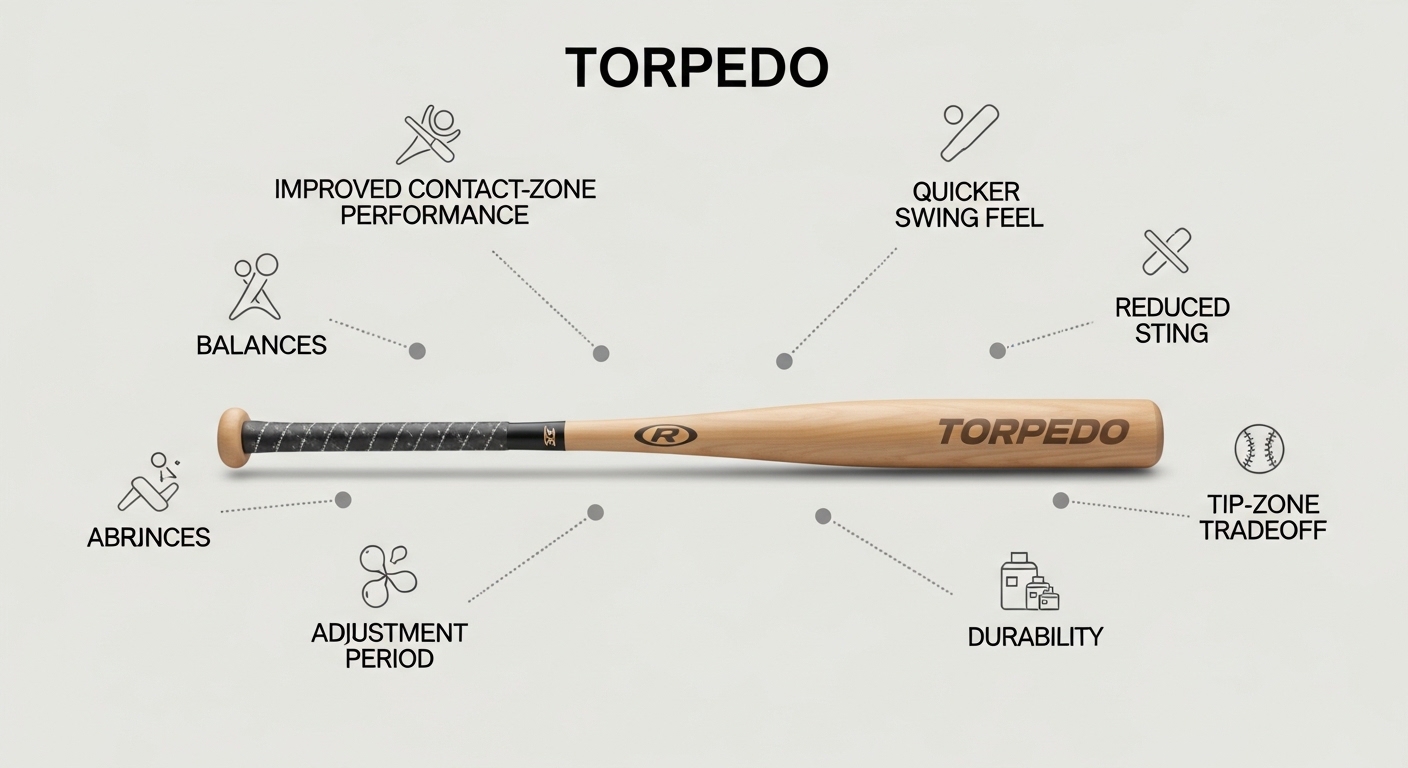
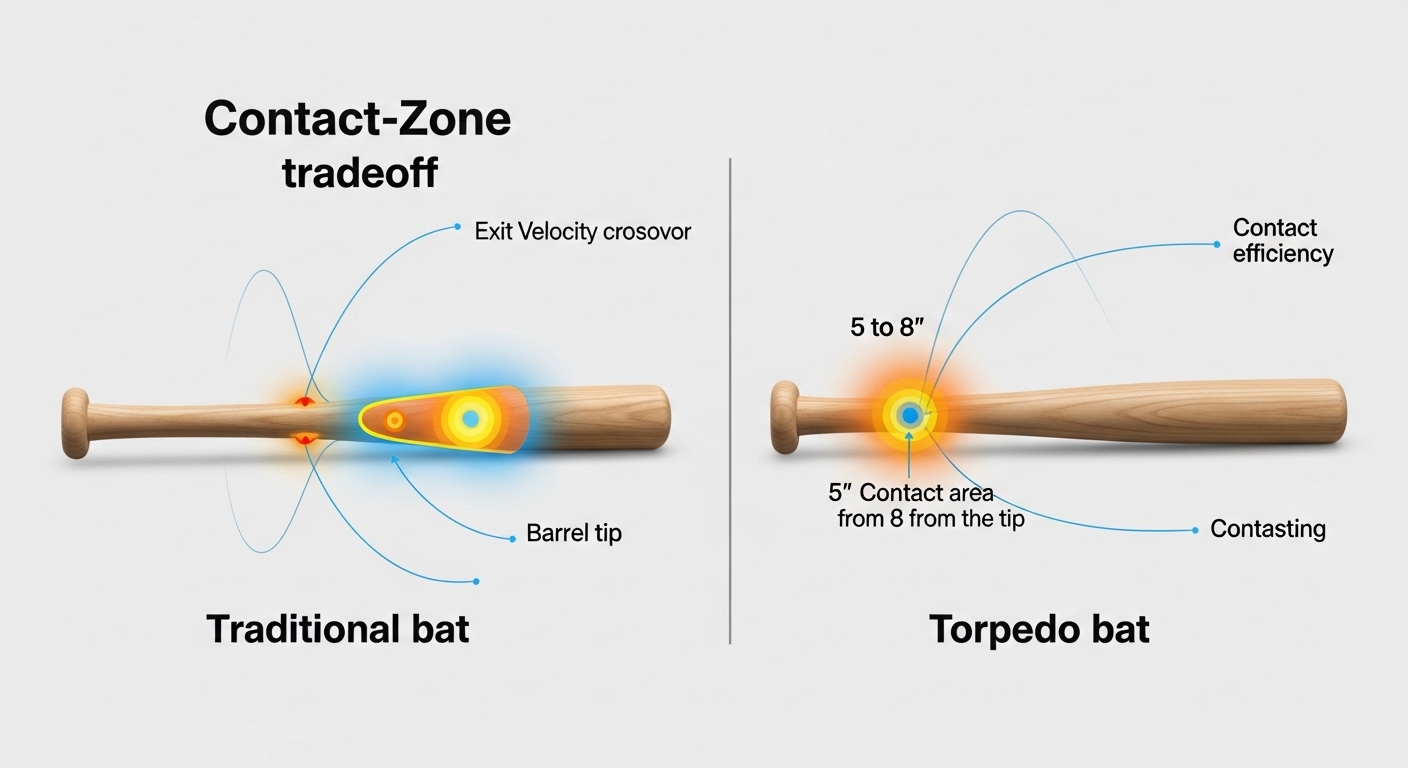
| ✅ | EV gain at contact zone (5–8" from tip) | +5–7% exit velocity | Baseball Performance Lab barrel map — direct zone measurement |
| ✅ | Bat speed increase from lower MOI | +1–3 mph (sub-elite swingers) | Yankees 5-player Statcast: Volpe +3.0 mph, Chisholm +1.1 mph |
| ✅ | Wider effective sweet spot | Nathan: 'non-trivial' zone expansion | Nathan FanGraphs simulation (Apr 2025) — model-independent result |
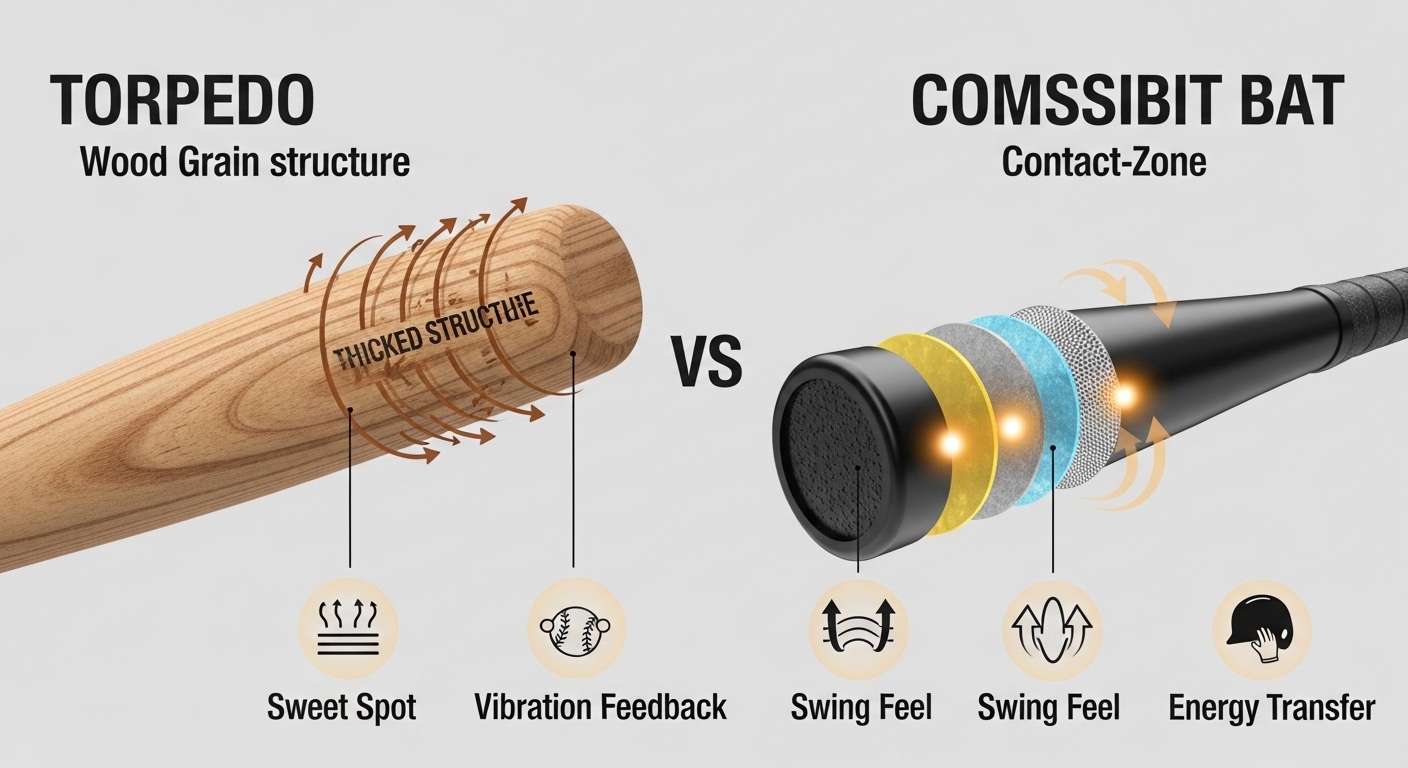
| ✅ | Reduced sting on near-miss contacts | Vibration nodes shift to contact zone | Mark Canha: 'not as ringy.' Confirmed by Penn State vibration analysis. |
| ✅ | Hard-hit rate improvement | 35%→48% (Volpe, +13 ppts) | Statcast 2025 — at 95+ mph MLB BA is .490 vs .218 below |
| ✅ | Fly ball distance gains | +8.3 ft (314.4→322.7 ft avg) | ESPN 13-user group data (Cockcroft, Apr 2025) |
| ✅ | Slugging improvement | +84 pts (.406→.490) | ESPN 13-user group — caveat: includes Yankees short porch effect |
| ✅ | Bat-speed-to-EV multiplier | 1 mph bat speed → 1.2 mph EV → 7 ft | Marquee Sports cascade formula — validated by Statcast distributions |
| ✅ | CNC manufacturing precision | Mass variance < hand-lathed bats | Leanhardt data pipeline — 7-stage process from Statcast to CNC lathe |
| ✅ | Legal in all MLB and wood-bat leagues | No rule change required | MLB Rule 3.02 — confirmed by MLB spokesman (Sportico, Apr 2025) |
| ✅ | Confidence / psychological boost | Real but unquantifiable | Dan Russell, Penn State: 'if you found something that makes you more confident, it's going to work' |
| ✅ | Cal Raleigh Home Run Derby win | 54 HR, 471 ft longest, won 18-15 | 2025 Home Run Derby — only torpedo participant. .258/.372/.603, 179 wRC+ season line. |
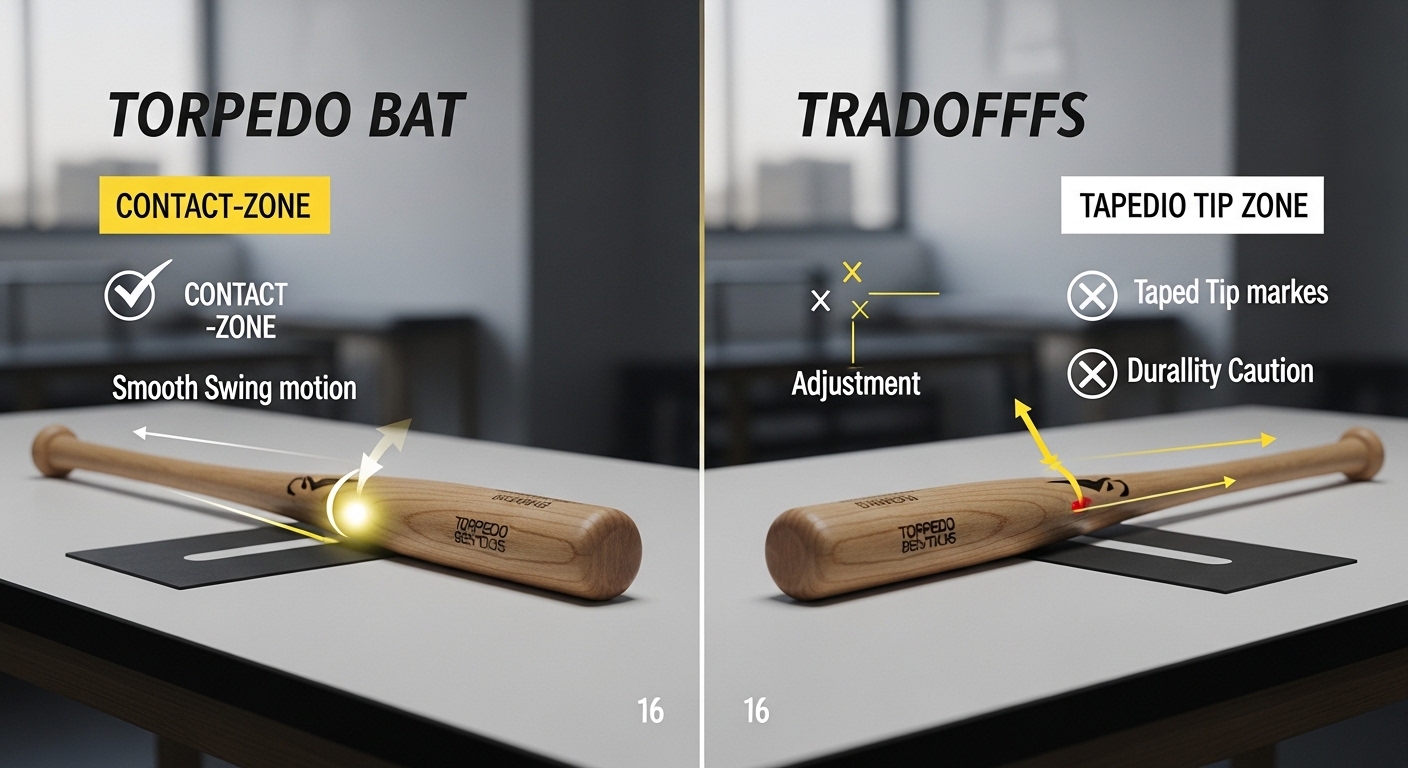
| ❌ | EV loss at barrel tip (0–3" from tip) | -2–3% exit velocity | Nathan simulation — traditional bat outperforms at tip zone |
| ❌ | Not universal — 39% showed EV decline | 7 of 18 players declined | 18-player Statcast study (Sportscasting.com) — heterogeneous outcome |
| ❌ | Adjustment period required | 1–3 weeks typical | Matt Shaw switched back game 1. Swanson: 'not the perfect product.' Montgomery needed first game. |
| ❌ | Tip-zone breakage risk | Narrowed tip more vulnerable | Montgomery's bat broke at tip in Anaheim. Tater: recommends Drop 2 to mitigate. |
| ❌ | Non-Yankees SLG below 2024 baseline | .404 SLG (below .406 baseline) | Cockcroft ESPN data — non-Yankees sub-sample. Small n; directionally honest. |
| ❌ | Amateur bats ≠ MLB fitted bats | Standardised peak location only | AZ Snake Pit: 'completely misses the point.' Retail = generic fit, not Leanhardt-fitted. |
| ❌ | Bohm / Contreras wRC+ declines | Bohm -22 pts; Contreras -39 pts | AZ Snake Pit mid-season tracker — reactive adoption without contact zone matching |
| ❌ | Dansby Swanson reverted to traditional | Switched back ~late April 2025 | Cubs Insider: bat path steepened, whiff rate rose, switched back mid-season |
| ❌ | Some youth leagues restrict it | USA Bat stamp required | Non-wood torpedo needs USA Bat certification for Little League Majors and below |
| ❌ | Visual discomfort / psychological friction | Real barrier for some players | Cubs coach Kelly: 'we've looked at baseball bats the same way since we were 3'. Byron Buxton: declined to try. |
The most important column is the rightmost one. Every claim in this table — pro and con — has a named source. If a claim cannot be traced to a specific source, it is not in this table. This is the standard that torpedo bat marketing material consistently fails to meet, and the standard that separates genuine performance analysis from hype.
🎯 The Swanson Arc: The Most Instructive Story in the Dataset
Dansby Swanson's 2025 torpedo bat experience is the most instructive single-player arc in the dataset — not because it is the best outcome (Raleigh and Montgomery are better) or the worst (Bohm's decline is starker), but because it shows the full torpedo bat story in one player's season: early promise, mechanism working, then a cascade of unintended consequences, and an honest reversion to what works.
| Phase | Statcast Signal | Outcome | What It Tells Us |
|---|---|---|---|
| Early adoption (Tokyo, April 1–10) | Squared-up: 33.4%→47.7%. Blast rate: 15.4%→26.2% | Hot start — HR vs Athletics, early promise | Torpedo contact zone alignment working: more barrels, more hard contact |
| Mid-April (Apr 10–20) | Launch angle rising steeply, fly ball rate up | BABIP: .179 (career avg: ~.300). Frustration building. | Bat path steepening — possible over-correction; torpedo's lighter feel changing swing plane |
| Late April — regression | Whiff rate rising, hard-hit rate failing to produce hits | wRC+ fell to 62. Production collapsed. | Feast-or-famine pattern: great contacts and poor contacts; no middle ground |
| Late April — reversion | Switched back to traditional bat (Cubs Insider, Apr 24) | Singles in Dodgers win — more controlled contact | Traditional bat's end-loaded feel recalibrated his swing plane. Torpedo's lighter barrel had steepened his path. |
What the Swanson arc teaches: Even when the contact zone alignment mechanism works (his squared-up rate did jump), the swing path disruption from an unfamiliar bat weight distribution can cost more than the barrel efficiency gains. This is why the adjustment period is a genuine con, not just a temporary inconvenience.
🎯 Verdict by Player Profile: Should YOU Use a Torpedo Bat?
The pros and cons mean different things for different hitter profiles. This table translates the scorecard into a profile-specific verdict.
🔬 The Evidence Quality Behind the Claims
Not all torpedo bat performance claims are equally well evidenced. This scorecard rates each major claim by the evidence tier and sample size behind it — so readers can weight the claims appropriately.
| Pro/Con | Evidence Tier | Sample Size | Confidence Level |
|---|---|---|---|
| EV gain at contact zone | Tier 1 (physics lab) | Direct measurement | High — physics simulation + BPL lab confirmation + Statcast player data all agree |
| Wider sweet spot | Tier 1 (physics model) | Model-derived | High — Nathan's peer-reviewed result; independent of data noise |
| Bat speed gain | Tier 2 (player Statcast) | 5 Yankees players | Moderate — real Statcast data; small n; Yankees environment confounder |
| Hard-hit rate improvement | Tier 2 (player Statcast) | 18 players | Moderate — 61% positive rate in study; directionally consistent |
| Fly ball distance / SLG | Tier 2 (group data) | 13 users | Moderate — non-Yankees sub-sample below baseline; small n; mixed signal |
| EV loss at tip | Tier 1 (physics sim) | Model-derived | High — Nathan's crossover result; confirmed by BPL map; physics, not data |
| Bohm/Contreras decline | Tier 2 (Statcast) | 2 players | Low confidence as generalisation — two players, potential confounders beyond bat choice |
| Non-Yankees SLG below baseline | Tier 2 (group data) | ~8 non-Yankees users | Low n — directionally honest but insufficient for firm conclusions |
| Montgomery natural experiment | Tier 2+ (within-player) | 1 player (best available) | Highest available within-player evidence — JMP moving average confirms EV dip during bat-less period |
The critical pattern: The strongest evidence supports the physics-based claims (EV gain at contact zone, wider sweet spot, EV loss at tip) — because these are model-independent results derived from physics, not from player data that can be confounded by skill, opponent quality, or park factors. The weakest evidence is behind the group-level outcome claims (non-Yankees SLG, Bohm/Contreras declines) — because the sample sizes are small and the confounders are real. The honest reader weighs Tier 1 evidence more heavily than Tier 2; the honest writer tells them which is which.
💡 The Three Torpedo Bat Truths That Hype Usually Skips
1 The fitting matters more than the shape
AZ Snake Pit's roundtable established this clearly: the torpedo bats that manufacturers are rushing out for amateurs are not the same thing that the pros are swinging. The MLB torpedo bat's performance advantage flows from the Leanhardt data pipeline — Statcast contact zone data fitted to each player's actual hitting pattern. The retail torpedo bat uses the torpedo shape with a standardised peak location. For players whose contact zone matches the standard location, most of the benefit is available. For players whose contact zone differs, the benefit is proportionally reduced. Shape without fitting is partial performance. The hype focuses on the shape. The science is in the fitting.
2 The adjustment period is a real cost, not just an inconvenience
The torpedo bat's pros assume the player has completed the adjustment period. The cons begin immediately — in the first game, first week, first month. Matt Shaw switched back game 1. Swanson's collapse happened in mid-April as his swing path changed. Montgomery needed his first game with the bat to feel comfortable. A bat that will improve your performance in month 2 will likely cost you performance in week 1. Planning the transition during off-season, extended spring training, or a scheduled rest period is not optional — it is the difference between the Volpe outcome and the Shaw outcome.
3 The confidence effect is both a pro and a con
Dan Russell's finding — that confidence effects are real and meaningful in baseball performance — means the torpedo bat's psychological dimension cuts in both directions. For players who find the torpedo's feel exciting and confidence-building (Canha, Montgomery, Hoerner), the confidence effect amplifies the physics benefit. For players who find the torpedo visually unfamiliar and mechanically uncomfortable (Shaw, Buxton, Benintendi), the confidence loss can outweigh the physics gain. There is no data that can predict which category you are in before you swing the bat. The only way to find out is to give it a genuine, committed trial — not a single at-bat, but weeks of batting practice to let your instinctive reaction settle.
❓ Frequently Asked Questions: Torpedo Bat Pros and Cons
Gallery