Best Torpedo Bats for Youth Players 2026
What's Legal and What Actually Helps
Every parent who watched the Yankees' torpedo bat coverage in March 2025 asked the same question within 48 hours: can my kid use one of these? The answer has two parts — what's available for game use, and what's available for practice. The game answer depends heavily on your child's age and league. The practice answer is the same at every level: a wood torpedo bat is legal everywhere, always, with no stamp required.
Age-by-Age Guide: Torpedo Bat Recommendations
Find your child's age and league in this table for an immediate recommendation:
| Age | Typical League | Torpedo Game Bat? | Torpedo Practice Bat | Recommendation & Notes |
|---|---|---|---|---|
| 5–7 | Little League Tee Ball / Coach Pitch Minors | ❌ No non-wood torpedo (USA Bat cert needed) | ✅ Wood torpedo: any maker | No non-wood torpedo in USA Bat format. Wood torpedo bat is legal (no stamp needed) and can be used for tee work and soft toss. At this age, any USA Bat-certified bat works for games. Focus: swing mechanics, not performance. |
| 8–10 | Little League Minors / Majors; USSSA 9U–10U | ❌ No non-wood torpedo in USA Bat or USSSA format | ✅ Wood torpedo: any maker | Game: standard USA Bat (Little League) or USSSA bat for travel. Practice: wood torpedo for tee and cage. At this age range, contact zone habits are being formed — this is when wood torpedo practice has the most developmental return on investment. |
| 10–12 | Little League Majors; USSSA 11U–12U | ❌ No non-wood torpedo in USA Bat or USSSA format | ✅ Wood torpedo: Tater birch (~$110) | Game: Easton Hype Fire USSSA or Rawlings Icon USA depending on league. Practice: wood torpedo for tee and cage develops contact zone consistency. The feedback from wood on mishits is informative at this age even if frustrating. |
| 13U USSSA | USSSA travel; Little League Intermediate/Junior | ❌ No USSSA torpedo bat available | ✅ Wood torpedo: Tater or Marucci | Game: standard USSSA bat (Supra, Hype Fire, Icon). Practice: wood torpedo. If player is a strong 13U and will move to 14U in 2026, consider starting BBCOR practice now. A wood torpedo + BBCOR dry swings is the optimal 14U transition prep. |
| 14U USSSA (from Jan 1 2026) |
USSSA 14U — BBCOR or wood required | ✅ Marucci RCKLESS Torpedo BBCOR or CB15 Torpedo BBCOR | ✅ Wood torpedo for practice | GAME CHANGER: USSSA 14U now requires BBCOR or wood nationally. A BBCOR torpedo bat is legal for 14U USSSA AND high school. This is the purchase that covers both. Marucci RCKLESS Torpedo BBCOR ($350–$400) or previous-year CB15 Torpedo BBCOR at discount ($200–$260). |
| High School (9th–12th grade) |
NFHS / BBCOR leagues | ✅ Marucci RCKLESS Torpedo BBCOR or CB15 Torpedo BBCOR | ✅ Wood torpedo for practice | Full BBCOR applies. RCKLESS Torpedo BBCOR is the best game option. Wood torpedo (Tater maple or Marucci CB15/LINDY12 Pro Wood) for practice. The wood/BBCOR torpedo pairing is the most coherent two-bat approach for a contact hitter at this level. |
The Market Gap: Why Your 10-Year-Old Can't Buy a Non-Wood Torpedo
Why No USSSA or USA Bat Torpedo Exists (Yet)
The straightforward answer: no manufacturer has released a USA Bat or USSSA-certified torpedo bat in non-wood form. The torpedo geometry is a barrel shape — technically straightforward to apply to any material. The market gap is a product timing issue, not a technical impossibility.
The likely reason for the gap: torpedo bat development was driven by MLB-level data fitting (Statcast contact zone analysis) and initially focused on the wood bat market. BBCOR certification followed because the BBCOR-level contact hitter population is the most similar to MLB in terms of contact zone analytics. Youth USSSA and USA Bat certifications involve different performance standards, different barrel diameter limits (2¾" for USSSA vs. 2⅝" for USA Bat), and different drop weight options — requiring separate engineering investment.
What to expect in the next 12–24 months: major manufacturers are widely expected to release USA Bat and USSSA torpedo designs given the market demand generated by the 2025 MLB torpedo wave. When those products arrive, they will likely appear first in the USSSA -5 and -8 drop weights (13U–14U transition market), and then expand downward.
The practical alternative right now: a wood torpedo bat for batting practice delivers the full development benefit — contact zone habit-building, MOI reduction, honest feedback on mishits — regardless of what game bat is used in games. The practice bat does not have to be a game bat to be valuable.
Wood Torpedo Bat Sizing by Age
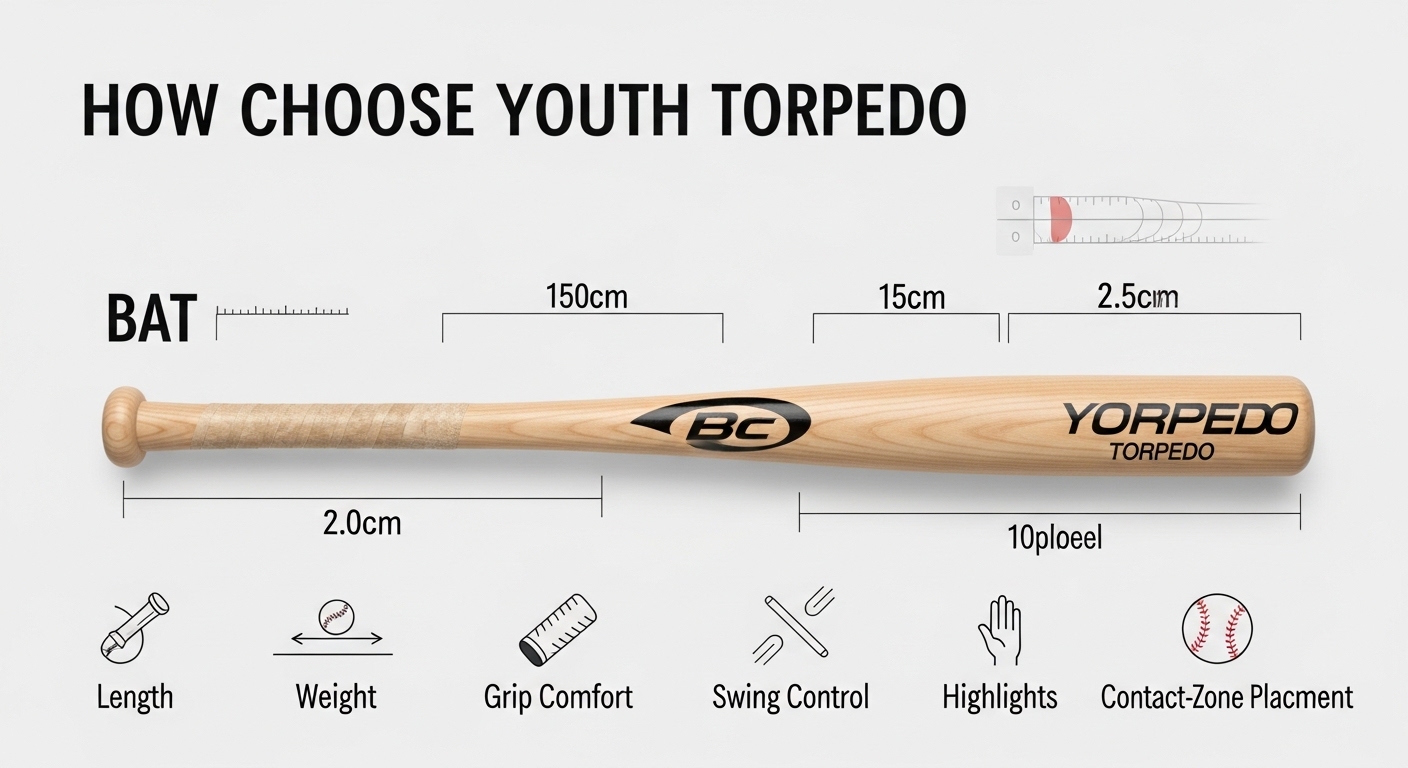
Wood torpedo bats are not subject to certification drop weight restrictions — they come in the same length/weight combinations as any wood bat. The right size follows the same principles as any wood bat selection: bat speed matters more than length, and a bat your player can swing fully through the zone is better than a longer, heavier bat they muscle.
| Age | Typical Length | Typical Weight | Drop | Notes for Wood Torpedo |
|---|---|---|---|---|
| 7–8 | 26–28" | 15–18 oz | -10 to -13 | Very short, light wood. Most wood torpedoes start at 28". Check manufacturer minimum length. Focus on lightest option available. Tater and Marucci both make 28" wood torpedoes. |
| 9–10 | 28–30" | 18–22 oz | -10 to -12 | A 28–29" wood torpedo is the right length for most players this age. Drop weight is less constrained in wood than non-wood. Buy the length they can swing comfortably with full swing speed. |
| 11–12 | 30–32" | 22–27 oz | -8 to -10 | Most competitive 11–12U players can swing a 30–31" wood torpedo. Avoid going too long — bat speed matters more than length. A light 30" is better than a heavy 32". |
| 13–14 | 31–33" | 26–30 oz | -5 to -8 | 13U moving toward BBCOR: practicing with a 32"/-3 wood torpedo (~29 oz) occasionally is the best BBCOR transition prep. 14U USSSA now requires BBCOR -3 — wood torpedo at 33" is legal. |
| High School | 32–34" | 29–31 oz | -3 (BBCOR standard) | Wood torpedo for practice: same length/weight as game BBCOR bat. 33" maple wood torpedo is the standard practice configuration for HS players. Marucci Torpedo Pro Wood and Tater both available in 33" and 34". |
The 14U USSSA Transition: What Parents Need to Know in 2026
The USSSA rule change effective January 1, 2026 is the biggest youth bat news of the year for families in competitive travel baseball. 14U national USSSA events now require BBCOR (-3) or wood — USSSA 1.15 BPF bats are no longer accepted.
| Player Situation | Action | Reasoning |
|---|---|---|
| 13U in 2025, moving to 14U USSSA in 2026 | Buy BBCOR torpedo bat now (for 2026) | 14U USSSA national standard is BBCOR from Jan 1, 2026. Don't buy a new USSSA -5 now — that bat is illegal for 14U USSSA in 2026. A BBCOR torpedo (Marucci RCKLESS Torpedo or CB15 BBCOR at discount) covers both 14U USSSA and HS when they get there. |
| Player with existing USSSA torpedo bat entering 14U | Keep for practice; buy BBCOR for 14U USSSA games | The existing USSSA torpedo bat is not legal for 14U USSSA national events from Jan 1 2026. It remains legal for practice and any non-USSSA events. Buy a BBCOR torpedo for game use. The USSSA bat is still excellent for batting cage development. |
| Strong 12U / 13U player, considering BBCOR early | Wood torpedo practice + occasional BBCOR dry swings | BBCOR bats are heavier and less forgiving than USSSA. Transitioning cold is jarring. HB Sports recommends 13U players start using BBCOR occasionally in practice before the full transition. A wood torpedo + BBCOR practice swings is the most effective transition preparation. |
| 14U player already bought USSSA torpedo bat for 2025 season | It is legal until Dec 31 2025; plan BBCOR purchase for 2026 | The USSSA bat is legal for 2025 USSSA events. After Jan 1, 2026: BBCOR or wood only at 14U national USSSA. Don't waste the current season's bat — use it fully, then upgrade. |
| Player in a state USSSA program with different standards | Verify with state USSSA director before buying | Florida USSSA and other state programs may have state-specific rules that differ from the national standard. State directors have authority to amend. Confirm your specific state program before any BBCOR purchase. |
The Strategic Case for BBCOR Torpedo at 14U
A BBCOR torpedo bat purchased for 14U USSSA is the same bat needed for high school. The BBCOR certification covers both contexts — 14U USSSA and NFHS high school (9th grade onward). A family that buys a Marucci RCKLESS Torpedo BBCOR at the end of 13U for 14U USSSA use does not need another bat for the first year of high school. That is a meaningful value argument for the $350–$400 price point — one bat covering two years of competitive play across two league contexts.
For budget-conscious families: the previous-year Marucci CB15 Torpedo BBCOR at $200–$260 makes the same legal argument (BBCOR certified for both 14U USSSA and high school) at significantly lower cost. Functionally, there is no performance difference between a discounted previous-year CB15 Torpedo BBCOR and the current-year version for a youth player transitioning to BBCOR — both are BBCOR-certified torpedo bats at the same performance ceiling.
The Development Case: Why Wood Torpedo is the Best Youth Practice Tool
The Developmental Advantage
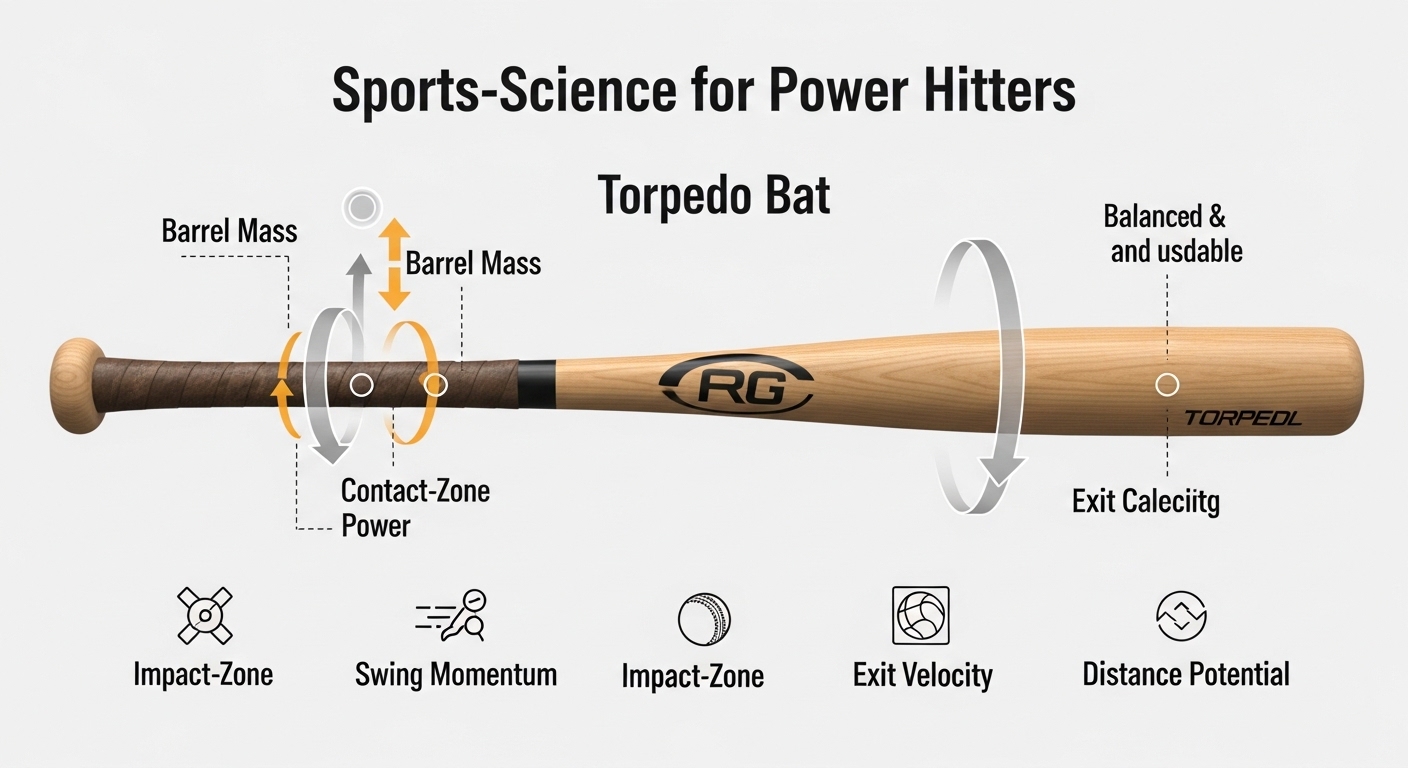
The developmental argument for wood torpedo practice is the strongest at the youth level — not despite the market gap, but because of it. The years before BBCOR (ages 8–13) are exactly when contact zone habits are formed. A player who develops the habit of making contact at 6–8" from the barrel tip — the torpedo's peak zone — through wood torpedo cage work will carry that habit into every game bat they swing.
The mechanism: wood torpedo bats are stiff and unforgiving on mishits. When a youth player makes contact with the handle-side or tip of a wood torpedo, they feel it — sting, weak contact, bat vibration. This informative feedback teaches the contact zone in a way that a forgiving USSSA composite cannot. The wider sweet spot of the USSSA game bat masks off-zone contact; the wood torpedo exposes it. Using both creates the developmental combination: identify the contact zone in practice (wood torpedo), then use the larger-sweet-spot USSSA bat to validate and reward that habit in games.
"A kid who can barrel a wood torpedo consistently at the cage already knows where the bat is in the zone. When they step in against a pitcher with their USSSA bat, that knowledge doesn't disappear — it just gets more forgiving margins."
Complete Combo Recommendations: Game Bat + Practice Torpedo by Age
These pairings match the best game bat for the league standard with the right wood torpedo for practice at each age group:
| Age / League | Game Bat (best standard option) | Practice Torpedo Bat | Total Cost (approx.) |
|---|---|---|---|
| Ages 8–12 Little League |
Easton Hype Fire USA -10 or Rawlings Icon USA -10 (~$300–$350) | Tater birch torpedo 28"–30" (~$110–$120) | ~$410–$470 Note: the standard USA game bat will likely give better game performance than any wood torpedo since no non-wood torpedo game bat exists in USA Bat format. |
| Ages 10–13 USSSA travel |
Easton Hype Fire USSSA -8 or Louisville Slugger Supra -10 (~$300–$350) | Tater birch torpedo 30"–32" (~$110–$130) | ~$410–$480 Wood torpedo is excellent development tool alongside the USSSA game bat. The two bats serve different purposes. |
| 14U USSSA / HS (from Jan 2026) |
Marucci RCKLESS Torpedo BBCOR (~$350–$400) | Tater maple torpedo 32"–33" (~$120–$150) or Marucci CB15 Torpedo Pro Wood (~$155–$185) | ~$470–$585 for premium setup Best value: previous-year CB15 Torpedo BBCOR at discount (~$220) + Tater birch torpedo (~$120) = complete setup under $350 |
| Budget-conscious any age |
Previous-year standard game bat at discount | Tater birch torpedo (~$100–$120) | Wood torpedo is the lowest-cost entry point to torpedo geometry. $100–$120 Tater birch torpedo for batting cage use delivers the full development benefit regardless of what game bat is used. |
Frequently Asked Questions: Youth Torpedo Bats
Can a 10-year-old use a torpedo bat in Little League?
A solid one-piece wood torpedo bat: yes, universally legal in Little League Majors (ages 9–12) with no stamp required. A non-wood torpedo bat with a USA Bat certification stamp: yes — but no such bat exists from a major manufacturer in early 2026. A USSSA-stamped torpedo bat: no — USSSA bats are explicitly prohibited in Little League. Until USA Bat-certified torpedo bats reach the market, a wood torpedo is the only torpedo option for Little League Majors players.
My child is in 13U USSSA. Do they need a BBCOR bat for 2026?
For 13U events: no — 13U USSSA still operates under USSSA 1.15 BPF standard. Your child can use their current USSSA bat for 13U events. However, if your child will be moving to 14U for the 2026 season, they will need a BBCOR bat (or wood) for 14U USSSA national events from January 1, 2026. Planning the BBCOR purchase before the season starts is wise — don't wait until mid-season. A BBCOR torpedo bat covers both 14U USSSA and high school. Verify your specific state USSSA director's rules — some states have variations from the national standard.
What is the best wood torpedo bat for a youth player?
For players still developing contact zone consistency (ages 8–12): Tater birch torpedo (~$100–$130). Birch is more forgiving on mishits than maple — more contact stays in play, and the reduced sting allows more swings per session. For players with more established mechanics (ages 12–14 and HS): Tater maple torpedo (~$120–$150) or Marucci CB15 Torpedo Pro Wood (~$150–$185). Maple provides maximum feedback and energy transfer at perfect contact — more developmental value for players who have already located their contact zone.
Is the wood torpedo bat good for practice even if my child's game bat is not a torpedo?
Yes — this is actually the primary use case for wood torpedo bats at the youth level. The wood torpedo develops the contact zone habits that transfer to any game bat, not just torpedo game bats. A player who consistently barrels a wood torpedo in practice is developing the swing path and contact zone precision that the entire torpedo design philosophy is built on. When they swing their USSSA game bat in a game, those habits produce better contact regardless of whether the game bat has torpedo geometry.
Will there be a USSSA or USA Bat torpedo bat in 2026 or 2027?
No confirmed release dates as of early 2026, but the market expectation is strong. Major manufacturers including Marucci, Easton, Louisville Slugger, and Rawlings are all aware of the youth torpedo bat demand generated by the 2025 MLB torpedo wave. The technical barriers are low — torpedo geometry is a barrel shape change, not a materials innovation. A USSSA torpedo bat in standard USSSA drop weights (-5, -8, -10) would be straightforward to produce. Most industry observers expect these to arrive in the 2026 or 2027 product cycles. This page will be updated when USA Bat or USSSA torpedo bats reach retail.
Continue in the Buying Guide
Gallery